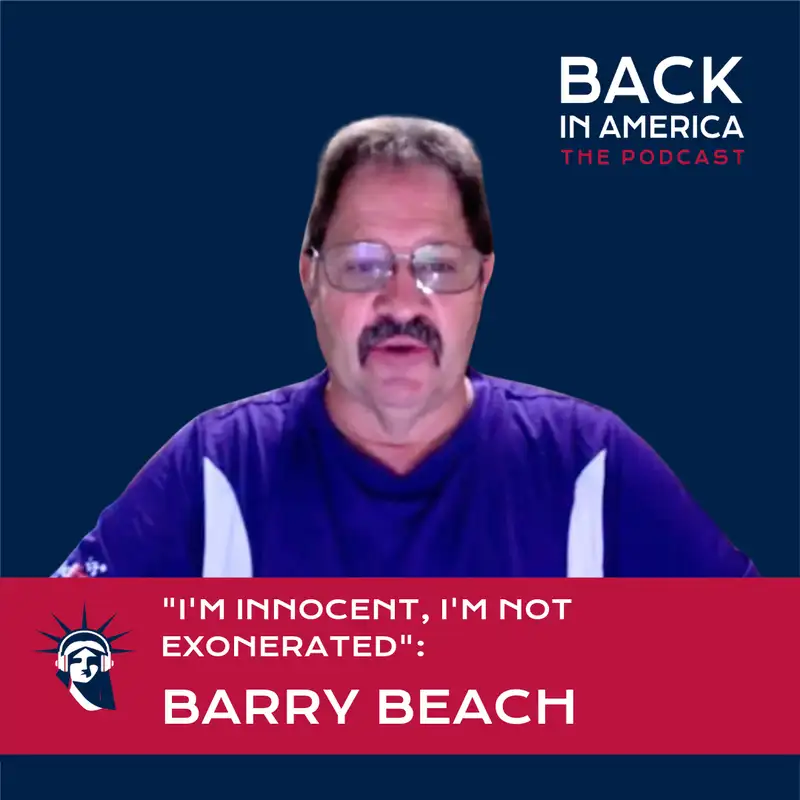
"I'm innocent, I'm not exonerated": Barry Beach
Barry Beach lived four houses from Kim Nees in Poplar, Montana, a small town on the Fort Peck Indian Reservation. In June 1979 Kim, 17, was beaten to death. Barry, also 17, was questioned and told he was free to go. In January 1983, in Louisiana, his stepmother handed police a sheriff's letter naming him as a suspect. A homicide task force questioned him for about seven hours with no lawyer, and he signed a confession. He has said ever since that it was false. In 1984 he was sentenced to 100 years without parole.
This conversation is Barry's account, with Jim McCloskey as a second voice. Jim founded Centurion in Princeton, New Jersey, in 1983, the first wrongful-conviction organization in the US. It took Barry's case in 2000 after he wrote to them. Stan also asks Jim about Framed, the book he co-wrote with John Grisham.
Along the way: why Barry turned himself in when he could have run, what helps the wrongly convicted rebuild, and what Barry tells every jury. Stan ends with the question he asks every guest: what is America to you?
In this episode:
- The detective who, in Barry's telling, described the electric chair and said he couldn't wait to see him fry: "It broke me down."
- The brown jacket the confession put on Kim. She did not wear one.
- How Centurion picks a case from the 1,000 to 1,200 letters it receives each year
- Jim on why Barry's confession did not hold up
- 2011: a judge orders a new trial and Barry walks out. 2013: the Montana Supreme Court reinstates the conviction, and he keeps his word to Centurion. "I coulda ran, I coulda took off."
- House Bill 43, and Gov. Steve Bullock's commutation in November 2015, when Barry walked out at 53
- Ten years of probation, his own handyman business, and a conviction that still stands
- Jim on whether the system can be fixed, with 3,000 counties each running its own, and the 72 people Centurion has freed
Jim McCloskey's books:
- Framed: Astonishing True Stories of Wrongful Convictions (2024), with John Grisham. Ten cases, five written by each.
- When Truth Is All You Have, a memoir
Subscribe to Back in America wherever you listen, and leave a review if this one moved you.