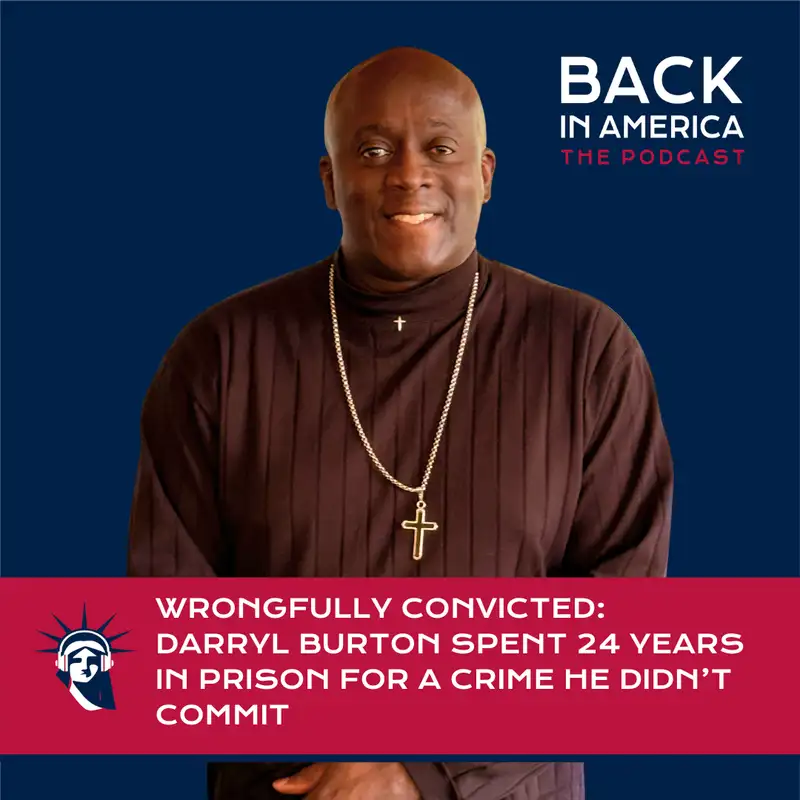
Wrongfully Convicted: Darryl Burton Spent 24 Years in Prison for a Crime He Didn’t Commit
Missouri State Penitentiary, the bloodiest 47 acres in America. I went inside of that prison, it was a huge banner. They said, welcome, leave all your hope, family and dreams behind. I never dreamed we'd turn into more than 24 years. Before we start, a reminder. Derral Burton's story is not an exception. It is a mirror held up to a justice system that far too often gets it tragically wrong. Today, more than 1.8 million people are incarcerated in the United States.
That's 541 people per 100,000 residents, ranking among the highest incarceration rate globally. But incarceration in America isn't just a bad number, it's a bad disparity. Black Americans are imprisoned at a rate of 911 per 100,000. Nearly 5 times higher than white Americans, who are imprisoned at a rate of 188 per 100,000. Since 1989, over 3,000 individuals have been exonerated in the US, collectively losing more than 27,000 euros to wrongful imprisonment. In this episode of Back in America, we hear from one of them. Derral Burton spent nearly 25 years in prison for a crime that he did not commit.
No DNA, no weapon, no motive. Just a couple of jealous informants and a system all too willing to believe them. His story isn't just about injustice, it is a story about survival, faith and the wrong road to reclaiming a life. If you're tired of arguing with strangers on the internet, try talking with one of them in real life. Welcome to Back in America, the podcast. My name is Derral Burton and I'm from St. Louis, Missouri. I was wrongfully convicted and sent to prison and served nearly 25 years as an innocent man.
I grew up in a large family, but my grandmother, she had nine children, seven girls and two boys. So I had a lot of cousins, a lot of playmates. I was an athlete. I loved to do flips. I was acrobatic. I used to tumble, a gymnast. And also I loved academics. I was someone who was learning things in school. When it came to mathematics, reading, science, geology, biology. I was an average student. I did boxing. I did some swimming. I did a little bit of track and field, some football, baseball. We are talking because you spent 24 years of your life in jail, wrongfully convicted.
Take us back to 1984. What were you doing at the time? And how did you first learn that you were being accused of murder? I was in Washington State when the murder was committed. Seattle, Tacoma, Washington, where I was with my best friend. The crime was committed in St. Louis, Missouri, which is thousands of miles away from Washington. When I came back to Missouri to see the parole officers, because I was on parole, I had committed a crime of burglary, which I was in trouble with when I was 17 years old. And I pled guilty to that. When I went to see the parole officers, they arrested me
and said I was charged with a capital murder for the victim, Donald Ball. I hadn't seen Donald Ball in years. We had no conflicts. They had no motive, no ballistics, no DNA, no confession, no weapon, no fingerprint. Nothing connected me to the crime, with the exception of witnesses, snitch witnesses, guys who came to court and lied. They were jailhouse snitch witnesses. When you heard the evidence against you, the jailhouse snitches, witnesses that didn't match any of your description, I heard that people were describing the murder as being light-skinned,
and you are not light-skinned, smaller than you. That's correct. What went through your mind at the time? Yes, four people described the suspect as a short, medium to light-skinned guy. And everyone, they laughed because they look at me and say, you're not light-skinned. Even the famous author John Grisham, one time I was sharing that with him, and he looked at me and he said, girl, I don't know if you noticed, but man, you're not light-skinned.
He said, I'm light-skinned. And these people gave testimony or statements to the police the night of the crime, that very night. What went through your mind? I was disbelief. Shocked. I was angry. And I'm thinking that the system is going to work. I'm thinking that these people have gotten something all mixed up, and that if I can just get in front of a court or a judge, they're going to figure this all out and let me go.
I thought it would take 24 hours. I never dreamed it would turn into more than 24 years. So for those listening who don't know what a jailhouse snitch is, can you tell us what it is? Yes, a jailhouse snitch is someone who's gotten into trouble. He's in jail, and he makes deals with the prosecutor to testify for the prosecution. The police and the prosecution, they prop this person up, and they tell him what to say. And this person comes to court, and they raise their hand and give an oath,
and they say whatever they've been coached to say. And in this case, they was coached to say that Darrell committed this crime against the victim, and they were given leniency or payment for testifying in a case as serious as capital murder. That's what a jailhouse snitch is. Someone facing time in unrelated charge, an unrelated case, and then they make a deal and get paid to come and testify against someone like myself. I think it's important to pause for a minute and to realize that jailhouse informants continue to be utilized in courts across the United States. Despite growing awareness of the potential for false testimony, the practice persists.
Some states have begun to implement reforms such as requiring pre-trial hearing to assess the reliability of informant testimony and mandatory disclosure of any benefits offered to informant. However, these reforms are not yet widespread, and the use of jailhouse informant remains a contentious issue within the justice system. How old were you? I was 22 years old. My girl had just had a baby, and my daughter was seven months, and I saw her three times. Could you believe at the time that you would spend a long time, 24 years there, or would you go like, no, I mean, this is going to be solved? Yes, I felt like I'm not going to be in here.
I didn't think I was going to get convicted at first, and I was telling some of the other prisoners in the jailhouse, I'm going home as soon as I get to trial. I committed this crime, that's what I thought. And then when I got convicted, I thought, well, I'll be able to get an appeal, maybe in a couple of years, because they sentenced me to life without parole for 50 years plus 25 years consecutive. They waived the death penalty. So I thought, well, maybe five years. So I kept thinking it was going to all get resolved over a period of time. Never thought that it would run up to become almost two and a half decades. So you were sent to a misery state penitentiary.
It's one of the toughest prisons in America, I believe. Yes. How did you survive both mentally, spiritually during those 24 years? Maybe I would like you to close your eyes and take me back through how you felt when you walked inside the prison. What did you hear? Is there any smell, any noise, any feeling that comes back to you? Yes, there's very good descriptions that you're giving. And the Missouri State Penitentiary, it was described as the bloodiest 47 acres in America. Time magazine wrote that article about the Missouri State Penitentiary, based in Jefferson City, Missouri.
That's the capital of Missouri. And when I went inside of that prison, it was a huge banner. It said, welcome, leave all your hope, family and dreams behind. That was the introduction into that place, the smells. The prison was built in 1836, so it smelled like sewage. It smelled like feces. It smelled like urine. I mean, you're talking about a prison that was built in 1836. The pipes and the water that flowed through the pipes, it smelled like sewage. It tastes like sewage.
It had rust and soot and sand that we had to filter it on the faucet just to try to keep this rocks and sand from getting to the cup. It was an experience that I'll never forget. Some of the things that I will never forget also is that the screams, unbelievable screams of men who were being assaulted and attacked by other men or sometimes by guards. We would ask why was that guy screaming like that to discover that two or three men were in the cell and they were assaulting that guy in a sexual way because he was sent to prison for harming women or children in a sexual way. They are the most hated people in prison and some of those people were innocent. You described it as being hell on earth. Yeah, hell on earth. And I went in as an unbeliever. I was not a Christian. I was not a believer in God or in heaven and hell.
But that prison, I can only describe it as evil. It was the most evil experience that I have ever encountered on earth. And I mean, top down, not just inmates, prisoners, administrators, guards, people who worked there. It was literally hell on earth. The gentleman approached me one time and said, you know, you're in the belly of the beast. This on earth. Do you know that? And I told him I don't believe in hell. I don't believe in the devil. I don't believe in anything like that.
And he saw really I had this number over my left breast pocket. One five three zero six three. He was outside the bars and he stepped closer. You don't believe in hell on earth. You don't believe in the devil. Well, the devil believes in you. And he walked away laughing. It's very hysterical, strange kind of laugh. And he had a strange look in his eyes. And I added those numbers up. One five is six.
Three three is six. Zero six is six six six. It's like the mark of the beast. And that's what he was referring to. He says you're going to dance with the devil in this place. How do we survive such a system? Did you have any connection there? Did anyone there? How do you survive? What's your support system? Do you make friends there?
No, prison is not a place where you make friends. You're asked about mental state, emotional state, spiritual state. As a person who is not a believer in God, my spiritual state of existence wasn't something I was ready to tap into. But emotionally, I was very angry, very upset and filled with rage and hate. They separated me from my little girl. So I used that anger, that energy to fight my case as I told the judge at the sentencing hearing. I don't know how long it's going to take, but I'm going to fight this case and I prove that I'm innocent.
Mentally, I had to be as tough as I could because I'm around a bunch of angry people all the time. It's an environment of anger and hate and violence. Every day three men got assaulted. Have you been assaulted? Yes, I had to fight in that prison. I went in at 147 pounds and when that guy said, you're going to dance with the devil, he meant that. It was a time when a guy was, man, he was fighting on this way up there on the third level. He was trying to throw me off this wall and I was trying to throw him off the wall.
At least he was going with me. You have to fight for your manhood, your money and survival. Animals do that. It's instinctive. It's nothing that's special to me. If someone come after you right now, you're going to fight to survive. Sure. And there, they don't box with fists. They fight with knives.
The first day in the holly unit, I saw two men getting stabbed. The day that I was released, August 29, 2008, they was rushing a man on his rolling bed. They called it a gurney. A guy cut his throat from ear to ear trying to decapitate him. That's what I saw the day I went to the prison and the day I got out of prison and was proven innocent. So much more in between. Yes, and my daughter was my motivation. I said, I want to stay alive long enough so I can see my little girl again.
That was my motivation. So no friends? Anyone you could trust in jail? You can't really trust anyone in prison. You get close associates and guys who may watch your back and you watch their back. But those same guys, you could become rivals in five, 10 years. You just don't know. There are a couple of guys who I became really close with and I'm close to them to this day, but only a couple. I had two best friends in my lifetime and both of them died when they was like in their 20s.
You're not going to get one best friend in your lifetime. If you get two, that's a miracle, but that's a blessing. So I haven't had what I call a best friend since then, except maybe one or two guys who I'm really close to now. It was because of what we went through in prison together. So it's like if you go to war with someone, you bond. I have bonded with a couple of other guys since that experience, but they are probably the only two guys that I would trust with my life. And you met them there? I met them in prison.
But we became close because sometimes we had to fight shoulder to shoulder against other prisoners. What does a typical day look like? A typical day starts at about five in the morning. You hear this real loud horn to wake you up to get prepared for breakfast. You have seven minutes to finish. So you go to your breakfast, you come back, you do count, counts everything. And it's about 730 after count, they go to the work call and tell you to stand still. They have guards with a clipboard and a count sheet.
They count each housing unit until they count 2500 people, 2000 people, whatever the numbers are. And they make sure everyone is there. And then you go to work calls at 730 at about 1130. That morning you go to lunch. Every two hours they're doing counts. And then, you know, 1130 you go to lunch, then you go back to the housing unit or you go back to your job site. At one o'clock you basically can move around a little bit. If you want to go to recreation or if you want to go to the library or if you want to go to a call out, you can go to a program like a self-help program.
Whether it's like anger management or Christian or religious program. At three o'clock they have another count and you go back to the housing unit at about 3330 and they have another count. And then at about 430 count clear at five o'clock. Then they have what's called wreck time or dinner time. You go to dinner. You come back in at six o'clock. Then they say you can go out on the yard for two hours. They release you and let you go to the yard where you can lift weights, run track, play handball or basketball or whatever the case may be.
At eight o'clock you go back into the housing unit. They count you again. And then they have what's called the last movement at nine o'clock. They open the sale at nine o'clock and you can go take a shower or if you want to use a telephone. But you have 15 minutes at nine fifteen. The whole prison is on what's called total lockdown. That's the curfew for every grown man in that prison. Nine o'clock you're in your cell unless you have a special call out to be out of the cell.
But that's the typical day and that's every day. How long did it took you for you to maybe overcome the disbelief that you were going to be there and start to go like I'm going to survive and this is my plan? Yeah, it was many, many years before I decided to call out to God. I felt it was for weak guys. I felt like God had nothing to do with human affairs. I never blamed God. I never believed in God. And I was saying, keep God out of what human beings are doing on Earth.
Human beings did this to me and that's what I said to people. God had nothing to do with me being in prison and I still believe that. But my grandmother who raised me to know about God in the Baptist faith tradition said to me when I was a little boy and I got away from church. She said, one of these days you're going to need Jesus. I just hope you remember to call on him. And I just dismissed and said, yeah, grandma, I'm never going to need your Jesus. He don't exist. That's what I was saying to her.
Sass in her behind the back, not in her face. She would hit me with a friend, man. It's so, you know. At some point I had tried. I had written letters from Europe to Parliament to Canada to governors to presidents of United States to senators, representatives, political figures, Republicans, Democrats, independents in this country. I had written Opal Winfrey, celebrities, everybody. But I never had tried God. I had written hundreds and hundreds of letters.
So I said, let me try to write this guy named Jesus a letter because I don't believe in him. I'm from Missouri. The Show Me States. I'm going to challenge this guy named Jesus, who my grandmother loved so much. And I said these words verbatim, dear Jesus Christ, if you're real and you and I know I'm innocent, if you help me get out of this place, not only would I serve you, but I'll tell the world about you. Sincerely yours, Darrell Burton. Didn't have a medal in their dress. Folded it up and got rid of it after two days because had the guards found that letter, they would say this guy's going nuts.
He's he don't even believe in God and he's writing letters to Jesus. But I wrote it for that reason and also challenge these believers in God when they say, man, why don't you try God? Try religion. And I would say, you know, fellas, I've written him a letter. He's not answering my mail. So stop calling on God. God don't exist, brothers. And I would say that to individuals, two individuals, religious guys.
One was a Muslim. One was a Christian. They challenged me and pushed back. I said to these religious groups, any of them, Christian, Buddhist, Judaism, Islam, I said, why y'all God don't help the poor? Why your God don't help famine and people who are dying around the world in wars? Why your guys don't help these situations? And one Christian guy said, you know, Darrell, do you ever give him credit when something good happens? I said, I hadn't thought about that.
I'll talk to you later. I'll get back to you. Never got back to this guy. Muslim guy challenged me. He says, you know, Darrell, you can have a dark heart. You know, you're doing in prison the same things you basically did on the street. You're living like, you know, a heathen. You're running, you know, gangs and doing these kinds of things.
Look, I'm an innocent man. They violated all the rules in the world. So why should I be their rules? I'm innocent. So the rules don't apply to me anymore. I don't want to hear about nobody's rules. He said, you know what? Allah, God will never let you out of this prison until you change the condition of your heart.
And I didn't talk to that guy for over a year. I said, man, I don't want to talk to you anymore because I thought you was cool with me. But he was telling me something I needed to hear. And I read one verse in the Bible. This is what began to change my heart. I didn't know the story of Jesus and that he was an innocent man. He was convicted and killed and he was crucified as an innocent man. When I was challenged to read the Bible and I read that story, I said, man, this guy was innocent.
And the organization right here, Centurion, got the name from the Bible when Jesus was crucified. A centurion says, surely this man was innocent. And then Jesus on the cross when he's being crucified in one verse, Luke 23, 34, he said, Father, forgive them for they know not what they do. That verse touched me. I said, that's not human. That's divine. How could this guy forgive these people? And he's innocent and they're killing him.
So I wanted that whatever it was, that kind of peace. I was so bitter and angry. And that's when I started trying to read the Bible and pray for people I hated because Jesus said, pray for them, love them and forgive those who you consider as your enemies. So you turn to religion. You keep on writing nature. You trend yourself in law. Right. Yes.
How do you do that? I had access to a law library. Now I turned to faith. I challenged Jesus, God, and things started happening. I became more peaceful inside of me. I went to the law library and I began to read law books. Every day I was reading law books of all kinds, all kinds of law journals, law books, law annotated, what's called procedural law, civil law, process law, due process, the Constitution, the amendments. Anything has something to do with law.
I knew law would put me there. It's going to take law to get me out of there. I was also trying to figure out ways to escape. Did you try? Oh, yeah. I mean, yes, I tried. It wasn't like I had some elaborate plan that I put together, but I was just looking for ways and opportunities that if I saw, you know, like I said, opening or anything like that, I was going to be aligned for it. That was in my head.
I began to study the law. I took a course in paralegal in prison. I took a course in computers in prison. I began to study the law and I said, I have to figure this out because this is what's going to ultimately help me get out of prison, the law. And you write to Centurion? Yes. And they did an answer? When I wrote them in 1990, I saw them on television on a 60 Minutes program and they said to me, in 1990, we get a thousand requests.
Yes, we help free innocent people, but we get a thousand requests every year from people who claim to be innocent. Out of a thousand requests, we take two cases a year, maybe three. If we take your case, it'll be 10 years before we get to you. This was in 1990. I said good because I had 75 years, so I had time to write. And I wrote them for 10 years. They took my case 10 years later in 2000 and it got me out eight years after that in 2008. So it's 18 years from the first letter that I wrote Centurion before they were able to get me exonerated.
How did they do that? They discovered that there was a woman who was a gas station attendant. The night the crime was committed, she saw the victim of gas tonight and she was like from this window to maybe a few feet away from the gas pump that he was pumping his gas. They found her. She moved away to Baltimore, Maryland. She was not a young woman and she had told the police the day of the trial. She said, you've got the wrong man. That's not the man who committed the crime.
He's too dark. They hid that from the judge. They also discovered that the prosecutor, the judge and my defense attorney, public defender, they had a sidebar where the three of them talked about another woman. The three of them talked about another suspect. This other suspect who not only fit the description, but he had shot the victim on three separate occasions. He shot him three other times because these two gangs, they were fighting over drug turf and they was, you know, shooting at each other in each other's associates. They agreed not to let the jury hear about that information. Also, they also discovered that the prosecution witness, one of the snitch widgets they made deals with, they said he was facing a couple of years in jail.
He was facing 30 years in jail. Said he only had a couple of convictions. He had 12 or more convictions. They kind of whitewashed his criminal history and this stuff was hidden from the defense, from me and from my public defender. That helped me get out ultimately. My dark skin mainly. The lady said, I was, he's too dark. And she told the court and the judge that he's the wrong man.
I didn't know that the court had gave an order to the warden and told the warden to release me in 15 days. The warden had had the order for 11 days and then he came and said, Darrell, I have this order from the court. To release you and if they're not going to retry you, I'm going to release you today. It was on a Friday and I didn't believe him. I said, I'm not going to believe that until I'm on the outside of this prison, a free man. Because I've had ups and downs where it looked like the courts was going to let me go or something was going to happen. He grant me my release and it just went flop. So I wasn't convinced when they came to me that I was getting out.
I wasn't convinced until I was actually free on the outside of that prison. But it's all a range of emotions, disbelief, joy. It was a time that I used to hear guys say they blacked out and they couldn't remember what happened. Well, that happened to me. The last two doors leaving that prison, I don't remember going through those two doors. I do not remember. And my lawyer said all I started doing was chanting, praise God, praise God. I don't remember any of that.
I don't remember. Do you remember stepping outside? I don't remember. I just know someone had a video or something when it seemed like they was recording me and I just I was lost. I look lost. I don't remember any of that. All I remember is at some point they was getting me into this car. They said, we got to, you know, okay, Darryl, we're going to take you to see your mom.
And that's when it started. I started kind of coming down. It was just a euphoric kind of feeling out of body experience. It was surreal. That's the only way I can describe it. And who was it that took you? The lawyers, Cheryl Pilot, Dan Clark and Charlie Rogers. Those were the attorneys and one investigator.
That's who came and picked me up. Do you recall seeing your mom? That day, later that day, they took me to eat first. They took me my first meal outside of the prison. It was called TGI Fridays. And it was on a Friday. Okay. What did you have?
I just wanted a salad and a tall glass of water because in prison, remember I said the water tasted and smelled like soy sauce. So I wanted some fresh water and I wanted a salad with all the vegetables that I could get because in prison they only give you iceberg lettuce. That's just salad. No salad dressing, no other vegetables. So I wanted a salad with, now I'm a vegetarian. And they said, you can have more than that. And then they urged me to eat what's called mozzarella steak, fried mozzarella sticks. I said, that's fried cheese, right?
They said, yes. I said, who eats fried cheese? That's a heart attack waiting to happen. I'm not going to eat it in fried cheese until I tried it. And then with this little red sauce, this is good. Who thought of this? Get another servant of this. And your mom when you saw her?
Then they took me after we had my first meal. Then they drove me to St. Louis. But at first they put this little phone in my hand. It was about as big as the palm of my hand, but it was a flip phone. And they said, now flip it over and then call anywhere you want to call. If it's long distance, call 10 digits. I'm like, what? This is crazy.
What is this? This little bitty gadget? It was so small, I couldn't believe it. And so I called and I was nothing by my mouth. So I was talking very loud. And then my brother who asked, why are you yelling? I said, you can hear me? He said, yeah, right, clear. And so I said, well, tell everyone I'm out and I'm on my way home.
Tell mom I'm on my way home. I'm free. I've been set free. I can hear in the background once he shared it with the family, all the excitement. One of my cousins grabbed the phone and said, are you really out? And I said, yes, I'm really out. I'm with my attorneys. And then they got on the phone.
Yes, he's out and he's on his way home to see you all and his mom right now. It was a lot of folks at my mom's house when I got there. It was about a two hour drive. So it was a big, huge celebration. How did you cope with all the freedom you had? Freedom to do just anything that crossed your mind. You had lived a very controlled life. And all of a sudden you could do anything.
That was an adjustment. I was not used to getting up and doing things in my own free will. In fact, I was with my brother and a lady. We were having dinner at a restaurant. And I kept asking if I could go to the restroom because in prison you have to always ask. It's going to control environment. And so one time I had asked, I went to the restroom and she asked my brother, why does he keep asking if he can go to the bathroom? Doesn't he know he's free?
He can get up and go use the restroom or do whatever he wants. But I had been controlled for so long, it was almost like the Stockholm syndrome. I wasn't used to getting up and doing things freely. I stayed in this room at my cousin's house for 30 days. I was too afraid to come out unless someone was with me. This world was so fast and so advanced. I was not used to freedom. I was intimidated.
I was petrified. I was afraid, literally. I was afraid. And it took some time and some getting used to and being around crowds and crowds of people. That was also terrifying because in prison, you know, something's going to break out. It's going to be bad. In prison, when you're around a bunch of guys, somebody's going to start stabbing, fighting. Something's going to happen.
So that was something else I had to get used to. How do you even begin to start over? Start over? Well, you just start over one day at a time. I had some mentors. There was about three young ladies who used to come and get me every day. They helped me get identification, my driver's license. They helped me get my Social Security.
They helped me get clothes. They helped me get all the things that I would need. And then I left my hometown the next day. I didn't want to live in St. Louis. And the ladies who were helping me, they lived in Kansas City. I felt starting over, I just had to start from one day at a time. And I felt like I had been through the hardest thing in life already. So I felt nothing could be as hard as what I had already been through.
Getting out of prison as a free man was hard. I went to these self-help and reentry programs asking for help. And they told me, Darrell, we can't help you. We only help guilty people. We don't help innocent people, which is just unbelievable. I said, well, I did almost 25 years. They said, yes, and we're sorry. And you all need to start a group to help innocent people.
But we can't help you. Since you were innocent, we can't help you. And that's exactly what you did. I started Miracle of Innocence because it's a miracle to get out of prison. So Miracle of Innocence, we help innocent people get out of prison. And then we help them when they come home. And that's what we encourage those who want to support and help us by web donations, miracleofinnocence.org.
Or you can also go to darrellburton.org. But you can offer your time, your talent, your volunteer services to help us to help you. We have a donation for innocent people. Just yesterday we got a donation for $50,000. And about two weeks ago we got another donation for $20,000. We raised over $4 million in the seven years we've been in existence to help innocent people get out of prison. How many people are you helping at the moment?
At the moment we're helping five people at this time. We're helping a gentleman named Jeff Winehouse, Byron Case, Larry DeClue, and we have another case called Ahmad Mann. We're working on five cases right at this moment. That's about six cases. Each one of these guys who are in prison, they have been in prison on average for more than 20 years, some of them 25 years, for murder or very serious charges.
Collectively, they've all served over 100 years in prison for crimes they didn't commit. And they all went in. Every one of us go in as young men or women. We go in primarily in our prime, like in our 20s or younger, 18 or 19 or 17. And we come out in middle age, 40s or 50s. It's astounding that we lose all our youth in prison
for crimes that we didn't commit. And the perpetrator, the person who committed the crime, kept on going out doing whatever it is that they did in life and sometimes committing other crimes. Do you wake up thinking you're still in jail? Yeah, sometimes I wake up, I still feel like I'm being controlled. People may have the best of intentions
and they may not know that this is how it feels, controlling me and controlling situations where I can make decisions for myself. Yes, sometimes that reminds me of a prison environment where you're just being controlled and told what to do and where to go and when to be there. It's different out here than it was in there. And I refused in prison sometimes
when I was told what to do. I was not what you call a model prisoner. As I said, I was innocent, so I didn't want to obey nobody's rules. I hated the place and I hated the people who ran the place. But it's different out here in society. And that's what reminds me. Sometimes I get triggered,
something that could be said or I could see. It reminds me of prison. Are you fearful of cops? Every time a cop gets behind me, even if he don't turn his lights on, my heart goes to pounding. Yes, pounding. Sometimes my palms sweat.
Yes, I'm fearful of cops because I don't know. If you've seen the news, sometimes cops pull over a black man and shoot him and kill him for nothing. Yes, that's been like this my whole life. I've been black a long time. I'm going to be black for a long time. Hopefully for the rest of my life, I'll be black.
In fact, I know I will. Any books besides the Bible and religion, any book that really helped you when you were in jail? Yes, absolutely. One book in particular that I love, this author, his name was Victor Frankl, Man's Search for Meaning. I read that book and I've read many other books,
but that was the one where Victor Frankl, he's a Holocaust survivor. And so Victor Frankl said, if you can find the reason or the why to live, you'll find out just about any how. All you need is a reason to live and survive and you'll figure out how you can survive in the most treacherous and terrible situations.
When I read that book by Victor Frankl, that was one of the books that really touched me. Yeah, it really helped me. I read books about mega-evils. I read books about Martin Luther King and especially read books on Nelson Mandela, yeah, Malcolm X. Read a lot of books, a lot of books.
But I used to read books when I was a kid. I loved reading books. Yes. So if you were sitting in front of someone facing injustice, be it in jail or in her life, what would you tell that person? I would say to them, don't stop fighting to advocate for yourself.
You have to advocate for yourself. Continue to write letters, continue to reach out to news media, national figures, sports figures, entertainers, names that you may see on the news. Find out where they're located and send them a letter. Write to them, write to the churches, write to the synagogues and the temples,
write to ordinary people. Continue to advocate for yourself because you're going to be the person to help yourself. Whether you're in prison or someone has done you an injustice, you have to fight for your rights. When you know that you didn't do anything, you have to let people know that and continue to shout that off the mountaintops
and never stop saying it. Good. Well, thank you, Daryl. Last question. We are in the podcast Back in America and my question is always, what is America to you? What is America to me?
America is a mixed blend of blessings and burdens for me. What is America to me? It has a history of slavery. It has a history of colonizations and oppression. Some of the historical figures, and I'm not saying that that's the white people who did this today, and many of them may have some lineage to those people.
Their ancestors who had people like my ancestors in slavery. And then there are situations today that sometimes it seemed like it's getting better and then sometimes it seemed like there was some pushback. And for some people, they don't want it to change or share power. But I still say that America is one of the greatest countries that has ever rose to this time in history.
It is a blessed country. It is a generous country. There are generous people in America. I wouldn't be out if it wasn't. The system didn't work. I lost almost 25 years. That's not a system that works. But some of the people here in America, you had Quakers, you had people like John Brown,
you had people like this gentleman by Free State of Jones. You had white people who were advocating for freedom, like Harriet Tubman in the Underground Railroad. So you had a lot of people who were always on the side of doing what was just. There's a gentleman, Wilbur Wilbur Force, that came out of England. He was one of the first persons in England
to advocate for the abolishment of slavery. So you had white people who are on the side of justice. And not so much as Republicans, Democrats, or anything else. They're just people who want to do what's just and what's right. So America is a mixed blend of any people. It's good, and sometimes it's not so good.
Thank you. Anything else you want to add? Yes, I have a daughter who I was able to see for her birthday on Wednesday, this past Wednesday. And she hadn't spoke to me in months, if not years, because she's angry that her father and her mother was not in her life because my daughter ended up in foster care. Her mother lost parental rights.
I was in prison. I couldn't help her. She let me take her a birthday present this Wednesday. For the first time, she wouldn't communicate. She wouldn't speak to me. For the first time, I took my daughter a gift, and I was able to hug her and wish her a happy birthday. So her name is Tanisha. I want to talk about my little daughter.
If you have children, hug them a little close and appreciate them, because we take it for granted sometime when you haven't been separated from your offspring for many, many years, or months. But don't take it for granted, because you never know when the next time you may see your child. Darrell, thank you so much. You're welcome. Thank you for having me.