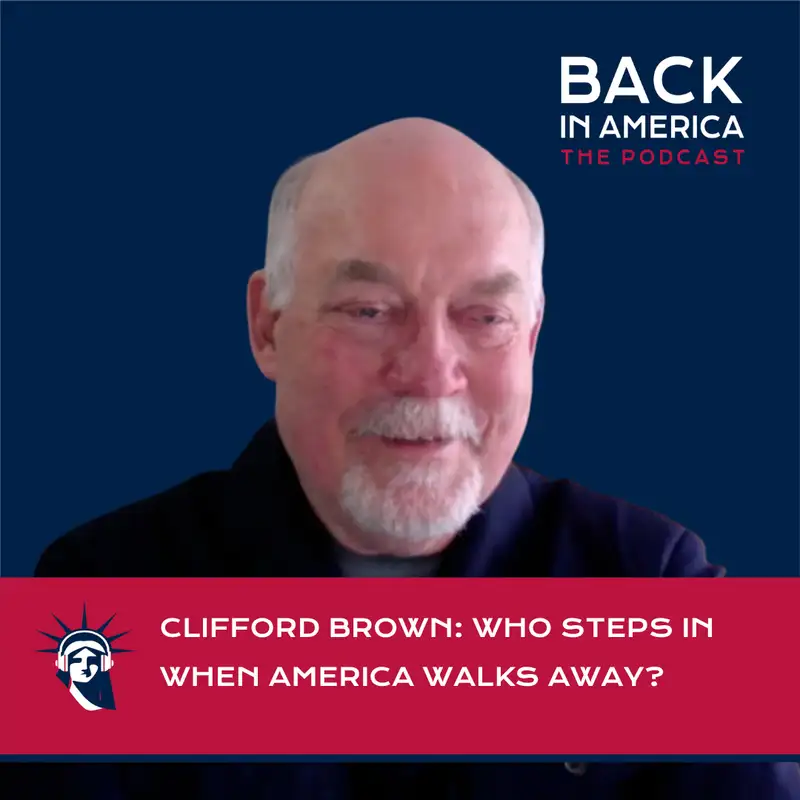
Who Steps In When America Walks Away? -- with Clifford Brown
She said, don't get a pretty one. I don't want a pretty one. I want one that's gonna work. Clifford Brown gave up a partnership at a Beverly Hill law firm and a house over the Pacific to join the US Agency for International Development. He spent 27 euros in places most Americans will never see. Haiti during coup,
Colombia at the height of the cocaine war, Guinea during a military takeover, and Kyrgyzstan, where his wife was abducted at gunpoint after he spoke out against corruption. In 2025, the agency he devoted his life was dismantled. Here is his story. If you're tired of arguing with strangers on the internet, try talking with one of them in real life.
Welcome to Back in America, the podcast.
I wanted to start the conversation somewhere a listener wouldn't expect. Not with policy, not with Washington. I asked Cliff to tell me about bride kidnapping in a country that is not a country. I asked Cliff to tell me about the bride kidnapping in Kyrgyzstan. It's a phenomenon that is unbelievable
or was to me when I first encountered it. It was a practice that had been historically practiced in Central Asia for thousands of years, but when the Soviets were in charge, it was illegal and it's still illegal, but the Soviets actually enforced it. But in rural areas of Kyrgyzstan, and even in some of the medium-sized cities in Kyrgyzstan,
the young people don't date. And the way the marriages are formed is that the young men are literally encouraged to go out and take a bride and they do that. They, the first family in the film, the filmmakers were allowed into the house and they were filming the grandmother who was advising the young son.
And he was getting dressed up in fancy dress clothes. And she said, don't get a pretty one. I don't want a pretty one. I want one that's gonna work. And then he gets some of his friends and they get in the car and they drive out on the countryside and this is all being filmed. And they get out of the car and they grab
a young school girl who was about to get on a bus and they drive her back into the car. They push her into the backseat. She's kicking and screaming that she's gotta go to classes. And they say, honey, your school days are over. They take the woman back to the groom's home and they put her in a corner in the room and all of the female relatives of the groom
surround the woman. And they tell her that, honey, this is how we do it. It's how we all did it. And this is what you must do. Put the scarf on and that means you're married. And in some cases, if she continues to refuse, they will leave the room and they will tell the man to go in there and do what he needs to do.
And that's community sanctioned rape. And at that point, that girl is not going to be accepted back home by her family. The same film crew returned a year later in each of the four cases and they interviewed the ladies at that point. And a couple of them had children. They claimed they didn't regret what they had done.
When they went to the four family, and this is the conclusion of the film, that woman had committed suicide. I had personally sat in rooms with Western dressed women who are young college students at the University of Central Asia in Bishkek, and that's an English speaking university. All the classes are in English.
So these women were telling me that this was their tradition. It's because they don't date. How else are they going to have a family? And the men were sitting there and saying, this is our tradition in our society. And I would say slavery used to be a tradition in this part of the world too. Does that make it right?
But I married my Russian teacher, who was my tutor in Kyrgyzstan when I first got there. This was 20 years ago. And her older sister was kidnapped. So it is, we estimated that some 60% of the rural marriages in Kyrgyzstan occur in this fashion. Now, often they are, the kids do it on purpose.
They know each other and they decide, let's make this look like a kidnapping. But many of, if not most, and nobody really knows exactly what that percentage is, are in fact unwilling brides who are simply taken and they submit. And it's a very hard phenomenon to comprehend in this century, but it's out there.
Cliff met his wife in Kyrgyzstan. She was his Russian language tutor and a concert pianist at the Kyrgyz National Conservatory. They married while he was posted there, but his anti-corruption work had made him enemies.
I was outspoken about high level corruption in Kyrgyzstan. I knew a lot of details about people in the department of ministry who were basically on the take. They were using their position to look the other way when electricity was smuggled north into Kazakhstan. And you can imagine that electricity can be smuggled, especially when you have transmission systems that were built before there were even borders
that meant anything. People were making enormous salaries under the table by smuggling electricity and I knew about it. I knew a lot of the details about high level corruption and I was talking to other donors about it. I told the World Bank about it. I told the IMF about it. And at some point I came later to realize
my meetings or my phone calls had been monitored. My wife, to get her hair done and she didn't come back that night because when she came out of the hairdresser, three boys jumped in the car with guns and they told her, they dragged her from the driver's seat into the back seat and one of them took his spot behind the steering wheel and drove out into the countryside
about 10 miles out of Bishkek and they tied her up and on their way out of town they said, we're not gonna hurt you elder sister, but your husband owes our boss money. And nobody ever asked me for money. I didn't know anybody anything. I get a phone call late in the evening. I was pacing it back and forth at home,
wondering where she is and I get a phone call and it's her. And she says, call Jera. She said, I've had an accident. I said, what are you talking about? Call Jera and then I realized she's hysterical. I said, how are you calling me? Where are you? And she said, these people gave me their phone.
What had happened was, and I learned this later, she had managed to untie her feet. They put her down on a pillow behind some bushes in a dry irrigation ditch. In November, you're not using your irrigation system. So she was sitting in the irrigation ditch on a pillow that she insisted they get out of the car because it was cold.
Somehow she saw a boy walking, pushing a cow with a stick. She could see him through the weeds, but he couldn't see her, but he just heard this voice, a girl calling for help. And somehow she's persuaded him to come over and he managed to untie her feet, but not her hands. So then she walks toward town and she managed to get her hands loose from the ropes.
And she comes across strawberry pickers. That were picking strawberries. She borrowed their cell phone and that's what she was calling me with. So I passed the number though to the security officers and they went out and got her. And that was the end of my tour in Kyrgyzstan. I tell the story in the book
there was a high-level embassy meeting at one point and at the end of it, I said, I do have one thing to say, Mr. Ambassador, I've been working on this subject of bride kidnapping and this last weekend I attended a Kyrgyz wedding, but it wasn't a Kyrgyz, it wasn't a kidnapping. It was a conventional Kyrgyz wedding. And the most interesting thing about it was that
I was the groom and the room fell. The ambassadors clicked, did you get married? And I said, sure. So after that, did you decide that you were going to leave? The embassy got us out of it for security reasons. I was already assigned to West Africa as a mission director in Guinea. But that didn't scare you enough to quit the agency.
You stayed with the agency. I did, it was a one-off event. Let's stop here for a minute and I want you now to take me back to Beverly Hills. You had the partnership, the house, apparently a very nice house over the ocean. Why did you walk away? And what did it mean for you at the time
to really quit that job? Yes, I was never really fully enamored of business law. I got bought off every year. They would pay me enough, but then, geez, I better stay doing this. I was working on a big case and that case was all consuming. It took most of my time for about three years and I was constantly traveling back and forth
to Houston and LA or to New Orleans and LA. And when it ended, I had a lot of time on my hands. So I had my feet on the desk and I was reading the newspaper and I saw that Usaid wanted attorneys that had a language. I saw this ad, I flew back to DC to interview with the agency and I saw the guy had a big wall and he had all these little pins all over the wall.
And he said, I asked him what those pins were. He said, that's where our attorneys are. Something in me said, I gotta have this job. I went back to LA and I had to explain it to my first wife at the time she was an attorney to a litigator. And she said, you go and see if you like it. And if you do, maybe the kids and I will come later. And we were living like Colonials.
We had a cook, we had a driver, we had a gardener. It was a colonial lifestyle. I could dabble in a thousand different subjects, which is what Usaid allowed me to do. They were involved. We didn't talk about what Usaid does. Most people understand that it was a humanitarian organization that it responded to disasters and whatnot.
But what they don't realize is we did everything else that falls inside the realm of, on one hand you have military responses and on the other hand you have pure diplomacy, which is essentially gathering information and passing information back and forth. But everything else that the US government wanted to do overseas, they used Usaid
as the principle tool to do it. And so that meant, for instance, if the Soviet Union fell apart and you needed people to train accountants or write new commercial laws, that was Usaid. We hired people to do that. If environmentalists wanted to set up a corridor of national parks that are contiguous in Central America, that was Usaid.
We got the governments together to do that. We negotiated that. If the court systems in all of Latin America wanted to switch to jury trial systems instead of using the old Napoleonic code systems, we were the ones that would hire people to do that. You make it sound super easy, leaving your job as a lawyer in LA
and moving to wherever that position sent you. However, not everybody does that, right? You change your life 360. What did people in your life think about it or said at the time?
I think they understood. They knew that my heart really wasn't in commercial law. Did it for almost 12 years. I was a partner in the firm, but it was not what I really wanted to do. I use this phrase almost jokingly, but there's a bit of seriousness to it. I felt like I was a mental prostitute.
I had to think about somebody else's problem as an attorney. And it wasn't my problem, and I didn't wanna think about it. And the only reason I was thinking about it was they were paying us to get me to think about it. And the international development field on the other hand, was a topic that I enjoyed thinking about. So most Americans have no idea
what USAID actually is or did because it's no longer. Can you pick one project for me and walk me through it from the beginning? We had a project in Honduras with the expertise to grow onions on a small experimental plot up in the mountains in Honduras. And when they harvested those onions, it was at a time when onions are not being harvested
here in the US and they shipped them in a container to Miami. And they discovered to their pleasant surprise that they could do this and then they could do it and make money doing it. So they taught more farmers how to do this and they continued to facilitate these shipments until the farmers learned how to do it themselves.
And 10 years later, there were half a million people that were making their money growing onions in Honduras. When they destroyed USAID, they didn't just destroy the jobs of the couple thousand people that worked in USAID. They destroyed the jobs for well over 10,000, maybe 20,000 people that work in the consulting business and the NGOs that relied on our funding
because they were the implementing organizations. Do you think the American knew what was happening? Did they know that the onion in their grocery stores were existed because of a government program? No, and you know, there's a reason for that. There was a law and it's called the Hippenlooper law named after the Senator that first introduced it that prohibited USAID from using any of its budget
for any funding or propaganda within the United States. We were not allowed to lobby or brag about what we were doing in the US. There was never any massive effort to explain what we did to the American public. And even to this day, there's an awful lot of publicity that's still circulating about how unfortunate it was to destroy USAID, but it's all centered around,
what I've seen has been centered around the humanitarian side that a lot of people dying. And I hope that's true. People are dying more, people are dying because our health projects and a lot of our humanitarian work, all of it is gone. But they're not talking about the other things we did. Half a million jobs in Honduras from an onion experiment.
300 villages in Guatemala connected to electricity for a $30,000 investment. Shrimp, cantaloupe, flour, broccoli, all shipped to American groceries from industry that USAID helped create. And there was a law that kept the agency from telling Americans about any of it. When the US stepped back from this kind of work,
the vacuum doesn't stay empty. It get filled often by countries that all play by the same role. I asked Cliff what the agency got wrong. What did the USAID get wrong? I was personally involved. I was the deputy director in Columbia, the third largest foreign assistance program
in the world at the time. It was all about destroying cocaine. Our part was to teach farmers how to grow things besides coca, which is the raw product to make cocaine. And 20 years later, 26 years later, Columbia is the biggest cocaine producer in the world. That was a complete waste of money. It was a futile effort.
If a single plane, for instance, from the Americas flies over to West Africa and lands in a country like Guinea-Bissau, that plane has more value on it than the entire national budget for their police and military combined. The democracy building projects. Those governments didn't want that kind of assistance. They were quite happy with their authoritarian regimes
and anything we did to try to stimulate democracy from the grassroots, will you? If you will, it just didn't work. And we got kicked out of Russia, and you can see where that's gone. What happened when America stepped back and someone else steps in? Certainly China will be taking as much advantage
as they can. Their approach is purely commercial. They asked the government what they would like. We need a soccer stadium. Oh, here you go. But they also do a lot of commercial projects. They've recently helped open a mine. It's one of the world's biggest,
and it may be the biggest greenfield iron ore project that's now come online and getting in. The Chinese built the railroad to the coast, and they've done much of the infrastructure. They bring in their own workers when they do that. They don't hire the local people to do it. And they saddled Kenya with a big debt that they can't pay now because they use loan money to do it.
Talk to me about something you really tried to make happen for 20 euros. You tried to have the US government form the translation of a text that said that suicide is a sin against God or Allah. What happened? I'm in Haiti, and the education officer comes to me and says, Cliff, they're saying prayer is in our building.
And I said, I don't care. That's fine. She said, doesn't that violate the separation of church and state? I said, no. It has nothing to do with the free exercise of religion in the United States. It is not a law respecting the, an establishment of religion
and it's good for him. So let him pray. That's been my attitude for 20 years. But when I was in Kyrgyzstan, now this is after 9-1-1. And while we are being attacked, we're actually conducting a war against an extreme version of Islam. The University of Montana comes to me with the proposal
to translate portions of the Quran that discourage, prohibit suicide in any form. So the USAID lawyers, and I have been one, told me, no, you can't pay to translate portions of the Quran that will discourage suicide because that would be excessive entanglement with religion. And they're saying this at a time when we are entangled in a war against religious extremism.
So we're already entangled from my standpoint. But I got nowhere with that argument. All the time I was in USAID, that the closest I came to getting any traction was in 2009, the Washington Post published an article where they talk about my position and the fact that the agency refrained from doing it. So we have this absurd situation now
that it's considered legal to pick up a gun that the US Army got with government funding and you can shoot somebody, but you can't argue with them about their mistaken interpretation, which I think Wahhabism is. It's a mistaken interpretation of Islam. And it's what has inspired much of this Islamic terrorism
that we've been fighting for over 25 years. Did you ever come close to winning that argument? No, not with, I do know that the US Army has a more enlightened attitude about it. I have been told that in Afghanistan and or Iraq, there were military units that were allowed even to reconstruct or repair a mosque. So nobody had a problem with that.
So I don't know why the use of the foreign aid, the program that we managed. Do you think it would have made a difference if you had won the argument and if you had been able to use that version of the Quran or that translation? I think it could make a difference if we and other donors tried deliberately
to stimulate a debate with public money within Islam about the extreme version of it and whether it is consistent with their faith. I think we can provide all the infrastructure and other assistance, but if we don't start changing minds within the extreme version of Islam, then I think that will not be the most effective way
to resist the terrorism and to accomplish what we're trying to accomplish. On January 20th, 2025, President Trump signed an executive order posing nearly all foreign aid. By early February, US aid headquarters were closed, the website went dark and most employees were placed administrative leave.
On July 1st, US aid officially ceased to exist. More than 80% of its program were terminated. A study published by The Lancet projected that the cut could lead to 14 million preventable deaths by 2030.
When the website went down in February, 2025,
what was the first thing that you felt? Not what you thought, but really what you felt.
Sadness. It was the equivalent of burning up the library at Alexandria. We had 60 years of project data. I hope that data is out there somewhere and I hope it can be restored at some point, but for the time being, a lot of people that would otherwise use it
for their research are not able to see it, but more than that, what I felt was just sadness for all of my friends and colleagues that were out of work. There were people that had worked for 18, 19 years, that had one year to go before they could retire and also their pensions gone. I know personally people that are forced into very different careers now.
I had a woman who worked for me in Turkestan, she had 20 years with the US government, so they gave her a green card for her and her children. She's a widow. So she came here assuming that she would find work in the international development field and she comes here with her three minor children and she does find work.
And six months later, it's gone. Now she's scrambling. She's working in a grocery store deli, putting cheese in plastic bags for a fraction of what she could have earned.
You call it destruction. The administration calls it reform. For someone who really does not, genuinely does not know what's right, what is the factual difference?
Trump himself apparently believed, or at least says that USAID was a bunch of crooks, that we were a corrupt organization. He's crazy. That's just not true. It's completely false. We were, the group was some of the most altruistic, high-minded people I've ever known.
And most of them could have made far more in the private sector, but they took great satisfaction in working in this field and helping people overseas. It was not a corrupt organization, no more so than any other government agency. There's bad apples in all of them, and we had our share. But to say the entire organization was dedicated to skimming money off from the American public
is complete nonsense. As I said before, everything we did was cleared by the State Department, by the executive branch, by Office of Management and Budget, and by Congress. Nothing we did was a secret.
And now you can't go back and look at the project records because they're all taken offline. Knowing everything that it cost you, your income, big salary cut at the start, your safety, your wife's safety, 20 years of you losing the same argument about this translation, watching the entire thing get dismantled, would you still do it again? I don't regret doing it.
I can't put myself back in those days right now and predict what I would have done. I think we all work on the margin of forces we barely understand. I feel very lucky to have been able to do what I did and to have the very experiences I did. If I had to guess, yeah, I think I probably would do it again. It was a great gig while it lasted.
I'm very happy that I worked in the field as long as I did. And do you think American care?
A lot do, a lot don't. A lot don't know what we did overseas and don't care to learn what we did overseas. Given your career, you've seen America from Bogota, from Bisse. You've seen what it does when it shows up, as we said. What happened when it walks away? And what is America to you?
When it walks away, we simply won't have that much influence anymore. And it makes me sad. I think that in some ways we are becoming like some of the countries that you said was trying to assist in their own development. What we see happening now is the level of mistrust within our own society is rising.
And I think what we don't appreciate is just how fragile the social consensus really is. I was in many places where I was able to see the social consensus fall apart in a very short period of time and it scares me to think that could happen here. But I don't think it's out of the realm of possibility yet. We continue to mistrust ourselves. Then I think I can only hope that at some point
there will be a change in our administration and then change in our own approach to go back to what we were doing, because it was worth doing.
Thank you. Is there anything else you want to add? I just want to thank you for the opportunity, Stan. I think the idea of assisting other countries to develop economically is part of the better angels of humanity and I welcome any chance to spread that word. So thank you for the chance. Thank you for your time today.
Thank you, Cliff.
Clifford Brown's book, Inside US Aid, An Odyssey of Foreign Assistance is available now. You can also find his writing at cliffordbrown.substack.com.
If you like this conversation, one of the most helpful thing you can do is to leave a review. It takes only 30 seconds and it's how a new listener will find the show. So go to rate.backinamericasepodcast.com
and leave a review. Your review will make a real difference. Thank you.