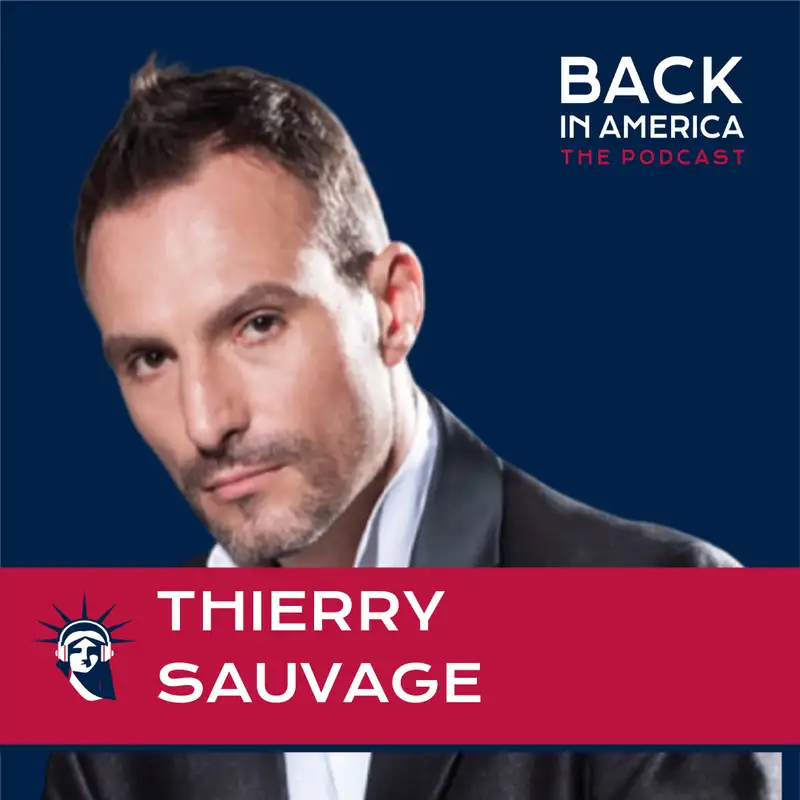
Thierry Sauvage -- COVID, changement de vie : de Shanghai au Croisic
This is a one-off episode in French. Don't worry, Back in America will revert to English in the following episode.
If you're tired of arguing with strangers on the internet, try talking with one of them in real life. Welcome to Back in America, the podcast.
My guest will join me in a few moments. If I ask him to share his experience, it's because, as many of my guests have been interviewed since the beginning of the pandemic, this period has been for him the opportunity to reflect on his life. Eric Marsh told us that Americans took advantage of the confinement to realize the extent of systemic racism in the United States. Glenda Wren, on her account, rediscovered her children and the interest in eating in the bedroom every night.
Others were confronted with depression or domestic violence. Positively or not, COVID does not spare anyone. In New York, since March, more than 246,000 people have left the city, which represents an increase of almost 100% compared to the same period in 2019. In France, according to the Capital magazine, a Parisian out of two people are planning to leave the Paris region. For my guest, COVID-19 was the trigger for a radical change in life. In February, he lived with his Chinese wife and four-year-old son in Shanghai.
As part of the automotive industry, he is also a DJ and electronic music producer during his free time. He is booked a year in advance to play in the biggest clubs in Shanghai. Four months later, after many sleepless nights, it is in the small cruise ship of 4,000 inhabitants in the Atlantic Sea that he lives with his wife and son. Thierry Sauvage, hello and welcome to Back in America. We are live. Can you introduce yourself succinctly?
We are going to go back in time, Thierry. We are in October 2019. What does your life look like at this time? Where do you live? What does your wife do? Where does your son go to school? In October 2019, I live in Shanghai. I work for a big Chinese company. I am a supplier who makes all the automotive parts for the interior.
I work for all the manufacturers in the world. My part was to manage all the international projects. I had a client, Jaguar, Lotus, Vinfast, the new Vietnamese manufacturer. That's it, for the majors. At the same time, I was a Chinese and Shanghai DJ. In October 2019, I had just a few months before I had set up my own label with a friend. The label is called Tachi Records.
It is practically the first label in China that has exported worldwide. My son went to a French school in Shanghai. In a small section. My wife started looking for a job at the time. Noean went to school. What did your wife do? At the time, she was working in an architecture bureau. What do your typical days look like?
What time do you get up, where do you work, do you travel a lot? I am already a super lefty. I get up at 5 a.m. I start by running or doing sports. This is always my morning routine. A run or exercise session for at least an hour. I usually live at the hotel during the week. The company I worked for was in Shenzhou.
It's two hours away from Shanghai. Transport wasn't practical either. I was at the hotel during the week. After my sports session, I would spend about two hours on my own label or on productions. After 9 p.m., I would start working. You graduated your son in a French high school. What kind of circles did you go to in Shanghai?
I went to night clubs. A lot of small clubs. So they are Chinese? Two thirds are foreign, one third is Chinese. And the French community? When I arrived in China in 2011, there were 200,000 French people living in China. In Shanghai, not in China.
Wow, that's huge. Do you go to a lot of night clubs? Not really. I left France because I was a bit angry with the French. I wasn't really looking for people in France. I was looking for cool people, regardless of nationality, who would exchange cultures.
I was looking for people who were open-minded. We're in October 2019. It's been almost 9 years since you've been in China. Yes, that's right. Do you like your life? Yes, I like my life. After more than 7 years in China, we started asking questions.
It's not easy every day. In any country, it's easy. But we started asking questions. And I started asking myself questions about my work. I started when I was very young. And I started to have a bit of laziness. A bit of laziness. Then there was no more challenge.
Yes, yes. In December, we started hearing about COVID-19. When do you realize that it could become a problem? Honestly, I didn't really think it would be a problem. I realized it was a problem when I arrived in China. They may have all the faults in the world, but I found that they managed the situation. They are great.
OK, so what is facial rejuvenation? It's good, it's good, it's bad. There is even more bad. But I admit that for this kind of situation, it was good enough because they were able to... Because when the pandemic really started, it started with the Chinese New Year. All the Chinese leave their place where they work
to join their families. So they were able to trace their journey and isolate them quickly so that it wouldn't be a problem. And in China, if I remember correctly, it was maxing out to 90,000 cases in China. Because they really controlled the situation. They were able to park, after the word is a bit strong,
because they parked people in restaurants, in five-star hotels. But all those who were from Wuhan and who were potentially infected by the population, they parked in five-star hotels. So they quickly located people and they also did a very good lockdown.
And so to answer your question, I realized the subject, seriously, when I found myself a bit stuck in France. So right now we are in February. You go back to France for a business trip and a friend of yours lives in Paris, right? Absolutely. So on January 31, I take a plane to go to Paris.
My clients were Jaguar and Lotus. So I had important meetings in England. So when I arrived in France, my meetings were cancelled. I was quarantined. I stayed 15 days in France with my friend. While the quarantine was going on. Because the meeting was really important.
After that, I could have gone home and said, well, too bad for the meetings. I think if I had made that decision, today we wouldn't be able to talk. So I went with my superior. We decided that I was going to quarantine to attend these two important meetings with my two clients.
And as time went by, the pandemic started to spread in Europe. Air France started to cancel its flights. So they cancelled my return flights. Practically, because every time I finished a return flight with them, they cancelled them. Until I arrived at a critical phase
when I had my visa expiring. When the pandemic started to really spread in Europe, China closed its doors. I couldn't renew my visa. Despite the fact that I'm married, despite my Chinese society, it was impossible to renew my visa.
So I was really stuck in France with my friend, because my friend was keeping me. And so there you go. And now we're going to take a break before we continue the rest of the meeting. So Thierry, you arrived in France. You're stuck.
It's the lockdown. You're at your friend's place in Paris. We know what's going to happen because we know the rest of the adventure. You're going to stay in France. You're going to bring your family back. But let's go back a little bit. I'd like you to close your eyes.
You're 10 years old. Where do you live? What are the images that come to your mind when you close your eyes and see a 10-year-old child? Well, as a 10-year-old child, my biggest dream was to visit the world. That's something I've managed to do
thanks to my work. Thanks to my work, I was able to visit the world. I've worked in many countries. I started in France, Austria, Russia, Czechoslovakia,
Germany, Japan, China. Through my work, I was able to visit countries like Vietnam. I had a client who was a Vietnamese. Thanks to my work, I was able to start a good visit and I plan to continue by myself.
Were you visiting or living there? The countries I started, I was able to visit them. The countries I started, I lived there. I was able to see them. It was a small... Depending on the country,
depending on the missions, it was either short or long missions. The longest one was China, where I was 9 years old. I spent almost a year in Japan. Then it was small missions, 3 months. Here, I spent almost 2 years in Austria.
Living abroad, visiting the world, what did your parents do when you were 10? Where did you live? When I was 10, my parents had a service station in Ranget, Avenue Paton. They had a service station.
There was also a garage at the bottom. You weren't a son of a military, who would have a burlingue to travel the world, or other... No. It was my dream. It was my dream. I wanted to discover
and discover something else.
In my work, it allowed me to grow in many subjects, on the behavior of people. It's true that in France, I had a behavior that was a bit characteristic. As time went by,
I tried to understand different situations. It allowed me to take a step back and see things differently. To grow. It allowed me to grow. Let's go back to February. How did you react
when you realized you couldn't go back to China, that you were separated from your wife and your son? How did you feel? A lot of frustration already.
I was frustrated because I knew my wife who was doing the housework and only my son who lived the lockdown in Shanghai. They stayed practically locked up for more than three months, practically three months in the apartment.
I was frustrated because my son is not easy. He is quite naughty. So, you have to have energy to be able to endure 24 hours a day, and I had a lot of complaints
for my wife because I wasn't there to support her. It was sad too. I was also very sad because the problem is that even for a child who works in a webcam,
a four-year-old child doesn't understand and is tired of coming to the camera every night. So, I felt like I was losing my son too.
I would like to understand how it is when you say that you don't go back to China and that your wife is coming here, and you decide to stay in France.
Do you think Covid-19 triggered something or rather the drop that was overflowing because it was already starting? I think that Covid-19 was a trigger
because without Covid-19 I would have stayed in Shanghai. I had always told my friends and my parents that coming back to France would not be a dream. So, why? I started to put
everything on the table and say how I can see my family again knowing that it was not possible to go back to China and I couldn't see the visa. Even today, I still have friends who are sick and who can't go to China.
I told myself that the only way to see my family as closely as possible is to bring them back or to find another country where we can all meet again. So, it was already to say to leave China.
The place was to be defined but the idea was to leave China quickly and that was the only way. So, why France? Everything happened when the trigger was
when the first speech of our president of the Republic was announced the total lockdown in France. That night, I was in Paris at my friend's house and he said to me strongly, I'm going to the cruise
I have an apartment there and that way you will be better there than both here in 40 square meters. So, I went to the cruise. You didn't know the cruise, I think. No, not at all. I think I had to go
once when I was young and I still don't remember. So, you take the train to Montparnasse terminus the cruise at the end of the Presquilles Guérantez after Nantes. I take the train to Montparnasse so of course, as once
I had taken the tickets and what did they do to me? They cancelled my tickets. What did I do? I did it a little wild, so I'm in the first train and I said, well, it doesn't matter if I get checked, I get checked. But it was the only way
to leave Paris and go to the cruise. It wasn't checked? The problem is that everyone did that. They cancelled all the trains. The worst thing is that they didn't even cancel all the trains because I knew that my train
the train I had selected to walk and their communication was so bad that everyone was on the first train in fear of not having means of transport to go to join their house. So, communication was very bad
and everyone was in a mess. And then you decided to stay in France at that time? Not at all. I was starting to think about it, but I was thinking, what am I going to do in France?
I didn't really want to leave China to resume my job. I think I would have less interest in doing the job you did in China
in France. I had the advantage and I had a good place where I was. I was quite autonomous and free. I was free of my choices
and actions. Only the result was important to me. So, you arrived at the cruise. What do you think? What do you see and what do you notice when you leave Shanghai?
It's a shock, isn't it? Yes, it's a shock. As the apartment is on the foot of the port, I see a beautiful sunrise every morning. During the lockdown, it was very beautiful. I had the right to a beautiful
sunrise every morning. There was no tour. It also changes the atmosphere in Shanghai. The only big difference is that there were more people at the cruise during the lockdown than in Shanghai during the lockdown.
That's not bad. It was not bad. I thought it was not that bad because I was told that the cruise in the lockdown would be scary. There was a little bit of life at the cruise.
There was food that was open. The apartment is above a restaurant that belongs to your friend who hosted you in Paris. He lends you this apartment. Absolutely. He told me that if I had two minutes,
I would be a bit of a griller and pay a little electricity, a little plumbing and everything. I started to enter the place and started to do a few things. And then, little by little, the subject came up.
What was the subject? To take back the restaurant? I thought about taking back the restaurant. I started to think about it. I talked to my friend. I talked to my wife too. And then, little by little,
everything got better. And I thought, life is the solution. Wait, we have to replace things. You didn't know the cruise. You decided to come live here. You don't know anything about
the restaurant. It's a bit of a hassle to say, no problem, I'll take this restaurant to the cruise. I don't know anything about the restaurant. But it's still management. Instead of making
car parts, we make the dishes. There is personal management, budget management, marketing. That's what I did during the years of project management. I took it as if it was a project.
How is it going? How did you get into this small town? Pretty good. I already got along with some competitors.
As I got into the city, I got used to it. You said it's still management and project management. I think it's quite a lot of work to do that. It's even more work to do it
in the middle of Covid. We're talking about closing restaurants. In the south of France, it's not scary? It was one of my problems. In both cases, I was in China.
And since it's still impossible to go back, I lost moments whenever it happened. Were you ready to take the risk? I can't say it was a risk. I think if I didn't do anything and said we'll wait for it to happen,
I would take the risk. In my life, I don't like to suffer. I prefer to put things in the past to try to control the situation.
Your Chinese wife, who doesn't speak French, joined the cruise. How did it happen? She joined me. Both of them arrived at the end of August. I picked them up at the airport in Paris.
We stayed a quiet day to rest and then we went down to the cruise. It went well. She started working in the restaurant
a few weeks ago. What does she think of life here? For now, it's cool. When it's cool, it's fine.
She's waiting to see it. It's a little harder for her because it's the first of October. It's Chinese holidays. Chinese holidays where the whole family meets. It's a little hard
for her today. She should be with her family for now. She's integrated and she started doing her first courses in French. If you could do it again, if you could change the course
of history, what would you do? I think I would do the same thing. You can't go back. You have to accept a decision. The future will tell me
if I made the right decision or not. I have no regrets about my choice. If it doesn't work as it should, I'll have to think about something else and start over. Was Covid a good thing for you?
It was an opportunity to ask the right questions. The problem is that you never take the time to ask the right questions. What were the questions you asked yourself? About my life.
I was on the family side because last month I wasn't at home because I had to work. I had to sleep at the hotel because my work was far from Shanghai. Since the weekends,
I was very busy with the evenings. I didn't see my family anymore.
That's not what I wanted in a second family. I wanted to avoid the mistakes of the first family. I told myself I was making the same mistakes as the first one.
It allowed me to think about the wrong direction if I took one of my family to work.
It was a reflection on how to improve this point.
I know that restoration takes a lot of time.
But every morning I wake up and prepare my loulou and take it to school. That's great. I have more time than before. I never took it to school.
I had to take it to school the first time. I had the first day for that. Now, since we start at 10am, I have time to take it to school and enjoy it. If you had to do it again, would you do it again?
There is always a change of direction. We gain something and lose something. What is the priority?
What advice would you give to people who are asking questions about life changing?
At one point, you have to stop thinking and move on. It's our big problem in this new world.
There are many people who limit themselves and block themselves from going forward. At one point, you have to stop asking yourself questions and move on. You have to hope it goes well.
You don't have to do anything, but you have to balance your current life, the new life, to balance it. If you find that balancing is the right direction, you have to move on.
You have to make the decision to move on.
Don't you think that changing your life is as risky for people who have a problem in their current life and who think that this radical change is a solution? It's not as risky as solving the problem
that exists? You have to know the problem. If you leave life without knowing the problem, it will be a failure. It's easier to know the problem. I knew that my family was gone.
I was really hard. When I was separated from them for more than seven months, I wondered what was more important for me, my career, my music, or being with my family.
How much did you earn in China? In China, I earned almost 100 euros. It should come back to more than 10,000 euros per month. And today, the restaurant? I think I lost
more than 60% of my salary. I will depend on the numbers I will make. I lost a lot. I lost, but you have to take into account that school is not the same price.
Here, I don't pay school. In China, for my son last year, I paid 17,000 euros in small sections. So, in addition, five months in the apartment, we return it. Social security,
as there is no one, you have to take mutual. It's worth a fortune. By putting everything at zero, taking all the fees, I almost reached the same level. It's not really
a loss of purchasing power. Not salary, but purchasing power. Because in the end, the person who has the power, China has become very, very expensive.
And tell me, do you continue to mix, play in clubs, produce music? Mix, no, unfortunately, since all clubs are closed in France, bars, the same. But I admit that I miss it. So I think that as soon as
everything gets better, I will try to get back my contacts and try to play. After, I will try to have something once a month, not more, just for fun. But production, I continue.
For that, I can do it at home. So there, I did last week, I did two productions, one that is finished, and we are doing the release. And there is one that is in progress, where I work with
another producer. I have other topics with a Canadian singer. We have already done two tracks together, but we have to work on the third. Currently, I work with three labels. I have mine,
Taishi Records, I have a French label, Antfrix Records, and then the new label with which I work, Gasoline Records, which gives me the opportunity to export myself even more. Because it's a bigger label.
And so, in addition, regularly, I go to the radio episodes. So that's it. And you mix, is that it? That's it, I mix. After, at the moment, we are doing that
by streaming, we will say. And then that's it. And does it bring you? No, not at all. Music is really for fun. First,
sales is not what will bring more. Now everything is streaming. It doesn't bring much. But it brought me, when I was in China to do parties, because it brings.
But I didn't try to earn much with music, until I could pay my equipment and everything, and it didn't impact on the budget for the family. OK. We come to the end
of this interview. And when I do it in English for the American backing, the question is on the United States. We do it in French and in France, what does France mean to you? France means it's my
country of birth. I was a little detached from my country, but what I can say is that it's a privilege to be born in France. And we realize this privilege
when we go abroad. When we are French, we didn't ask ourselves if we are sick or if we are sick. You go to a hospital, we will welcome you, we will treat you. When you go abroad, we will ask you for your blue card. In France,
you can be fired from the game all day long without a life insurance, without a right, you can be in the game all day long. In France, there is no such thing.
I often see the information from the French people who were unhappy with the regime and everything they are, but they should be happy because we are still ultra protected.
And we are well privileged, especially with social security.
I think it's a nice gift to be a Frenchman.
You are in a beautiful little town to enjoy. The city is nice, the people are welcoming. Winter is coming, it's going to be a bit hard. Are you going to keep the restaurant open? Yes, of course, we will stay open. 24 hours a day,
but 7 days a week. I have a lot of things to do, some work, some renovations. We will enjoy being open and continue to work on the restaurant. We work with the chef on new menus.
It's interesting.
Very good. Thank you very much. Congratulations on your change of life. Thank you for the invitation. Good luck with the restaurant. Bigoudin, at the Croisic, in the Atlantic Ocean. Terminus de la Ligne,
Montparnasse, the Croisic. Goodbye and once again, congratulations. If you liked this interview, share it with your friends and subscribe to Back in America to be notified of the broadcast of new episodes.