Students Becoming Pro: the Interns Behind the Mic
If you're tired of arguing with strangers on the internet, try talking with one of them in real life.
Welcome to Back in America, the podcast.
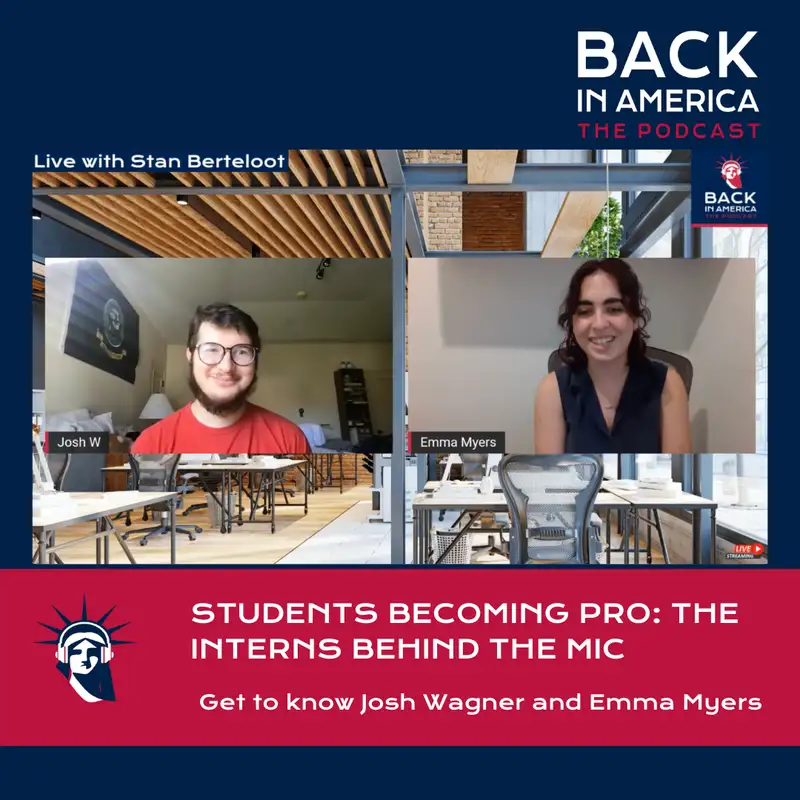
Doing a podcast can be a very, very lonely endeavour. Of course, you meet interesting guests and you get to edit fascinating episodes, but once it's published, it is only you and your screen. Rarely do you hear from your audience. So when Josh and later Emma joined Back in America as interns, I jumped at the opportunity to welcome them on board. We meet every day, sometime on Clubhouse, to brainstorm on story ideas, exchange tips on sourcing guests, interviewing techniques and editing tricks. We talk about life in general, and they get to make fun at my accent. It seems like for the life of me, I can't pronounce potatoes correctly. In this short episode, Emma and Josh interview each other and introduce themselves to the Back
in America community. The interview was recorded online and on video, so make sure you log in to YouTube or Facebook to see this amazing video interview. Enjoy. Hello everyone and welcome to this special episode of Back in America. This is Behind the Mic, and I'm Josh Wagner. And I'm Emma Myers, and we are the interns of Back in America.
In today's little episode, we're going to give you a little bit of background about who we are and why we're at Back in America. So to start off, Emma, tell us a little bit about yourself. Sure. So I'm originally from Rhode Island. For those that don't know, it's the smallest state in America, and it is the southern part of New England. So very New England-esque, kind of like a combination of Connecticut and Massachusetts. I went to college in D.C. studying politics, so I'm very fascinated and passionate about U.S. politics and international affairs. I studied psychology as well. So yeah, seems like a perfect fit at Back in America, right? What about you, Josh? Where are you from? Where did you go to school?
Yeah, so I'm from Los Angeles, California, and currently in my childhood bedroom, as you can see in the background. I'm super interested in poetry, in English, and all things humanities. So I went to Stanford, I went to Bay Area, studied English, but also dabbled in everything humanities across Finca, from philosophy to human biology to whatever else comes across your mind in art history. Yeah, that's me. I'm so interested in journalism, just why Back in America was a good fit for me. That kind of leads to my question. Those are a lot of subjects, and so which of those have you gotten to explore on the podcast so far? The nice thing about Back in America is that this is really your own project. So as long as it relates
to the general themes of identity culture in America, anything goes. So I've been able to do podcasts about transhumanism, podcasts about Judaism in America. I'm Jewish, and so that's a theme that's very close to my heart. I'm also working on a little series on poetry, which is kind of more related to my academic interests and trying to expose people who maybe don't read poetry to interesting poems that they may enjoy. For you, Emma, this has been kind of a wild year of the COVID-19 pandemic. Where are you right now? What are you up to outside of your Back in America?
Yeah, so for the listeners that don't know, I just joined, and for the first half of the pandemic, I was mostly doing advocacy work for a really great organization called Asylum Connect, and I was updating their database, trying to communicate to the people using the app which services were still available to asylum applicants. It was really interesting work. Wasn't necessarily my favorite job because it was remote and I was just calling and cold calling businesses all day. So I started volunteering for a different organization called House of Good Deeds and focusing on the environment and different kinds of ways of reducing waste, specifically in household items, clothing, and even food waste. So that's been really interesting, really passionate
actually of mine. And yeah, I've also been working with AmeriCorps, doing a year of service in a Brooklyn homeless shelter called Providence House, and within that program I'm also working with a sisterhood called the Sisters of St. Joseph, and it's a program called the St. Joseph Worker Program where we live in an intentional community. We share everything, you know, our salary, our food, our house, everything. We also share a car, which is very lucky, so we've had the opportunity of volunteering every weekend for different organizations that the sisterhood is a part of, and so I've done land restoration projects, I've done food pantry volunteer work, I've volunteered at retirement and elderly homes, I've done the food and clothing drive, like I said,
and they've just connected me to so many different programs in the city and I didn't even realize how much the New York City community really does offer. It's just been really, really great. So you know, I am working in person, but luckily I have my own office so I can take my mask off and breathe, and yeah, it's still helped in the small ways that I can. What I do at the homeless shelter is I'm an employment specialist, so I work on resumes, interviewing skills, lifestyle skills, financial literacy, things like that. Also higher education programs as well. So yeah, it's a lot of work, but I really like it, and being in COVID, I just needed to be busy, you know. That makes a lot of sense, and it sounds like you're insanely busy, like running between all these different
opportunities and jobs that you're playing a vital role in. I'm actually really curious if you could say more about being a part of that intentional community. What does living intentionally mean, both for the community you live in, but also for you personally? Sure, sure. So I didn't really know what intentional community meant when I signed up for it, and it turns out it's a lot to do with regularly meeting and actually sharing what we need in that week, that moment, whatever, in that relationship likely, and so we have meetings every Monday night, and a sister actually comes to host them for us, and this was more in the beginning that the sisters were hosting. We've now kind of taken over, but in the beginning,
they kind of guided us through opening up and sharing our needs and communicating directly to the people that we're living with what we need to feel at home, what we need to feel cared for, and it really brought all of the issues to the space, and making that time and making that space to listen and be attentive and then follow up on that and follow through with the requests that people are making or even setting a boundary of, oh, it's wonderful that you have communicated you need that, but I'm not capable of being that person to provide it. I think you need to seek support outside of the community for those needs, and that's been really helpful too. Bringing that intentionality to communication and also to the budgeting,
which was really, really helpful. We're very intentional with what we buy and how we distribute the money that we receive from AmeriCorps. We each have our own stipend, but we share it, so nothing we buy is just for us, and that's been actually a lot better, because if you buy produce and you don't necessarily have the time to eat it, you don't have to worry that it's going to rot in your fridge. Someone in the community will cook it and hopefully make enough for everyone. So yeah, it's been really, really enlightening and helpful. Wonderful.
So in your time at Back in America, have there been moments with Stan where there was kind of a cultural barrier or even a language barrier? Have you had the opportunity to maybe share your own American perspective with him, him being a Frenchman, of course?
Definitely. I think coming into Back in America, mostly knowing Americans, I had some friends from France in college, but just working with Stan, we meet every day at 10 a.m. Pacific time, and just seeing him every day raise all these kinds of cultural clashes with the vets. He's trying to say a word 10 times in a row, and I have no idea what word he's saying. I think recently the word potatoes came out super strangely from his mouth in such a way that I had no idea what was going on. So I think there were also those moments that happened just in the flow of conversation. But I think more generally about the kinds of podcasts I'm interested in pitching are relevant to America, are very different than what Stan would come up with on
his own. And I think you can see the difference between the kinds of podcasts I am posting and the ones that he ends up posting. So for example, I went to school in Silicon Valley, in the Bay Area, and so I think I have more of a tech focus. Even though I'm not really in that space, given my background, I host a podcast about transhumanism, which is the idea that humans can essentially evolve themselves through technological attachments, whether that's a pair of glasses or an extra brain. And then I'm actually now working a series on eugenics, which is again kind of in this tech adjacent space, which I think looks a little, I know it's associated with science, like World War II Nazi era science, but there are ways in which eugenics, especially at Stanford,
has infiltrated the patterns of the university as well as the way in which we think about things like class and race today. I think some of these issues that are on my mind being from America, that maybe Stan would not have thought of. And so I'm often trying to defend or explain why these questions and topics are relevant to someone who may be as close to them as I might be. History has been kind of a gateway to all of those kinds of topics that maybe the French history hasn't been touched as intimately as America has by especially eugenics and technology and all of the advances in what they cause. So yeah, that makes a lot of sense. With that in mind, what does America or what does being American mean to you?
Yeah. So it's really interesting you asked this question. So if you have one of the podcasts, this is the question that Stan or I will ask at the end of every episode. And we get wildly different answers. And so I was actually on a podcast about six, eight months ago now, and I answered the same question. And I think listening to lots of other people who approach that question, I feel my answer has changed a little bit. So I think on the earlier podcast, I said America is an experiment. It's people kind of being isolated in their own little bubbles, and they have these connections through a podcast, through a job, but really are very cut off from one another. And that America evolves over time and that it's now an imperial colonial experiment.
We're home over from Europe, but really has expanded into much more and much less than that. And so I feel like America is less an experiment than I first thought. Or I think the word experiment, I think has this connotation of like experience or empiricism, which kind of scientific philosophy where you have a hypothesis of like, what should be the case, and then you try a few things and you write your paper at the end, say, okay, it turns out all of this, no, I think you're right, all right, or all wrong. And I think America is a lot more intentional, kind of in the way that you were talking about earlier, Emma, and that like we have structures and systems in place that were designed,
not just random items and people coming together and making something just to turn it into day. I think that all of our systems and modes of life were designed at one point in time by a certain number of people for purpose. And even if those purposes have been outlived, we still have the structural systems in place. And so in this way, I do feel like America is a little bit monstrosity, where it has a sense of like, actually growing and changing, while also staying the same, like kind of the core beliefs that founded it in the first place, which includes lots of beliefs that no one I know or no one I wouldn't want to share. And I'm actually curious about your answer to this question, Emma, someone who has not listened to like, no, 20 plus of these answers.
What is America to you? Well, I hope that it evolves because I love history and love it so much. And I think I've learned so much about the 19th and 20th century that I'm still kind of catching up on the history of the 21st century, even of like, the current events that were happening when I was still kind of catching up on the past few centuries. So, you know, my answer will probably change too. But for right now, I see America as a stomping ground. And that the way that I define that a stomping ground is a place where people bring their cultures. And, you know, throughout history, people brought their cultures and maybe adapted and acclimated to the cultures that were already here. But now people are starting to really dig back into their own past and bring back some
of their ancestry and some of their culture, really trying to bring it into the conversation, into the economy, into the culture. And I think you're right, though, I think there is a lot of unspoken etiquette within this country that is expected of us. And those structures of social behavior really do help us to cooperate and to collaborate in a system that really does require a lot of individual effort. Like, people don't just help altruistically in this country as often as other places. So you really do need to work to cooperate and to collaborate and to contribute to the structures that we rely on. And that's kind of why I say it's a stomping ground because you come and you bring your skills, your passion, your culture, your ancestry to the
stomping ground and you do what you can to contribute, which I think is a really beautiful thing and probably a reason why there is so much available to us in this country because so many people are contributing and working very, very hard. I think in this country, we have some of the highest rates of workaholism, which is like a new kind of diagnostic, I don't know. But it's interesting to think about because in say the 1950s, 60s, people weren't working more than they were living. Now it's shifted where we really are working to contribute and to earn more than we are spending and living. So it's really interesting. I do think, like you said, we're a country kind of dependent on each other in that intentional way. So yeah, definitely
interesting to think about. Yeah, I just to close it out, maybe would you mind sharing some of the projects you're working on right now for Back in America? Right now I'm working on a story on the vaccine and vaccine hesitancy and just like the political connotations of that and maybe the history that's indicating certain people being hesitant, others not being hesitant, so that I'm researching that in the moment and that should be released on our sub-stack soon. And I know you have some podcasts coming out. Do you want to tell the listeners about those? Yeah, so I only have working on two series right now. One I mentioned earlier is this poetry and music series where I sit down with a friend or anyone who's interested in poetry and music and I'm like, oh, I'm going
to talk about this. And then the second series is a series on the history of the United States and America today where I sit down with a Ugenesis and activist and historian and three episodes to kind of talk about the legacy of Ugenesis today and why this is a question we're still grappling with hundreds of years later in America. So I'm going to talk about the history of the United States and America today and why I sit down with a Ugenesis and activist and historian and three hundreds of years later in America. When can we expect those? When can the listeners expect to hear either one of those? Over the summer, back in America, you should go to a hiatus. And so this summer I'm going to do a takeover of the podcast and I'm hoping to release one episode of my poetry
series every week throughout June and July. It's about eight episodes, which I'm excited about, but it is a big project. And then the Ugenesis series should be coming out in the next few weeks. Wonderful. Okay. Well, we look forward to hearing those and I guess we'll hear you then. Yeah, I think it's been great to kind of talk to you outside of our like daily meetings where I feel like it's like less of personal interaction and more like we have work to do. Yeah, it's good to get to know you a little better. Yeah. Yeah. I guess we should sign off there and look forward to hearing more from our fans. In the days and weeks to come. Yeah. If you guys have any questions for us,
be sure to leave your comments. I believe they can do that. And I believe we have an email listed as well if you guys ever want to get in touch with us. You can also find us on Facebook, LinkedIn, Twitter, Instagram, Clubhouse. We are occasionally on Clubhouse if you ever want to chat with us. But yeah, thanks again for tuning in. Bye Josh. Bye Emma.