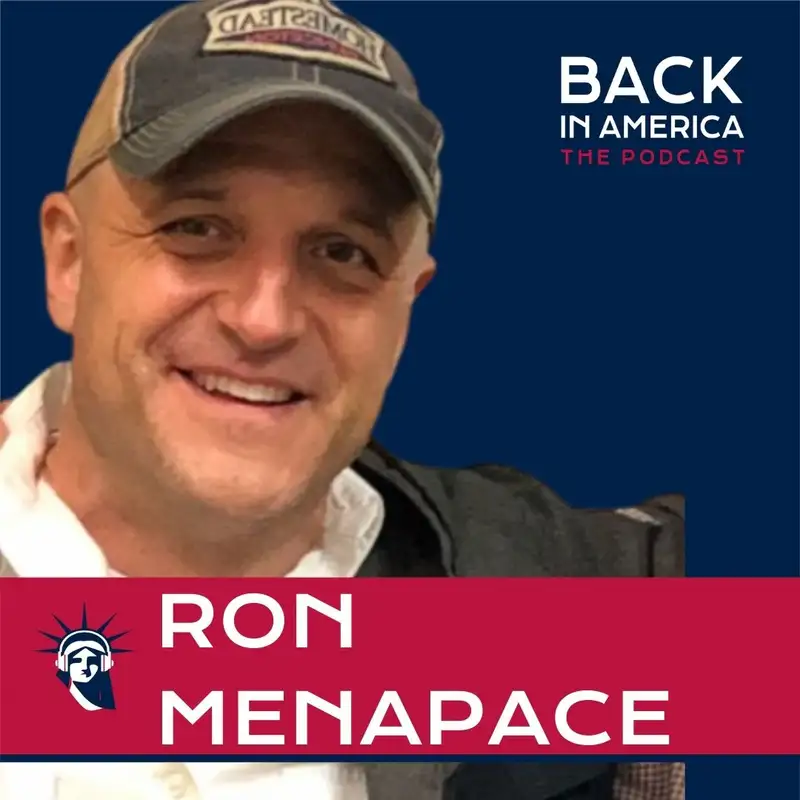
Ron Menapace - Homestead Princeton - From Pharma to business owner: Challenges and opportunities in America
If you're tired of arguing with strangers on the internet, try talking with one of them in real life.
Welcome to Back in America, the podcast.
I'm Stan Bertolot and this is Back in America. Today, I'm with Princeton entrepreneur Ron Manapase, owner of Princeton Homestead, a furniture and home decor store specialized in custom-born wood furniture located in the heart of Princeton on Palmer Square. Ron, your dad was a carpenter and after a degree in sport management, you also had a stint at woodwork, fixing and refurbishing furniture. Yet, you went on to work as a sales and a pharma corporation. Thirteen years later, however, you and your wife, Kristen, decided to follow your dreams and in 2012, you opened what is then called the farmhouse. Welcome to Back in America, Ron. Thank you.
So, would you like to add anything to this brief introduction? One of the biggest parts of my life is my family. There's really no reference to that. I've got a lovely, wonderful wife, Kristen, and four children. We live here in Princeton. Four children, wow. Yeah, it's a large family, but I grew up in a large family. It's chaotic and it's crazy and it's wonderful.
How old are they? They are five, eight, eight and eleven. Wow, twins? Twins, yeah, boy-girl twins. Congratulations. Thank you. So, yeah, you work for a very long time in the pharma industry, a job that seems to be quite remote from the world in which you grew up, right? And from whom you are today.
I'm wondering why, while so many people get stuck in the job that they don't really like, you manage to move on. I started in a pharmaceutical company in the late 90s where there was this arms race, basically, of these large pharmaceutical companies creating these bigger and more prolific sales forces trying to promote their blockbuster drugs. I was very fortunate to start with a company that was a small pharma company. We started with 50 sales reps in the entire country. And I was able to start as a sales rep and really help grow this business, help build the company and put my fingerprints all over the company itself. So I started as a sales rep, became a sales manager, started managing other sales reps and then got into analytics and then became a regional director on the West Coast where I had about 100 sales reps or so up and down the West Coast. And then there was an opportunity to move back to where I came from. I'm originally here from New Jersey.
I became a state lobbyist, so I was working with politicians and found myself negotiating contracts with both private payers as well as state Medicaid people that were on government plans. So that's what I was doing in pharma. And at a certain point we were bought out by a Japanese company. We had become a mid-sized company and the company had changed and there was a downsizing during the Great Recession. I started interviewing with other companies and realized what we had with this small pharma company and building something was pretty special. And I was interviewing with these large pharma companies where I felt like I was just a cog in the machine. I was just filling a role and it didn't feel like it was really building something. It wasn't truly integral in developing the business.
At the time, could you have seen yourself working all your life in this job or in the pharma industry or were you back in your mind thinking of doing something else at another period of your life? I could. I could imagine continuing to work with that particular company in that context, how the company was. But the company changed and we have to deal with change throughout our lives. And then when change happens, then you sit quietly and you think about really what you want to do and what you want to accomplish. There was plenty of people that I worked with that had said something along the lines of, if I could only hold on for 15 more years. And it struck me like, is that how I want to live the rest of my life, my working career at least? And so we decided we wanted to try something else and follow our dreams and we opened our own store. And we're going to come back to that in a minute.
Let's go back to your earlier years. You come from a large family. I do. You mentioned that. If you close your eyes for a minute, what memories of growing up in this family of six in Hillsborough do you have? Yeah, well, growing up in Hillsborough. Well, first of all, the large family, I'm the youngest of six. So I had five older brothers and sisters and, you know, fantastic parents.
So I had seven people and my mom stayed at home until I was probably in middle school and then she started working outside the home. But I had seven tremendous role models that I could look up to. Growing up in Hillsborough, at that point, Hillsborough was a lot of farms and fields. So we found ourselves playing in the soybean fields and riding our dirt bikes and playing flashlight tag at night. It was a pretty special existence growing up. I feel very fortunate. What kind of dreams did you have for when you grew up at the time? Well, I thought I was going to be a professional basketball player, but then reality set in and that wasn't going to happen.
So dreams, you know, I guess I think I wanted to be a sports star. OK. Is it why you studied sport management? That's why I got into sports management. That's right, in college. And what was the vision of your world or of the world at the time? You know, kids growing up in New Jersey. What was the world to you?
The world was my neighborhood, frankly. I didn't have a global view of the world. We were kind of isolated and focused on our own life. So I read somewhere that you had 14 addresses in 16 years. That's quite a lot. Well, out of college, I started working for a retail organization. And there were opportunities in multiple locations. So I started managing sporting goods stores and there was different opportunities in different stores.
And so I was basically the cleaner for this company and going and making efficient changes to all these stores. And eventually found my way out to California where I was managing two stores out there and then moved back to New Jersey. And that's when I started the former career. OK. What states did you prefer at the time? Well, I lived in Monterey, California. That was pretty special. But I also lived in Cleveland, Ohio.
That was pretty special to me.
Would you say that the culture is different from a state to another? There's no question. I've lived in, let's see, Ohio, California, New Jersey, Virginia, Atlanta. So there's no question. And it was one of the best things about traveling and moving to all these different places is all the people that you get to meet. All the different perspectives. It's fascinating. All right.
So California might be your choice. Would you see yourself living there again? Well, I've lived there twice now. And we certainly enjoyed it. But for Kristen and I, family is key. And that's why we moved back to New Jersey. And I wanted to see my kids growing up with aunts, uncles, cousins. I grew up in a large family, as we mentioned.
That was a large extended family, too. And I valued that in my youth. So I wanted to provide my children the same opportunity to really be very close with our family. So yes, I enjoyed California. But the roots are here. Yeah, that's true. And frankly, when we moved back to New Jersey, we looked all over New Jersey. And we landed in Princeton because we felt like this is about as good as it gets.
It's a pretty amazing space. There's people from all over the world here. It's just a function of the university. And as you walk down the street in this almost suburban town, you'll hear five languages spoken. That's very strange. Usually you only get that in a metropolitan city. And I'm glad that we were able to give our kids that worldview. When we were growing up in Hillsboro, we really didn't have a global view of how big this world is.
I'm glad that my kids have that.
So after college, you worked for a sports store, got to travel quite a lot, then moved back to New Jersey, worked in the pharma industry. And then this recession happened, and you and your wife decided to open what is now called Homestead. How did that happen? Why that store? So we understand why in Princeton, but why that kind of store? Well, when we were looking at different opportunities, when I was trying to figure out what I wanted to do with my career,
my brother owns a store as well. And so as I was looking at other opportunities within the pharma industry, I started talking with him and I opened up his books and determined that we can really do that. There is a market for this here in Princeton, what we're doing. And I think that was really the key driver. Like I said, we sat and we determined that there was a niche that we could fill. How did you do that? How did you determine that? Did you do any market studies?
There's really nobody doing what we do in Princeton, or the surrounding area, quite frankly, in regards to bringing some of the artists and the makers of this world, bringing it to this community. It's a community that supports the arts, which is right for what we do. We have an amazing theater, a MacArthur Theater here in town, and we have fantastic museums in town. It's people that really do appreciate the arts. And what we're doing is something that's very artisanal.
And so we saw an opportunity and we decided to take a leap of faith. So while working at Homestead, what are some of the jobs, or maybe one job, that you are extremely proud of? Well, I was showing you around here in our schoolhouse. What really drives me, what I really enjoy doing, is saving pieces of history, whether it's local or elsewhere. And some of the proud jobs that we've done has been really saving some of the artifacts of Princeton, including a mansion that burned down here in town, including some of the old spaces in town that otherwise the products and the salvage would have been lost to the landfills.
And so to be able to save some of that and then reimagine these things and build them into furniture and pieces of arts and decor that people can appreciate. Give us an example, a concrete example of how you transform an object. In that mansion that I mentioned, we went in and we pulled out a lot of the pieces, the mantles and the cloth of tubs and things like that. But one of the ones that's a project that's on our radar right now is a couple of elevator gears that we've pulled out of there that we will be taking to a welder to reimagine it as coffee tables. And these are pieces that have provenance.
These are pieces that have a history that are hundreds of years old and cannot be recreated. So as you said, we are in an old schoolhouse. This is an audio show so people cannot see it. Describe it and tell us what you are going to do with it. Well, the schoolhouse turned 100 years old this year. So it was built in 1920. It's been used as a schoolhouse and it had several other uses after the 50s. But we purchased the schoolhouse and would love to reimagine this space.
Just like we reimagine a lot of artifacts, we'd like to reimagine this space down the road. What are your influences? I mean, obviously you opened that store and it's quite unique, at least in Princeton. What do you look up to as being some of the strong influence for what you do? I think the strongest influence that I've had in my life has been my dad, who taught me the benefit of hard work and goals and modesty and family. He's by far been my strongest influence. Okay.
How does that show in what you do? I mean, obviously you work hard, but tell me a bit more. When you do something, does it happen that you think of your dad and you go like, how would he have done that? I worked with my father when he was a carpenter. I would work on the weekends with him on different projects. I didn't necessarily know I was actually learning anything. I was just there working with my hands and working with him.
A lot of clean-up work and things like that. But out of college, I was poor like most college 25-year-olds. With student debt. I found myself going to the Salvation Army and finding old broken-down furniture and realizing that I actually had some skills to be able to take it apart, put them back together, refinishing them and creating beautiful pieces. I really learned not knowing I was learning. Right.
Okay. Makes sense. For someone that walks into a homestead, especially a European like me, it looks American. I mean, would you agree that it sort of is the quintessential American home? That's nice of you to say. The comments we get quite a bit is unique, eclectic, things like that. Obviously we make furniture out of American barns.
That's a big part of our business. But we're also bringing in things from all over the world. I work with people that are bringing in pieces from Indonesia and Turkey and Egypt. So it is a bit more eclectic than just the farmhouse style. We want to meet the makers. It's probably the best part of what we do is that we get to go out, Kristen and I get to go and meet potters and glassblowers and stuff like that. Potters and glassblowers and interesting artists that see the world differently
than 90% of everybody here that we talk to and the interesting characters that are the makers of the world. So you were telling me earlier on that you can do custom work. Yeah. So how does that work? Let's say I've got a home to furnish. What would be the process? Well, we come out and we do full interior design services.
Is that the service you're from? We do. And so Kristen and I wanted to give that opportunity to everybody at a reasonable rate. The fact is we would never have an interior designer come into our house and spend $1,000 just for them to walk over the threshold of our door. So we wanted to give that interior design service and experience to customers basically free of charge. And to go in and give people ideas and give people a vision of what their home could be
and how they can live very comfortably in the space that they love. And so we do full service. It's more than just selling knickknacks and pieces here and there. We're here, full customer service. Okay. And what you offer is sustainable, right? I mean, you have a lot of reclaim wood. The store itself is sustainable in a way, I read.
Yeah, it is. We're actually the only furniture store in New Jersey that's listed on the sustainable registry in New Jersey. We are committed to our sustainable practices. And that includes making sure that our landfills are not being overrun with unneeded products and we're not cutting down new lumber to make furniture. This is all wood that's already out there and it's beautiful. I mean, you cannot recreate 200-year-old timbers
and the oxidized nail holes and all the scars and the saw marks that were evident in history's past. And you have them beams right behind you right here, these hand-hewn beams with all the scars and beauty within that wood. It's not recreatable. Right. What are some of the challenges that you've faced in the time you've had your store?
Well, right now, we're going through a period that some people are calling the retail apocalypse. There's a wide range of stores that are closing around the country. It's not just locally. A lot of that has to do with changing buying patterns, online sales and things like that. So, one of the challenges we're having right now is the commoditization of products
and just trying to find something at the very lowest price that you can find it. And that, unfortunately, ends up looking like furniture that has veneers and that is made with particle board and things like that. And yes, you can get a side table for $100, but it will last you three years and then it's disposable. So, that's one of the other challenges that we're finding now, too,
is a disposable society, frankly. It goes in fashion. You find that in what they call fast fashion now where people are looking for something on the cheap. And our products are not high-end when it comes to the expense of it, but it's all stuff that's made to last. It's heirloom pieces.
These are things that you pass down to your children. So, how does someone like you try to solve those challenges? I mean, is it a question of reinventing the customer experience? It is. It's full-service customer experience. And experiential retail is a part of it. And I want people to come in and feel like they're part of the community.
What we're doing is a bit of a dying breed where you have a local shop owner. We get that comment all the time, that it's amazing, this town needs to be filled with small businesses and you're seeing less and less of that. So, what we can do is create a meeting place, a place of comfort where people are coming from all over
and feeling like this is a part of the community. We are the living room of Princeton. Right. Is that part of the project you've got, creating more community engagement within the store or around the store? Yeah, we're very fortunate. I mean, people understand what we're doing and we're kind of a small batch and we're local.
And again, we're providing that level of customer service that you cannot replicate from a big box retailer. As you say, the society is changing, this country is changing, elections are coming up. What does that mean to you? That's a dangerous, loaded question, isn't it? Yeah, yeah, yeah. Whom are you going to vote for?
I'm not going to get into who I'm voting for, but what I'd like to see from a business standpoint is whether it's local or national politics, I'd like to see the recognition of the importance of small businesses. The fact is, small businesses represent 60% of our GDP in this country. It's a tremendous part of our overall economy and certainly hope that our local politicians will honor the small businesses of this country
and help support that. Would you have any advice or takeaways for people that are looking at creating a business here in Princeton? If somebody is going to open a business, my suggestion is make it unique, make it interesting. If you're going to try to compete versus Amazon, you're going to lose. If you can bring something new to the table,
something that this community will rally around, and there are some small businesses here in town that have thrived, and the locals will support that as long as it's something that's interesting and something unique and unusual. What keeps you awake at night? Recently? Sure.
Things like right now we're staring down this public health crisis of a coronavirus, frankly. I think about my family, that's what keeps me up at night, is the safety of my family. But when it comes to business, this coronavirus, people could self-quarantine and decide not to go out. We're seeing shortages of toilet paper and water everywhere.
So things like that, just that people are not going to be gathering downtown. This is a community that everybody does tend to gravitate towards, the downtown community. And it's... So that does... Have you seen an impact already? No, not yet.
Finally, I always ask the following two questions at the end of the interview. And the first one is, what is America to you? I mean, it sounds cliché, but it's a society of self-reliance that we can build something, that we can make something for ourselves. My family immigrated to America 100 years ago.
From where? From my father's side is from Northern Italy. My mother's side is Poland, in that area. But one of my grandfathers was a coal miner. The other was a car mechanic. And that... They instilled values in my parents. And then they then passed that along to us.
And we were able to build something for ourselves. All my brothers and sisters, I'm proud of every one of them and what they've accomplished throughout their lives. But the fact that we've started in this country with hopes and dreams and that we could build something great for our families, that's what America is to me.
Okay. Anything new that people are going to see at the store pretty soon? You know what? I showed you our bus. I hope that they can see our bus. We bought a vintage bus that we are going to renovate. I hope to see that on the streets here soon.
Yeah, in ten years from now when I see the shape of it.
I'm not afraid of projects. Good, well done. Thank you so much. Thank you for your time. Thank you for listening. If you liked this show, share it with your friends. And if you have a minute, do leave us a review on Apple Podcasts.
It is extremely important to help other listeners discover it. I am already recording future episodes. So stay tuned and see you soon on Back in America.