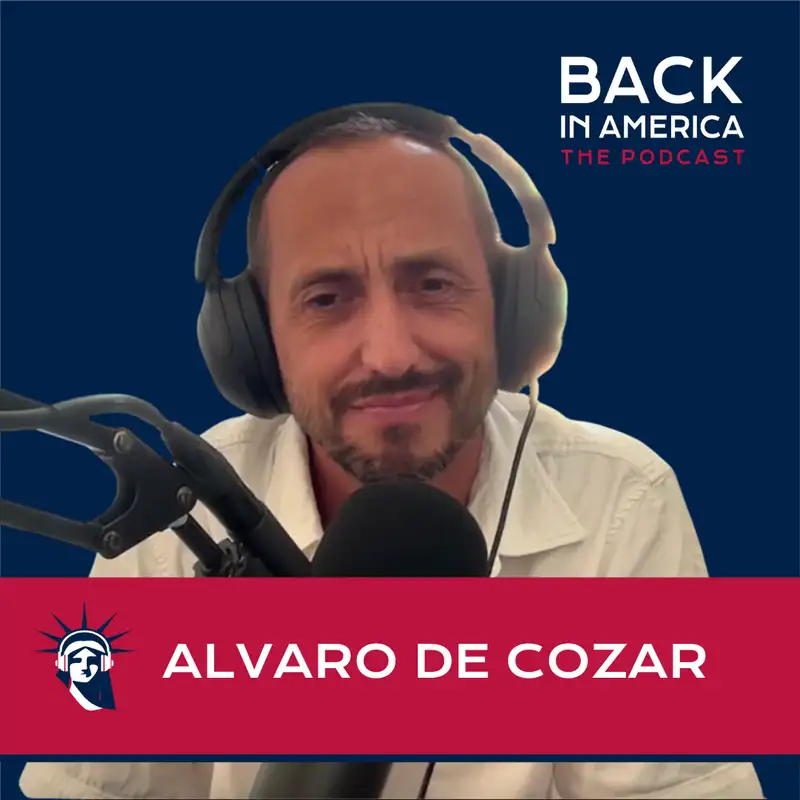
Rewriting the American Dream: Aquilino Gonell, January 6, and the Power of Storytelling -- with Alvaro de Cozar
We're going to give riot warning to prove the outrout is here. We're going to give riot warning. We're going to try to get compliance, but this is now effectively a riot. 49 hours declaring it a riot. The cops are going to be advised, they're trying to breach and get to the Capitol. Hold the line! Hold the line! Hold the line!
We have a breach of the Capitol. Breach of the Capitol to the upper level.
My kids didn't have the courage to do what should have been done to protect our country and our Constitution. Bring out peace! Bring out peace! Bring out peace! Bring out peace!
We can't hold this. We're going to get too many f***ing people. Look at this vantage point, man. We're f***ed. We're trying to hold the upper back. We're trying to hold the upper back down. We need an area for the cows and lambers. They're all walking over now through the tunnels. We need to move now. If we lose any more time, we may lose the ability to leave. So if we're going to leave, we need to do it now. We've lost the line! We've lost the line! All MPDs, come back! All MPDs, come back to the upper back!
H208 with four members. The door's barricaded. There's people flung to the hallways outside. We have no way out. Officers still remaining on the House floor. So we secured the members on the other side. Copy. Officer down! Get him up!
And if I win, I will be looking very, very strongly at that pardon. And I mean full pardons with an apology, just too many an apology.
They were peaceful people. These were great people. The crowd was unbelievable. And I mentioned the word love. The love in the air. I've never seen anything like it. USA! USA! USA! USA! USA! If you're tired of arguing with strangers on the Internet, try talking with one of them in real life.
Welcome to Back in America, the podcast.
Alvaro de Causar, you are an award-winning journalist. You live in the heart of the United States. You're a billionaire. You're a You are an award-winning journalist. You lived in Washington, DC, where you covered US politics and produced stories for your podcast. Now, back in your home country, Spain, you are leading an extremely successful podcast production company, producing, among others, True Stories, a podcast with over a million listeners. Some of the stories you are revealing are being adapted as feature filmed.
True Stories, H.O. Reales, launched last April with the story of Aquilino Gunnell, one of the United States Capitol Police officers who defended the Capitol during the January 6th insurrection. He had to learn to speak English and who pledged to defend and protect the Constitution. If you're tired of arguing with strangers on the Internet, Alvaro, try talking with one of them in real life. Why is the story of Aquilino Gunnell so important and what does it tell us about the United States?
Welcome to Back in America, the podcast. I think it's the story of the American dream. Alvaro de Causao, you are an award-winning journalist. You live in Washington, DC, where you covered US politics and produced stories for your podcast. The meaning of his life is to pursue the American dream. And once you get it, I think he does everything properly, as he's told. And once you get that dream, then suddenly, one day, you are wrong.
Some of the stories you are revealing are being adapted as feature filmed. The true stories, H.O. Reales launched last April with the story of Aquilino Gunnell, one of the United States Capitol Police officers who defended the Capitol during the January 6th insurrection. The story is the story of a Dominican immigrant, a former US Army soldier, an Iraq war veteran who had to fight to become an American. It's a story tale that should be known by everyone. I want to come back to that, but looking at the time in which we live, which is a time
where truth is constantly being challenged, AI makes deepfake a hallmark of social media. And former President Trump lied during his debate with Joe Biden last June. He said that the attack on the Capitol involved a relatively small group of people and that most of them were just, in many cases, just being hushed in by the police. In your interview with Aquilino, what does he say about this confrontation with the far-right extremists? Well, he's really angry about that. I think Aquilino, he has suffered a lot in that attack. I don't remember now the way you say that in English, but he has this kind of psychological problem
that you have after. So he has that and he has some injuries also. And he lost his job as a result of that. Yeah, finally he couldn't stay more in the police and he had to finally give up his American dream. But the thing that is more problematic for him is just reading and listening to the stories that are sold every day in the press and the ones that come from the Trump followers saying that nothing happened in the Capitol. For him, that is really amazing.
And also the thing that makes him feeling more angry about that. Yeah, can you believe? You went through that, you lived the attacks and now you've got President Trump.
I don't know if you heard, but recently he raised the rioters, calling them unbelievable patriots and saying that they were hostages and people that have been in prison because of the attacks. And he promised to pardon them if he's elected. His story is being rewritten as we speak. It's amazing. Yeah, and I think that anytime we do something and someone tells the opposite, once we know that, I mean, if I go to the moon and people say, no, you were not in the moon, you were not that astronaut, that didn't happen.
That is something that would make everyone angry and you would feel that you had the need to tell the real story. That is what Aquilino has done in his book and also in our podcast. But yeah, it's amazing. It's amazing also because we saw it on television. I mean, maybe you could invent another story if there's no proof of that, but everyone saw that attack. And we saw the thousands of people trying to get into one of the most important institutions
of the democracy in the United States, a symbol of the democracy. And that is what I still don't understand. I try to understand always the other part. I always try to say, okay, just let's put in their shoes and try to understand what they're saying. But it's really quite complicated to do it in this situation. Yeah, I wonder as an observer of the US, which historical period does this insurrection and the current time we live in with Trump rewriting history,
what does that remind you of? I think power has been always trying to rewrite the stories, to rewrite the way we confront ideas and the way we confront the facts. For example, in my country, in Spain, for years, we had with Franco, and dictatorship and facts is something that normally doesn't fit very well. But we didn't expect that in the democracies. We didn't expect that. So I think it's quite new really where we are seeing.
Also in terms of how fast the news go around the world. It's a fascinating time because knowledge and science can be spread all over the world so easily and fast. But at the same time, we have to admit that lies and fake news froth at the same speed.
That is making us just a bit confused. Yeah. So Achille, because of the trauma and the physical injuries that he endured during the insurrection on January 6th, finally, as we said, he lost his job and he decided to write a book. His book is called American Shield. And there he talks about the joys and the struggle of becoming an immigrant. He talks about his experience.
Obviously, this is the background of the book, January 6th experience. And I heard him talk during the congressional hearing. And he said, to be honest, I did not recognize my fellow citizen who stormed the Capitol on January 6th. What message do you think that Achille now is trying to convey to other immigrants and citizens who his experience? He just wants to tell his story because he knows that is the truth. He lived that.
He suffered that. He saw his colleagues, his older police, the other guys falling down in front of teams.
And he's so angry with the fact that all the people are saying that it's false, that he just wants to tell his truth. And at the same time, he believes that there are opportunities in the US for everyone. But he wants to say, this American dream you have told me, and this American dream we are still telling, it's false or has things that don't fit very well. We need to tell the truth about the American dream also. So finally, he's an American shield. Finally, he is someone who's trying to defend the truth.
And this is what he's saying to the rest of the United States. He's saying, I am an immigrant, but I am the American shield of your truth, of the truth of this country. I see. Yeah. It takes a lot of courage to do that, right? He's exposing himself, he's exposing his family, his son, his wife. Did he spoke to you about that?
Yes. We talked a lot about that. And I think he is that deep feeling he had that the very first day when he arrives to his house, and his wife sees his bones and she tries to help him. And he puts water on it and he tries to have a shower and say, let's see if I can feel better because all his body is injured and he's suffering much pain. And in that very first day, he starts to feel this anger and this thing that, what has happened to me?
I don't understand what has happened to me. And for some days, for some weeks, he tries to forget about it as many, many soldiers when they are at wars or things like that. But then he feels when he sees the news and he sees all the colleagues telling the story, he says, I have to do this. I have to go to the Congress and tell the truth about this. Finally, when he sees Trump saying false statements about what happened in the Capitol. So that's the reason he tries to convey his truth.
Yeah.
I now want to talk about your podcast. And so True Story, it's captivated the global audience. And I wonder what element do you consider essential in making a story like Akelyno's resonate universally? How do you adapt a story like that, which is a real American story, for listeners of diverse backgrounds? How do you make it universal? Well, I think it's already universal in a way.
We saw the attack on the Capitol and that is broadcasted internationally. So in a way, it is a global story. But then what you have to do is when you tell a story like this is to provide a lot of context and to say how is to be an immigrant in the US? How is to pray the Constitution of the United States? You have to provide that to the Spanish listener, to the Italian listener, or to the rest of Latin American countries. You have to tell that in order to tell a global story.
I think it's just that. And also I have the help of the Spanish language, which makes it a bit more global in a way.
What kind of feedback did you get after this episode was released?
The first feedback we had was very interesting because first of all, it was a feedback about the fact that we were just broadcasting our podcast, Echorreale. So we had a lot of people saying, okay, this is your new project and I like the first story. And we had another feedback that was just interested in this story, in this particular story. And the one that I am interested more is the feedback of Aquilino who called me. And this was quite interesting because he had already written a book.
But then when he listened to the podcast, he said, wow, this is a film. This is a movie. And he called me and said, well, are you interested in making this movie? And I said, obviously I am interested. And we are interested in True Story to make this movie. But it's a very complicated movie to make. And we would need a lot of money to make that. And well, I'm just in conversations with him to see if we can write in the future,
maybe something about this story. We are translating now the podcast into English. We are going to use my voice, my AI voice. We are going to synthesize my voice. It's already done, but we are still waiting for some details to publish that episode in English.
And I think it will have more feedback from the US. That's what we try to do, to see if finally that could be a project in cinema. Maybe. Why not?
Your talent is really to be someone that is able to source stories, true stories that are so incredible that they almost look like and sound like fictional stories. And then you have a way to narrate them in a way that captures your audience. So tell me, what makes a great story to you? When you hear the story, at what stage do you say, this is going to be an amazing podcast?
I'm looking for emotions, finally. I'm looking for emotions. I'm looking for that little secret that some of stories have that you see how this is going to connect with people. And the way to connect with people normally is humor or anger sometimes and deep emotions, like the ones you have when you are in love or the ones that you have when you are trying to solve a mystery. Those kinds of emotions of fear and love and all these kinds of emotions that are universal emotions, finally, I think those are the ones that make a story great and global. At least the ones that I think, okay, I'm interested in this and now I want to dig more on it,
to be a bit more deeper. Fascinating. So you mentioned that in this story with Aquilino, there might be a movie coming up. I also read that this is really a project of yours, right? To turn many of those stories that you've recorded into movies. What is the process? How do you go about doing that? Well, what we have is when we had the idea of writing and creating this podcast, Hecho Reales,
we wanted to have good partners in it. So we just look for the ideal partners and we find them in two Spanish production companies, Kowalski Films and Feel Good Media. So they are the ones that financed our podcast. And the agreement we have is that every story we have, every story we tell in the podcast has to be suitable for another version in cinema. So this is what we have done in the first episodes of the first season.
We have the one with Aquilino, but we have stories about mystery, about spies. We have stories about ex-former terrorists. We have a story about the war in Ukraine. We have very, very, very different stories.
The only thing they have in common is that it's like listening to a movie. That's the only thing that we try to find.
Anyone already made into movies or when is the first film coming out? No, we have started the first season this year. And the cinema industry is much, much slower than the podcast industry. So we have a couple of stories, two stories, that have received more interest from our production companies and also from other production companies that want to buy the IP or they are interested in it. But the industry of cinema is something that you build something and then finally, two years later, maybe nothing has happened.
And it depends on many aspects that you cannot control. Now the power is in the platforms. They are the ones that put the money on the stories. So they have to believe that they are good projects for everyone. But we're just trying. We're just trying. We believe that some of them could be movies in two or three years. So Alvaro, you started as a print journalist and then you started this podcast company.
What was very different to you switching to podcasts? What did you learn? What do you love about doing podcasts? And what do you miss about writing stories?
I don't miss many things from the newspapers. I just forgot that life I had. No, I haven't forgotten. And I have to be very grateful to all those years. But in 2015, when I left El País, I realized that I needed something different. And I realized that I wanted to tell long stories. I needed more time to tell the stories, to be a bit deeper about the stories where I was involved. I was the kind of guy who reported that normally wrote long articles in the newspaper.
But for some reason, I needed more. I needed to write a book. That was my idea. And finally, I listened to this podcast serial, an American podcast that everyone knows. I listened to that and I was shocked. I was like, wow. So this way of telling stories in a way that I think I can do and I think I can try to imitate. So I had a very long story about a spy in Spain.
It was very complex. I still had to do a lot of investigation, but I was going to write a book. And then I said, why instead of writing a book, why not a podcast?
Yes, I did my first podcast in 2016. It was a success at that time and there were not many listeners, but it was something underground. All our listeners, we didn't have the interest of the media or anything like that. But the podcast had like 2 million listeners after one year. So it was great. Then I said, I have to do this and I have to go on with this kind of way of telling stories. I'm very comfortable in it.
Tell me about the steps that you take when you are going to start a new episode.
We always start with an idea, with something. We are always talking to people. Me and my colleagues, we are talking to our former sources. We just say, okay, let's see each other and let's talk about anything. And when you talk and talk and talk, finally, one day you say, okay, I see something here.
And also we read a lot of newspapers and we say, okay, maybe if we tell this story in a long format, it could be interesting. So once we have decided that we want to dig into that, then we start thinking about an idea. What do we want to tell about this story? What's my idea? What's my angle? I wonder what is that thing that I want to give to the listeners? And once we have that, at least some kind of conversation around that,
then we start to make a document. And in that document, we always call it the mother document, something like that.
Once we do that, we start putting everything we have, telephone numbers, ideas, more articles, this conversation we had some time ago, this movie that is about this. And it gives us another idea about it. And once we have that document, we start looking for the interviews and we start looking for the people who are going to help us to make the podcast, to make the episode. And once we have the interview, we start writing the story as if we are writing a script for the cinema. And I always divide the story in seven parts, which is the classic arc,
narrative arc. So I start with an intro and then an insight and an exposition and then an insight in action, rising action, climax, falling action, resolution, and maybe at the moment. I always have that structure because it helps me and it helps all the people, all the writers to follow the path of the story. Don't forget that you are not writing a report, you're writing a story. It's not the same. You are not just adding information. No, you're just looking for that angle and to follow that path. I think a narrative podcast just tells one thing. And you have to go, you have to tell that one thing. And once you start telling another thing,
and also I want to describe this, and also I want to tell this, then you confuse the listener or the reader. So the secret of storytelling finally is just to show the conflict and solve the conflict. And the characters change in that space of time. So this is what we try to do. So you write everything, you write the story in the light of the angle that you want to give it. And then I guess you are going to go through the interview and you are going to just extract the part of the interview that fit the narrative as you created it. Exactly. Because normally when you have an interview with someone that has lived a very complicated story, normally they don't tell it the way you need. They
have a lot of assumptions and they think that everyone knows their story or their story before, so they don't explain the things that you need as a listener. So you have to help them to tell the story. And that is why I always use the voice of a narrator. In this case it's me, but it's not always me the one who give the voice to the narrative voice. But that is the secret, I guess, of what we do is just to help someone to tell their story. Just out of curiosity, how long does it take you on average per episode? It's quite, yeah, I think if you just don't count the days and weeks, even months, that we sometimes spend following the story, because we spend a lot of time sometimes just trying to convince someone to
give us an interview. But if you just forget about that and just imagine we have the interview and then the process of writing and recording and editing everything, I think that is for sure three weeks. Do you interview before you write the story or what happens? Normally we have an idea of the script we're going to have, but then we finally write the script after the interview. But we go to the interview with some ideas, very, very clear ideas. Sometimes we go to the person we invite and we tell them, I want you to explain now this moment in your life and what happened when someone called and what were you doing at that time? These are the kind of questions we do to them so that they can tell the story. Any project in relation to the US that you've got lined up? Well, we have a very
interesting project. The problem with projects you know is that once you talk about them, then they are not projects anymore. They're just failures. But this is so complicated. It's a very complicated issue and it's a story about Manuel Rocha. Manuel Rocha is a former employer of the US Department of State. He was an ambassador in Argentina, in Bolivia, in Chile. He has been in many, many countries in Latin America. Two years ago, an FBI agent discovered that he was really a spy of the Cuban government. He has been a spy for the Cuban government for 30 years.
It's a very, very interesting, it's still a mystery, but it's a very interesting story. He could be like the next Kim Philby. I don't know if you remember that English spy who spied for the Soviets for 30 or 40 years. I mean, he's a very famous spy. So, Manuel de la Rocha could be something like that. And my guess is that we could explain many countries in Latin America and we could explain many processes in Latin America just telling the story of this little but big spy. I would like to tell that story, but I can't say it because I believe that there are maybe 40 journalists in the US trying to get this story. So, I can't talk about that. It's not me the only one that is following it. But anyway, we'll try.
Well, Alvaro, thank you so much. My last question in this podcast is always, what is America to you? And I know you lived in the US. We spoke about that. You are covering still the US for your podcast. So, what is America to you? America to me, it's a land where you... I think it's a land of the free in some way. I think that message is sticking on the heads of the American people. And it's something that for a European, sometimes you don't feel as comfortable as you may think. I love the US. I love it. I love the stories. I love the movies. My cultural behavior has an explanation. It's the American cinema and the American novels. So, that is really something very deep in my heart and in my childhood. And when I was there in the US, especially in Washington,
DC, I was like saying, finally, I am here in this scenario. I don't know how many times I've seen the West Wing. And finally, I was there with my heroes that you can see all these sculptures and the presidents and all these things. Once you live there for some months, maybe one year, in my case, it was two years, once you are there for a long time, then you start feeling, okay, now the movie has passed. Okay. Now the movie has ended. And what do you have here? And the way the American lives their lives is not the way Europeans live. So, sometimes you feel a bit disconnected. I don't like to get the car to go for, I don't know, just for something at home when you need a lamp or something like that. You have to take the car and move 30 kilometers far
away. I don't like wandering around the streets with nothing to do or just houses, houses, houses. We, I believe in Spain. I like, the thing I like of Spain and Barcelona is that the life is in the streets. Everything is happening there. And I like just to go around and watch things. And that is my opinion really about the time I spent there. But I still love the US and I still love, and I still interested about everything that happened there. Okay. Thank you so much.