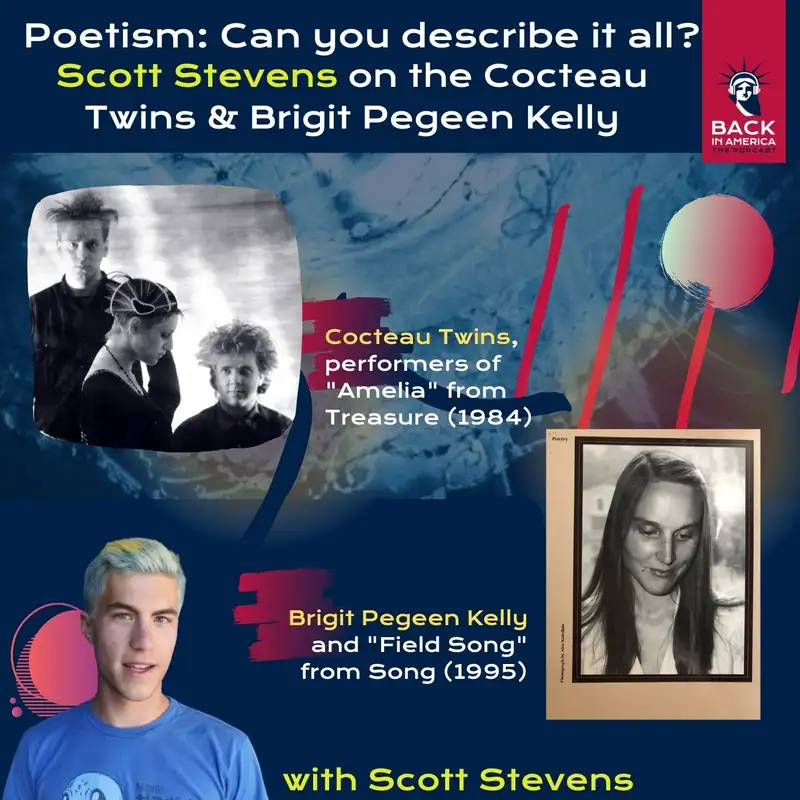
Poetism Part 7: Can you describe it all? Scott Stevens on the Cocteau Twins & Brigit Pegeen Kelly
You're tuning into the Cocktail Twins on Back in America, a podcast American culture, values, and history.
In this edition of Poetism, Back in America's correspondent, Josh Wagner, is drawn by his college friend, Scott Stevens, to talk about his correspondence and distinctions between the Cocktail Twins' ethereal lyrics and Bridget Piggy Kelly's grounded poem, Song. If you're tired of arguing with strangers on the internet, try talking with one of them in real life. Welcome to Back in America, the podcast. There is a vibration, a sonic event, a sound I want to talk about, but its ongoing movement makes its apprehension both illusory and provisional. Illusory because the thing itself is both given and withheld from view, from earshot. Provisional because it, the vibration, the sonic event, the sound, is not and cannot ever be stilled absolutely. It keeps going. It keeps moving. It is open-ended. It can be felt and detected. It remains almost obscure, almost unnoticed.
And this is for its protection. And this, its gift. So begins one of the early sections of Ashton T. Crowley's Black Pentecostal Breath, The Ascetics of Possibility, a 2016 book which traces how the how, the shout, and other non-linguistic modes of communication impossibly do communicate and form otherwise worlds of possibility. Elegies are difficult. How can we put words to describe atrocity, loss, or pay any kind of requisite tribute to that which was but no longer is? I'm Josh Wagner. Welcome to Poetism, your podcast of misplaced dreams and desires, poetry and music, forgotten happenings and newfound powers in the second or is it 57th century of the American landscape. This week, the staff here at Poetism like to think about loss, but also presence, absence, but also the distance the world from the mind. This installment, fresh from the back in American network, traces the origins and mysteries of sonic breath and a difficulty of description, not only of loss, but of and for the present. Where does breath emerge from and what does it do to us? Do meanings and definitions actually help us understand what a poem, what a piece of art or life is truly about?
Joining me to delve into the acoustic threads of art is Scott Stevens, a recent English graduate from Sanford University and soon to be Phil White Scholar. Scott once spent an entire summer working on a farm in Japan, his fluent in French and Japanese, and we first met in our freshman dorm in college. He selected both of companion pieces for this week. The Scottish band the Cofio Twins, Amelia, off of 1984's Treasure, and American poet Bridget Regine Kelly's Field Song from the 1995 collection Song. Departing from our usual American-only emphasis, this week's episode focuses on the sonic abilities of words and noise to reveal, unconceal, or otherwise elide common sense. Let's jump right in. Welcome to the program, Scott. Thank you, Josh. Super excited to be here. As he said, I'm going to be talking about the Scottish band Cofio Twins, as well as the poet Bridget Regine Kelly and a few weird poets in between. So, Josh, if you want to play the song Amelia by Cogtow Twins. Yeah. Well, actually, I'm curious, like, what about poetry really draws you in? Like when you're reading a poem or Bridget Regine Kelly's poetry, what do you listen for?
Poetry that draws me tends to have a sense of mystery. It's like, why bother writing a poem if it's like super straightforward? I mean, straightforward poems can be great, but I like, I tend to like mystery in my poems and in my music. I find it kind of funny when listening to music with other poets is they tend to look at the lyrics and listen to the lyrics and pick them apart a bit more than I do. I find that I listen to music more for the musicality and how the sound of the vocals fits with the music, which is very different to how I read poetry, because when I'm reading poetry, I'm reading for the words and it's all in my mind. I tend not to read it out loud because I'm shy and like reading by myself. But I think that'll be like one of the themes that I'm going to be talking about today is this this difference between between music and poetry, even as they might produce a similar mysterious atmosphere. Right. And I love this idea of the difficulty listening to both the lyrics and the music together and that there's like no one way to listen to music or it's really unclear how to listen. I feel like I either get distracted by instrumentals or by the lyrics and it's hard to oscillate between both at the same time. I love the song, the Cocktail Twins, because you don't have to listen to the lyrics or when you listen to the lyrics, you don't really know what they're saying. As you're telling me, like they choose lots of foreign words that maybe they don't know what they mean. Those are for their musical quality rather than some kind of overarching meaning or at least like literal linguistic meaning. Yeah, like, I don't know, maybe if I had better cognitive powers, like I could like parse both the instruments and the lyrics at the same time. But alas, I am not. I'm very impressed with people who can listen very carefully to both lyrics and instruments.
But the Cocktail Twins, you don't have to worry about that because they are not trying to really create straightforward sense with their lyrics. Well, so I can get into a little bit of what makes these this band unique. So this band was created, I think, in the early 80s. They became very active in the early 80s with band members from Scotland. So we had Elizabeth Fraser, who's the lead vocalist, Robin Guthrie, guitars, bass, drum machine production, and Simon Raymond, who I think came later and did bass, guitars and piano. So their style is said to be very much like part of the dream pop genre, also called shoegaze sometimes, slightly interchangeable. And these are kind of also said to be sub genres of alternative rock and psychedelic rock. I love psychedelic rock generally as a genre, but this group kind of took some of the features of psychedelic rock to the next level. You have Elizabeth Fraser's ethereal obscured vocals. You have many layers of distorted guitars with flanging effect, which is when you have two copies of the same signal, one delayed and creates this whooshing effect, kind of like a plane going over by. And yeah, so it's a sense of everything melding together. The music becomes very atmospheric, the vocals become very atmospheric, and you're not necessarily supposed to make sense of the lyrics apart from their sound. Right. And it feels very much like a soundscape, like you're being thrust into an experience that where you're not quite sure what to make of it. And the experience of listening to the song is almost like exploring a new world. Totally. Yeah, that's a great way to put it. Definitely.
I think one thing you might get into later is about the more experience of listening to music, which overtakes your whole body. We have all this language of both like consumption, but also like the meat sound waves wash over you and you're like interactured by it. I don't often tap my foot to music, but I will think I tap my foot to the cocktail twins music, but often even whatever I hear in Starbucks or on Spotify, I'm always moving to it in some way. Whereas with poetry, you know, it's on the page, it's silent unless you're reading it out loud. Yeah, definitely. It's interesting because I think poetry is often read silently today. Obviously, there's so many exceptions with spoken word and people just simply reading to each other in that old tradition of reading out loud. But yeah, I think I think you're definitely right in the sense that we expect music to take over us in a way that which isn't always I think poetry can take over our mind in a way that music doesn't always, you know, in ancient times, poetry was always often used as a memory tool to memorize different facts about the world. It was a way of thinking through things and thinking very logically through things, which I don't know if people really expect that of poetry. Nowadays, we have modern printing, which we have like lots of ways to store information. We have now prose narratives to give stories, which poetry used to do quite a bit. Whereas I think now, you know, a lot of poetry does give this soundscape, dreamscape atmospheres. I certainly look for that in the poetry I seek out, but I think perhaps many other people also do.
So there is a way in which poetry has been almost refined to try and do some of the similar kind of overtaking the self that music has done for so long. I don't know if this makes sense. I don't know if it's accurate, but this is my sense of how things have gone about. Yeah. And so I'm really curious what you want to get out of a poem. Not that there has to be some kind of like utilitarian, I need to have an experience when I read a poem, but you're talking about this, a sense of like leaving yourself. And so is that like a state you often find yourself in when you're reading poetry? I often find myself definitely entering some kind of different world. And I think that different world is the world of the poet that has written the poem. And I think we all have different worlds inside of our minds with many different, I mean, people often compare poetry to houses with rooms and various things within it. And I think, yeah, I think we have different chambers within us, within our like souls. And entrance into other people's souls is often through reading their poetry. I try to feel when I feel like I'm really reading poetry, I'm really feeling it is when I feel like I've entered into somebody else's world.
And other people's worlds may seem fairly familiar, may seem fairly colloquial in every day with its own type of beauty. But I think it's most noticeable for me when there's a sense of alien otherworldliness. Yeah. And something angelic to it, which is what we'll see with Bridget McGee and Kelly.
Speaking of other worlds, we will dip into Amelia.
Oh, oh, oh, oh,
oh, oh, oh, oh, oh, oh, oh, oh,
oh, oh, oh, oh, oh, oh, oh, oh,
oh, oh, oh, oh, oh, oh, oh, oh,
oh, oh, oh, oh, oh, oh, oh, oh,
oh, oh, oh, oh, oh, oh, oh, oh,
oh, oh, oh, oh, oh, oh, oh, oh,
oh, oh, oh, oh, oh, oh, oh, oh,
oh, oh, oh, oh, oh, oh, oh, oh,
oh, oh, oh, oh, oh, oh, oh, oh,
oh, oh, oh, oh, oh, oh, oh, oh,
oh, oh, oh, oh, oh, oh, oh, oh,
oh, oh, oh, oh, oh, oh, oh, oh,
oh, oh, oh, oh, oh, oh, oh, oh,
oh, oh, oh, oh, oh, oh, oh, oh,
oh, oh, oh, oh, oh, oh, oh, oh,
oh, oh, oh, oh, oh, oh, oh, oh,
oh, oh, oh, oh, oh, oh, oh, oh,
oh, oh, oh, oh, oh, oh, oh, oh,
oh, oh, oh, oh, oh, oh, oh, oh,
oh, oh, oh, oh, oh, oh, oh, oh,
oh, oh, oh, oh, oh, oh, oh, oh,
oh, oh, oh, oh, oh, oh, oh, oh,
oh, oh, oh, oh, oh, oh, oh, oh,
oh, oh, oh, oh, oh, oh, oh, oh,
oh, oh, oh, oh, oh, oh, oh, oh,
oh, oh, oh, oh, oh, oh, oh, oh,
oh, oh, oh, oh, oh, oh, oh, oh,
oh, oh, oh, oh, oh, oh, oh, oh,
oh, oh, oh, oh, oh, oh, oh, oh,
oh, oh, oh, oh, oh, oh, oh, oh,
oh, oh, oh, oh, oh, oh, oh, oh,
oh, oh, oh, oh, oh, oh, oh, oh,
oh, oh, oh, oh, oh, oh, oh, oh,
oh, oh, oh, oh, oh, oh, oh, oh,
oh, oh, oh, oh, oh, oh, oh, oh,
oh, oh, oh, oh, oh, oh, oh, oh,
oh, oh, oh, oh, oh, oh, oh, oh,
oh, oh, oh, oh, oh, oh, oh, oh,
oh, oh, oh, oh, oh, oh, oh, oh,
oh, oh, oh, oh, oh, oh, oh, oh,
oh, oh, oh, oh, oh, oh, oh, oh,
oh, oh, oh, oh, oh, oh, oh, oh,
oh, oh, oh, oh, oh, oh, oh, oh,
oh, oh, oh, oh, oh, oh, oh, oh,
oh, oh, oh, oh, oh, oh, oh, oh,
oh, oh, oh, oh, oh, oh, oh, oh,
oh, oh, oh, oh, oh, oh, oh, oh,
oh, oh, oh, oh, oh, oh, oh, oh,
oh, oh, oh, oh, oh, oh, oh, oh,
oh, oh, oh, oh, oh, oh, oh, oh,
oh, oh, oh, oh, oh, oh, oh, oh,
oh, oh, oh, oh, oh, oh, oh, oh,
oh, oh, oh, oh, oh, oh, oh, oh,
oh, oh, oh, oh, oh, oh, oh, oh,
oh, oh, oh, oh, oh, oh, oh, oh,
oh, oh, oh, oh, oh, oh, oh, oh,
oh, oh, oh, oh, oh, oh, oh, oh,
oh, oh, oh, oh, oh, oh, oh, oh,
oh, oh, oh, oh, oh, oh, oh, oh,
oh, oh, oh, oh, oh, oh, oh, oh,
oh, oh, oh, oh, oh, oh, oh, oh,
oh, oh, oh, oh, oh, oh, oh, oh,
oh, oh, oh, oh, oh, oh, oh, oh,
oh, oh, oh, oh, oh, oh, oh, oh,
oh, oh, oh, oh, oh, oh, oh, oh,
oh, oh, oh, oh, oh, oh, oh, oh,
oh, oh, oh, oh, oh, oh, oh, oh,
oh, oh, oh, oh, oh, oh, oh, oh,
oh, oh, oh, oh, oh, oh, oh, oh,
oh, oh, oh,