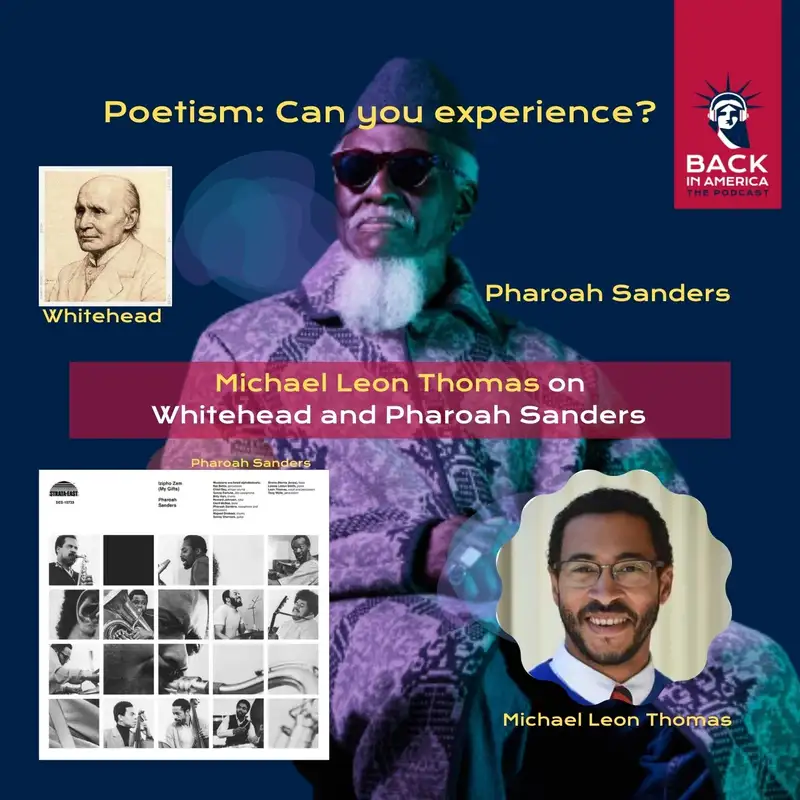
Poetism Part 6: Can you experience? Michael Leon Thomas on Whitehead and Pharoah Sanders
What you're about to hear is a sacrilegious cut of jazz artist Pharaoh Sanders' Izzy Faux Zam off of the 1973 album, also called Izzy Faux Zam, that was actually recorded in January of 1969. That's I-Z-I P-H-O Zam. I don't think I can adequately deliver a thick cut of the 28 minute composition, so I spliced together the last few verses with the opening remarks. It suggests and hopefully entices you, the listener, to locate a higher quality recording than this compressed podcast can hope to offer. And now, on to the main event.
In a departure from our usual programming, Poetism invites philosophy professor Michael Thomas of Susquehanna University to talk about the interrelation between Alfred and the
Faroah Sanders Rokos compositions.
Welcome to Poetism, a weekly summer shelter on the Back in America network, your podcast delivering hard-hitting questions about the state of the American experiment through its culture, values, and identity. As always, I'm your host, Josh Wagner, and this week we have a singular episode of Poetism for you all. And by we, I mean myself and this week's guest, Professor Michael Leon Thomas of Susquehanna University, an interdisciplinary philosopher of race, hip hop, James Baldwin, experience, and everything I don't have the space here to mention. We've combined Faroah Sanders' track with Alfred North Whitehead's postscript to his 1938 book, Modes of Thought, in a section humbly titled, The Aim of Philosophy, which suddenly or rather overtly undercuts the book's directives in defining thought precisely and clearly. As Michael makes clear in our time together, everything you think you understand about Whitehead quickly transmutes and changes form, especially in his odd turn to phrase. Over the next hour or so, we'll be thinking together about the experience of listening to poetry or music or philosophy, its potential to re-enchant the mind, if not the spirit, and the difficulty of rendering experience in words alone, or the arrogance in believing that such a task is ever fully accomplished. But I've said too much already. Welcome to the podcast, Michael. It's good to have you here. Hi, Josh. Thank you. It's good to be here.
Yeah, definitely. And I guess before we get too far into philosophy of the music, I'm really curious, how do you listen to music? What do you do? So it depends and it changes. When we were talking in the lead up to this, I realized my music listening has changed, especially during the pandemic when there's been different periods. So a lot of what had happened over the past few years is there was a lot of listening to music in the morning as a way of building atmosphere and waking up into a particular kind of character that I wanted to be during that day because I was teaching and really tired. It was horrible. In the past year, music has played a lot of roles. So like, especially during the summer last year, and I think I talked to you a couple of times, like I had close to a nervous breakdown, right? And a lot of going through that was I ended up listening to a lot of hip hop and listening to a lot of hip hop because it's therapeutic. There's a way of both having poetry and rhythm and a kind of reflection on the experience that when I was isolated in Paris during all the things that were happening in the U.S. kind of pulled me back in the community a bit to get me settled. And then what I started to notice towards the end of the year is like that then became how I listened to music, which meant I listened to less music because at a certain point, if I was listening to it but not listening, I wasn't getting what I needed from music. So I did a lot of work in silence for a while. And if I wanted to listen to something, I would have to force myself to, we're stopping now, we're going to turn it on, and we're just going to listen to someone actually do the poetry because if I'm not listening now, I'm not doing it justice.
Like it put me back into that mode again. A lot of what's been going on now, and this is kind of why I wanted to think about and talk about Pharaoh, is I've been kind of getting back into how do I reorient myself spiritually in the middle of all this? And especially doing a lot of thinking about African American spirituality and African American religion. Pharaoh is really good for that. And I think we'll talk about this too. There's a psychedelic vibe, but there's also a kind of a religious mystical vibe to it. What he's, it seems like he's trying to do with music that fits this purpose. Pharaoh Sanders is actually really great for yoga. And it's been for the past few days while I've been getting ready to talk to you, like I wake up, I get my cup of tea, I try to put my phone down. So because I've been waking up and like Twittering hecticly, even though I don't even tweet, I'm just like scrolling and like listen and have Pharaoh time before I like start to work. And that's been kind of a godsend. Yeah. Has it changed the way you like live your everyday life even for a few days? It really does help. And it's one of those things where like I think what's difficult for a lot of folks about religion is it involves a certain type of discipline and it involves a certain type of intentional practice. And one of the things that I've been struggling with, and I think a lot of people struggle with, especially when we complain about what the phones do to us or what like capitalist work rhythms do. When you wake up, you're already programmed to go about your day at a certain clock on a certain way. So it's like I wake up, I have 20 minutes to eat breakfast. Once I'm done eating breakfast, I probably have a ton of emails, so I have to get to the computer. So there's all these things that are waiting for you. So you wake up with all of that stress. So like I laugh now because my wife and I wake up in the morning and she's like straight up like, I'm like, I'm like, I'm like, I'm like, I'm like, I'm like, I'm like, I'm like, I'm like, I'm like, I'm like, I'm like, I'm like, I'm like, I'm like, I'm like, I'm like, I'm like,
stretching and moving. I told her she makes sounds that like I imagine that cartoons make and I didn't know that people did that because I wake up and I'm like, let's go. And like, I'm ready to like be snarky, make comments. I'm already like rationalizing, which is a terrible way to wake up. Like, it doesn't make you very nice. What I especially noticed this morning since I'm behind on a deadline and there's like the eight tasks that I'm trying to juggle through my brain and like the outline of a paper that I should probably just write down is like I sat, I had my Pharaoh time and you can kind of feel the more that you don't engage in that reflex action of going to the phone and then starting to write and starting to do the email. It happens to me both the brain relaxes and then like blood pressure goes down and you calm down. And it's a good way of kind of grounding yourself, I think is the language we've been using a lot like you can center into your day because you've already sort of broken that pattern. Yeah, that's great. I guess the other part of the question I want to ask about is philosophy. And this is a total cop out question. But why are you a philosopher? Why is we talking about other things like music, cosmology, spirituality?
There's like a bunch of different answers to that question. And like one of the reasons I'm taking this time to think about intention a lot now is I'm noticing a lot of the things I've done, I've done because this was I think this is like most people like you make choices when you're younger or throughout your life without really making a decision. It's just like, Okay, no, this is cool. I'm going to do this. And philosophy at a certain point felt like one of those things. So I've been trying to figure out like, why the hell am I doing this, especially now that I'm a professional philosopher. And if you know people in academia and people who are professionals, we all do this thing. We're like, why am I doing this isn't what I signed up for. I'm teaching I'm administrating my job is to go to meetings like why what am I doing this for. So philosophy for me has been a way to try to engage with reality. I think it's on a level that I want to engage with it at if that makes sense. Because like I started off and I mean, this is it's cliche, like I was in high school, we had a philosophy unit in English class. So I did like a report on Heidegger. My friends were really in the nature and existentialism. And like I was in high school debate, which is weird to think about now because it's I went to like debate camp for one summer and and now I'm like, okay, so we were basically being radicalized by a bunch of UT often leftists to like go back and argue with libertarians. But we read a bunch of Foucault. So like half of this was like you're reading a bunch of Foucault and cutting out articles and like putting together Foucault arguments to argue against policy people. And even in debate, I liked doing critique debate is what we called it doing philosophy debate in the middle of a policy round, because it was a way of not engaging on the level of like what these policies were. Because really, the policy debate portion of it was I'm going to argue that there's this problem. Here's a plan. And now I'm going to read a whole bunch of different arguments about why this solves this plan. And there's no logical connection between it. It's just an argument structure. So half of the fun I think of critique debate was you got to think about this on the level like, why are we even talking about this on this level? Like what the fuck is juvenile crime? Why are you defining this rather than kind of taking those assumptions for granted, as I've gone through school, like having that grounding in philosophy is I think it fits with my desire to think about what we say and how what we say changes what we do. And we can talk about that in connection to Whitehead. Philosophy itself has a way of kind of boundary policing in some really unhealthy ways. But if you take it for what it is, which is like, I've just been doing a bunch of analysis and reading the history of ideas, then I think you can kind of contextualize and historicize what you're reading and all of these different disciplines and then do some thinking on like, so how does this all work together? And how when I'm done with this, can I still be a functioning person that doesn't feel trapped? When I'm doing the philosophy of race stuff now, too, I've been thinking about this and like black studies does a lot. It's like, so what do you do to get out of the trap of seeing yourself in this way or feeling like humanity should be in this direction and you are now excluded? And if you are excluded from that concept, how do you live alongside of it in a way that becomes I think a really important question. Yeah, and I guess my follow up question there is another like very centralizing one. How is philosophy allow you to listen to music? I think part reason why I'm asking questions is that I know you care a lot about experience. And so I'm really curious about how these two experiences you've had with music and with philosophy might like gel together or maybe the other way phrasing is how you listen to music as a philosopher.
Yeah, so there's a part of me that thinks I do it really badly in the sense of I finally started. I decided I wanted to start doing aesthetics. So I go to aesthetics conferences and I realized that there's a vocabulary for talking about this stuff that I just don't have yet. I didn't formally study aesthetics in graduate school. So there's like a lot of work that I have to do to translate what I'm seeing and hearing both into like the vocabularies of the genre and the type of art I'm engaging with and also like what people are talking about when they talk about it. I think I'm doing it right. When I wrote the Kendrick Lamar
paper, for example, like that was me just listening to an album on repeat forever and just talking about what I was hearing and trying to figure out how what I was hearing was affecting my sense of what's happening in this song. So thinking about what Kendrick is doing as a work of art, because everybody talks about how like Kendrick Lamar is music is really cinematic. It's like, but how tell me how it works. And once you dig in, like in the lyrics and the music in the structure of the album, like he really is creating a world that's going to last 12 tracks. And tell a story and essentially sit here as a standalone until he does it again with a different period. Right. So there's even an evolution between the albums to where Kendrick tells a couple of stories that kind of position him as an artist and a person. And then like the later stories are like, all right, so now that I did that, like to pimple butterflies, like, so this has been really crazy. This whole being an artist thing and straddling between being this famous person while also being a regular person who is from this neighborhood. I have to figure out how to deal with that. And this is driving me nuts. And like that becomes the theme of an album. So that's what I'm doing. So there's the one level and there's the way that then I kind of engage with music on the level of how my experience aligns with the experience of the artist. I always talk about the pimple butterfly because that's actually my favorite Kendrick album. Because as I think, especially a graduate student and an early professional, like the type of madness that happens in the middle of that, I've had those moments on more than one occasion. I was like already kind of an anxious kid because I was a little too smart. And you get weird. But then once I got into graduate school and this has happened again, even like last year being a professor during COVID was weird because I was like, oh, I get class consciousness now. I am not in danger. I'm so afraid of being the person in danger, but I have a job that puts me out of what the fuck happened. When did this happen? Right. And it's been a moment of understanding Michael Thomas from Shreveport who lived on this particular street and had these experiences. And now it's like, I live in Berlin. What's going on? So like trying to piece those two persons together and having that kind of struggle has been something that's that'll keep me listening to Kendrick. So I think where the kind of philosophy and music and the experience part meet there is there's a sense in which what we're doing, which experiencing and this is where my research I think comes in, is you're engaged in an aesthetic process, right?
The world is being constructed for you through the way that you talk about things, the way that you see things and really how you feel yourself to be embodied. And there's a way in which you can very easily take that for granted and go along this track. But when something goes wrong or people say there's a few African-American philosophers who will say like sort of what gives a particular African-American philosophical disposition is that you've been forced to think critically about things that other people take for granted because you realize there's a certain illusion in it. And there's something that they're not seeing and you're seeing. So you have to learn how to kind of square the circle of these different logics where a lot of people can just live in a particular logic. That becomes a part of this experience of then. So then how do I construct myself? How am I composing an environment around me that fits this way? And I think music does that too. So to hear, to think about how those little pieces work together to create holes, which I think is what philosophy is supposed to do and make meaning whatever we can try to figure out what we mean. I don't know what I mean unless they meaning, but that seems to kind of be where music and philosophy are aligned. Yeah. So actually, maybe this is a good like almost segue into the Whitehead thinking about the experience of listening to music in a way in which what you do for life squares the way with what you're thinking about and what's in your head at any given time.
We were thinking about this is one really short and weird essay called The Aims of Philosophy, which really kind of sketches out what it means to do when you're doing philosophy. Yeah, I'm trying to remember how to introduce this essay because it's a weird one because it's the epilogue to this book called Modes of Thought, which when I was working on my dissertation of on Whitehead after reading all of these Whitehead books, I was like this one to me seems the simplest. I don't know why, but it seems to be the simplest. And I would say that to other people who'd read Whitehead and they said, no, this book is insane. What brought me to do this one, and this is something we'll talk about, right, is he finally says in a few spaces in this essay sort of philosophy is akin to poetry and he starts to flesh that out. And he's been hinting at it through the entire book. He's been sort of setting you up for this. So I think that's one way of introducing it. And just to give my plug for the book and why I think it's really good is sort of what he's doing poetically, right, is if you read something like Process in Reality, he set up this really complex cosmological system with all of these categories.
And you sort of get to what he's trying to say at the end, which is like there's a way of understanding the world in terms of language that breaks everything down into categories. And you understand its structure and you end up in a system of nature that's basically dead and mechanistic. Or there's a way in which you can understand interactions that have this rational structure, but always something happening that you haven't gotten in the structure. And that's where the magic is. So if you can think in that direction and kind of always be both opening your awareness and willing to be aware to feel things rather than to categorize them, we can flesh out why that's important in a second. That's when you can exist actually in a living nature in a living world. And that's what philosophy is meant to do is sort of put us in that position relative to other stuff. Yeah, and sort of this dual emphasis and philosophy towards both speculative reason versus definition. And I know if you want to read that first quote I put in the chat. Oh, yeah, there's a moment here where I love these quotes, but I keep remembering he might be kind of a jerk. And I'll explain that in a second. And yeah, so he says, but the philosopher, as he argues from his premises, has already marked down every word and every phrase in them as topics for future inquiry.
No philosopher is satisfied with the concurrence of sensible people, whether they be his colleagues or even his own previous self. He is always assaulting the boundaries of finitude. And there's a yeah, this concurrence of sensible people thing. There's a reference earlier here where he talks about how he's recoiling at a bunch of people who are on a trip together and look at a mountain scene and say, how pretty is though like that exhausts the scene and like all the things that are left behind by that statement. So I think he's being kind of glib, but it's also a way of showing how our ways of expressing things leave so much behind. And I like this quotation too, because it's also it gets at that tension in the philosophy, right? And he sets it up as a dialectic. And that's how we're talking about it. But like he does both. So like before he starts to do speculative metaphysics, Whitehead's a logician. So like one of the problems is he and Bertrand Russell write the Procipia Mathematica and they finish and they go, OK, so we can't break it all down into a logical system. There is no perfect system. Well, shit, what do we do now? And this is sort of his way, but he's always committed to the principles and the propositions that we create have to be logically coherent and rationalizable and clear. It's just that they're not definite. So I like this because while it is sort of glib, right, it's always its philosophy. Then not as a way of thinking in the sense of here is my system and here are the principles for how to think. But philosophy as a way of thinking insofar is it's it's an activity that's always self critical and always expanded. Right. It's still kind of violent here. It's an assault on the boundaries of finitude.
It's not something abstract thing you do in your arms here. It's you're in the trenches now. Yeah, that's a good pick up on the language, too. And that's another that's another one of his own poetic techniques where he'll always have these sort of provocative statements in the middle of something that should be romantic. Like there's a certain section in process and reality where he's talking about different life forms and different life systems, all connecting to one another feeding. And it has this idea of symbiosis. And he's like, oh, yeah, it's like all life is robbery. And you're like, wait, what? And like, he just broke it. But there's always then that kind of dualism of something that we would call moral or ethical that's at play. There is going to be beauty. But this is also a very violent situation we're in. And how we handle that is also a question that you have to walk through. Yeah. And also something I like, limitations of language at play here. How do you say what there are no words for his poetry must be felt before can be understood. There's no reference to like, then speaking with that experience was. Yeah. I mean, maybe do you already the second quote? Okay, yeah. So this is actually a useful one, too. I'm going to try not to ramble on this one, too. But there's a Peewee secret word in every book for me. And this is mine's in this one. Does philosophy is akin to poetry and both of them seek to express that ultimate good sense which we term civilization. In each case, there's reference to form beyond the direct meanings of words. Poetry allows itself to meter philosophy to mathematic pattern. And this one can this one always throws me in a tizzy. It's bad enough that just use the word tizzy. What was the start is to meet that word civilization, which I think you were for Whitehead and I think comes out of nowhere about knowing that could tell a little bit about what is civilization. Yeah, and let me get my I got to get my timeline right again, because I think modes of thought comes after adventures of ideas. But yeah, civilization is a big word. And it's the one that if I can get you if we can just keep talking about traumas from our childhood. That was the part of the dissertation where I just sort of lost it. And that's the fixated on this concept because he ends adventures of ideas with this notion. And adventures of ideas is a weird book because he goes back to doing a kind of intellectual history where the first section is sort of sociology. So he's tracing the first section of the book.
And he's just trying to flesh out with those terms, which means there's like on the level of truth. There's a certain way of identifying things in language that should be definite. But then that expression, and this is the beauty part, right, should be both broad enough and deep enough to create contrast so that it never feels settled. So thought should always be sort of unsettled in a certain way. And that's where the artistic process comes in. So what you're doing is you're fitting language to experience in such a way that it sort of pushes things forward. So good civilizations, civilizations that are thriving are ones in which you have a lot of creative adventure and decadent civilizations are one where the meanings become fixed. Because when meanings become fixed, they become more of a value and it just becomes repetition. There's no liveliness in that. So it just things civilizations seem to crumble and die at that point. And then the one about peace is just it relates that moral blip I had just a second ago of like sort of how you then balance what's gained and what's lost in any one of these transformations. But that becomes it right that civilization is just a way of trying to balance that. So one about peace is just it relates that moral blip I had just a second ago of like sort of how you then balance what's gained and what's lost in any one of these transformations. But that becomes it right that civilization then is a kind of it's a it's a process that he calls it an ultimate good sense is really interesting. When I'm going to have to stare at that for an hour one day. Yeah, and so I guess the place maybe I want to kind of end our discussion of Whitehead is how do we get from civilization to meter into mathematical, mathematical pattern, which seems to be a little leap year, but is poetry for you or for Whitehead like a way to like hold open possibility about deciding. Well, that's the thing is like so like one of the hard things with Whitehead right is I'm using a lot of words that sound normal, but they're not and that's sort of the poetry of it. So when I say like a society, everything that endures over time is a society for Whitehead. What's ultimately real is experience or just occasions of experience. So what a society is, is an actual occasion of experience that holds a certain pattern over time. So like at this point, right, he's not even talking about an object. So if we think on the level of like American society at that level of abstraction, right, there's a certain sort of structure that society that's built into laws built into human habits. And I would say that there's even to like borrow a phrase from Baldwin, like a certain sense of reality in America that would be different when you go somewhere else, right? That's why we have culture shock. It feels a certain way to live somewhere. I think that's one of the things that's going on with society and civilization, man, because like right above that, he says something really interesting. Philosophy is mystical for mysticism is direct insight into depth is yet unspoken. But the purpose of philosophy is to rationalize mysticism. Not by explaining it away, but by the introduction of novel verbal characterizations rationally coordinated, right? So that's the contrast in civilization thing that we were talking about. So but you were asking about meter and mathematic pattern. I think that's what's interesting. That's what threw me was like this throws me into a tizzy. I was like, no, that's not what I was expecting him to say because he's not juxtaposing two different types of philosophy anymore, speculative and kind of analytic. He's opposing philosophy itself to poetry and saying that they're working together. So I think the connection to philosophy and mathematic pattern is that it's not just about the way that we think about it.
The way that we think about it is that it's not just about the way that we think about it. It's about the way that we think about it. It's about the way that we think about it. And so I think that's the difference between the two. But what's interesting with poetry and meter, right? Is in like, so then what's the function of meter and poetry besides its rhythm, its flow, and it's I think how the words then align themselves to a kind of an experience, right? Which I like because that's one of the things that's fun about Whitehead. If you think about Whitehead in music, he seems to be breaking down this classical dichotomy between music as emotion and lyric and literature. It's this kind of rational thing. Like you didn't need it where he's like, but the problem with tragic poetry is we got away from the death around and we started doing these long orations and that just ruined the entirety of Greek society. He's like, no, I mean, you do both. Like there's poetry in the argument. It's just maybe you didn't like it. Maybe it wasn't your genre, but like it's okay. It's still it's just the way that you think about it. It's a different form of civilization and it's a different form of words. I think that's really interesting is there like that's their symbiosis. So it's another thing to stare at for three hours.
Yeah, maybe actually this is a good time to transition over to Pharaoh Sanders. One thing is how do we get from Whitehead to Pharaoh? He's like, I just want to get to the end of the story. I want to get to the end of the story. I want to get to the end of the story.
I think the ideas about philosophy, the faculty of thinking, rational logic, experience that can't be quantified or expressed in language are at the heart of both of these thinkers or writers, artists. How would you first encounter Pharaoh Sanders? Like why is it someone who you were coming back to in 2021? Yeah, I was going to start there anyway because that's there's so much stuff. Typically I just like I keep saying like I follow where I get led. Pharaoh Sanders is like the big jazz great that I've seen. I got to see him when I was in Paris in 2016 and the first two chunks of that show are on YouTube. But it's a weird thing to watch because it's from an angle close to the stage and I was sitting in the back. So it's really hard to draw memory from it just because the position of where I'm looking at it is different. So like as I was watching it, my brain was trying to transpose me. I was trying to draw memories based on like where I would have been sitting to kind of remember it. I'd been to jazz concerts before, but that was the first time seeing like a real living like living legend at this point. And even in that concert, I taught a lecture off of that concert once I started my job that fall off of the creators as a master plan. Because we were doing in a section on religion in my 101 class and the kind of glib question that in hindsight is sort of feels sort of goofy, but I think is important is like you're watching Pharaoh Sanders play music which is inspired by African and Eastern whatever Eastern means. People use this term and they don't get to the specifics of the source of this music. And they're really into it. So it's like, so if you're really into this, what does this mean for you right now? Because this is actually against your way of life and what's then being communicated through the music. And that really appeals to me as somebody who I wouldn't say I'm aligning myself with like a re-enchantment of the world because that's a way that some people talk about what Western society has done to us, whatever that means. But that one of the things that the type of music that's really like a re-enchantment of the world is that it's like a way of communicating with the music. And that's what I think is really important is that the music that's really appealing to me as Pharaoh's doing is he's making cosmological music. It's making music that appeals to what people would call psychedelic, but that's again another form of getting into the mystical of the religious. And I think it's important because that taps into a way of feeling on a cosmic level, feeling things ultimately, feeling things in a way that feels foundational and grounding and over-awing without being sublime in this kind of Kantian way. And that's what really attracted me to the music. So that was then one of the Whiteheadian attractions because he's doing a lot of the same things formally that happens in the mood from like these different periods of bebop into like what's going on with this version of post-cold trained jazz where you get into free jazz, where there's a lot of experimentation and you have all these guys who are super, super technically trained who have decided the only thing to do now is to play outside of the form and the technique. And the music hits different. It creates a much different experience. It's a lot more free flowing. And that seems to be what Whitehead's doing too. So like process and reality is like 40 pages of extensive postulates and theorems and concepts of system. And then he's like, and now I'm going to walk back through the history of philosophy in this very technical way and I'm going to break it. And every time I break it, I'm going to give you a co-on or I'm going to give you something to meditate on. I'm going to end this talking about God. And then I'm going to tell you, and he does this in the beginning of the section, this might be wrong and we're going to have to deconstruct it, but we'll just finish it for now. And that's what adventures of ideas turns into, but it's the same kind of play, right? Or to where like you've reached this hyper specialization,
right? And you've reached this hyper specialization of the form and you missed the most important part, which is that there's feeling at the bottom of it. And unless you're playing from that feeling, you're not really understanding what you're experiencing and what you're engaging in. So like, that's what the form is actually meant to serve. Especially this whole album is Faux Zam. It's hard to like remember, right? You're not going to like sing or hum along to this piece, like sprawling 28 minute tracks. I think I think of jazz thinking like the golden age in the thirties. No one's dancing to these songs. Yeah. I just find it so unimaginable that like, but that's the thing. What you're seeing here is less like a collective experience with the audience, but more so you're witnessing a collective experience. So I think one of the things about the song that we chose to talk about today, which is also called Faux Zam, is how many different voices there are musically in that song. It's 28 minutes. Farrow Sanders plays tenor sax. We don't hear, we hear his saxophone until 20 minutes into the track, until the last like the last third. And he keeps on delaying this. And he keeps on delaying this.
And he has like a, I think a 13 person band in this album. And you hear this plethora of voices. I'm interested in this comparison between like witnessing someone else having an aesthetic or spiritual experience versus inducing one in like the listener in the audience. Yeah, no. And that's, I think that was the thing. I'm going to jump back to the concert too. I started laughing and almost interrupted you and like nobody dances to this. And one of the things I remember really sharply is there were two French teenagers and they were obviously super drunk and they were dancing the whole time and this really like flimsy way. And they were just having a good time. I was like, I don't think you're doing it right. So like one, that's me being really judgmental. But two, like the songs that he's doing it for me feels like something to where you don't need to fling yourself around unless you're really drunk. And then you're like, oh, I'm going to do this. I'm going to do this. I'm going to do this. And then you're like, oh, I'm going to do this. I'm going to do this. And then you're like, oh, I'm going to do this. And then you're like, oh, I'm going to do this. And then you're like, oh, I'm going to do this. And then you're like, oh, I'm going to do this. And then you're like, oh, I'm going to do this. Yeah. So I think that's like the thing is, I think that's the thing that I remember really in it. But to do that, you have to start off more slowly. Right. So there's like, if you watch the video of the people at a concert, everybody's sort of moving. He would actually start to clap to get everybody to clap on rhythm. And a lot of what's going on is even he's not highlighting himself at the show. back off and he would watch the bandmates go. And like that was the whole thing is like, we weren't here to see Pharaoh. We were here to be in this space that
I wanted to create for us to experience music. And I think that's what's so fun about, like you're saying, there's so many voices, even on the cover of the album, right? There's a giant Pharaoh face, but I never see his face because I'm so focused on all the parts where you can actually see the individual band members faces
and their instruments in the different squares. You have to zoom out to see Pharaoh. So that's the thing is he's there, but he's so spread out. Like he's not really the focal point, which is really interesting. I think that's what's interesting about this album. And I keep thinking about how the track structure works too,
cause the two tracks before it, yeah, like Prince of Peace is like, and this is Pharaoh's second album, but like that's the style that he gets really known for on these albums. Just very straightforward. He's got Leon Thomas doing the vocals, who is freaking amazing. He's yodeling most of the time or throat singing,
these amazing chords and then balances more free play. So it's kind of setting you up for then what goes on when we get to our title track here. And then like you said, you start off in most of the voices are just tiny African percussion playing off of each other. And that's it. So that's, I think what's interesting there. And this is me, I think figuring out how to answer
the question that was hiding in your question. The multiple voices become how the experience happens. Cause in a lot of the big songs that we really love from Pharaoh, he does something that like rock musicians took too, which is like, there's always a drone or there's a pad or there's some type of a tone that's going on under it. And like, that's where the meditation goes.
But in here, the rhythm is implicit in the space, but that's it. Everyone's playing around the rhythm. And the only way that you're tied into it is by the fact that you just haven't lost track of all these different buzzing things that are coming in, like insects from all over the place and keeping your attention focused. But that's it.
And Sonny Sherrick doesn't change his guitar riff that much, but like he's only there for about five minutes at a time just to make sure that's still there. So it might be interesting to think about too. Like that's the one thing that I can't remember it now, but it's finally started to stick in my head last listen. Like he's sort of playing off of your ability to remember
and not remember what's happening to where like, I'm going to give you two minutes of horn. So you've got this melody, but then we're going to take it back and it's just, it'll be there. You won't hear it, but it's there. And you're just going to roll with it. It's kind of interesting. I keep thinking of this factor,
which told my high school band class, which is that you hear silences more than you hear the music. When there was a gap or a pause as a listener, you still hear the last note is played, resounding through your brain or your ears or whatever. And so those moments of pauses are way more important to get right than you're like really fast, really showy, really technical melody.
But no one knows you missed a note. You're like a little off the rhythm. But if you're like holding out something or pausing, you'll notice it sounds out or off. Yeah, no, it is. And the way that it's recorded too, it took me a second, but like if there is a sort of a pad, it's the guitar and the piano and they even mix it.
So they'll, they do a good job of fading them in and out. And the piano never, it comes to the fore maybe once or twice, but it's mostly they'll raise it a bit in the background so you can remember and it's gone. And the rest of the time, yeah, like you're saying, Sherrick gives you like one chord with a slide about six, 10 times and then you're done. Like it's really interesting that way.
Yeah, I'm also wondering if you say this to me more about like Pharaoh Sanders, especially his name, which I think is very striking. Yeah, this is really interesting. I was, yeah, I saw a review of him. It's his actual name, but spelled differently because his first name, it's, he said this in an interview before the concert
and I found it because his name, it's spelled F-A-R-R-E-L, Pharaoh Sanders, but they call him Pharaoh is the way he explains it in the interview, which is really interesting. But I think it's a really good signifier for what it feels like the mission is with the music because in the names of the tracks and then the performance, right,
this is where he's finally leading his own band. And it's about creating a type of unity and a type of unity that has, I think, a specific Pan-African vibe to it. He's Pharaoh, but even like, I know it's my guess, but which language is he using for the song? And no one ever discusses which language he's using for the track, but it's either Zulu or Kilsa.
I can't say it properly, but it's South African. No one mentions that. When they do reporting on Pharaoh, they don't kind of dig into where a lot of these elements are coming from. So there's a really, really strong Pan-African quality in the music that starts from this kind of mythological element, which I think then gives a lot
of what he's doing grounding in an Anglo-European-American context. But then he's like, and we're gonna explode this, but if you want to see the explosion, you gotta follow the tracks. You gotta do some philosophy with him. Yeah, okay. And then I think we should return to Whitehead
and figure out something about Whitehead next to Pharaoh Sanders. Before we do that, I wanna talk about Leon Thomas's streaks at the beginning. Uh.
eaten. eaten. Asherah. asherah. eaten. eaten. eaten. eaten.
times, how our
have I g
around him to see why he picked up Leon, but that's my middle and last name. I was like, what the hell is this? Apparently, he was just a really very good blues singer. He could do standards, he had a great tenor, but he decided at a certain point that the ancestors gave him a very elastic vocal range, so he was going to use his range doing a lot of this work.
It's something I was thinking about as I was listing, is there's a way to hear that, and I think we're already pronged based on a lot of the aesthetic experiences that we've had. To hear something primal in that type of a yell. So when I heard it mentioned as a yodel, I'm like, it's not a yodel, that's, and I'm thinking they're European,
they're looking at it from a European perspective. So it's already there, and I'm like, wait, wait, wait, so let that go. So then what's going on? And I think that's what we're into, is we're hearing, even if you hear someone singing a blues standard, or a jazz standard, or whatever, what you're hearing is how they can handle
all these oscillations, and not just how they hit the note, but all of the over and undertones they can give to a sound, right? So this is just like, so what if we don't do that? What if we don't need the words? What if I can just give you noise? And I think you're right that that really does seem to do a lot, because especially when you're juxtaposing it
with just little sounds of the percussion, and what feels like environment, that's the first human sound you get, right? The representation of the human there is just voice without words. And so, I must say, I love we've gone back to sociology. I think part of what's so interesting about this track, and Fair Outlandish in general,
is the history of the universe that's been boiled down to 20 minutes, or the way in which we're witnessing these 30 people interact on stage in their own form of society, which is not in the Whiteheadian sense, but just in more everyday sense. You're watching interactions between people.
So I think that's the interesting thing, right? Is like, so on this, I haven't really developed it in the conversation as well as I maybe could, but on this level of thinking about societies in Whiteheadian terms, all you really have is an ongoing kind of evolving relationship. And so hearing what goes on with the musicians, I like the way that you talk about it as an evolution,
because it really does, the song does slowly crescendo until it's at like 44 minutes in, where like Pharaoh comes in again, and it's the way that he hits the first note, it's so this is where we all go off, right? When you had to build there for like 15 minutes. So I think that's where this connection to societies comes in, and the thinking about human sociology
is sort of the world that you enter when you enter the song is primarily a world of silence, but it's a world of silence punctuated by sounds that interplay without being organized into a rigid order, which I think is a lot more with human life than we think. Like we end up defining it through the different sciences as a very stable order, but it's not that way. And that's why we're always really disappointed.
And then we're skeptical, especially with COVID, I keep thinking about how we're all now very skeptical of order, despite the fact that like we could actually have used a bit more. Like what we just saw was the order was unstable. Like there's an email that just went out from a school that I won't name, and no one could have foreseen
how this would have, and I was like, no, no, no, no, no, Falky's telling us like three weeks in, this was gonna be like two years of disturbance guys. But no one was listening because we were all so panicked. So that was the thing is like, Tensity had gotten so crazy, the messages of order and stability couldn't get through. He was also being blocked by an agent of chaos.
So I mean, you do what you gotta do. But I think that's it, right? And you said something really important to where then, so where the pattern is in the spaces, it's in the interestus. I always say this word wrong, and it's a really important Whitehead word, the gap between something.
Intersees, the interestus, right? And this is from Shaviro's reading of Whitehead is where life actually happens, right? The life of an object or the life of a society happens in the moment of transition between these shapes. It's always what happens before the form reasserts itself again. And it seems like that's where the action is in the song.
The form is what's going on within the space, and we're just kind of there to write out and to understand how these things are interacting and feel that evolution as it moves forward.
Yeah, so yeah. I'm not sure where that leaves us. Well, you said something and I was gonna ask you about it, and I can't remember now. I guess so then when you say that you're hearing an evolution of societies, what do you hear as evolution? Yeah, I think one way of optimizing the development
from nothing to something, right? From the shrink to an instrument, to Farrah Sanders playing. Yeah, I think I'm trying to find, I'm looking for a language to describe like the development of that song. I think you're identifying some kind of shift. When you hear the first few minutes of that song,
you can't mistake it for the last few minutes. There is some kind of evolution that has happened over the 28 minutes. Also the fact that it is 28 minutes. It is like a difficult song to listen to, very, a rock song from like the 70s when this was recorded. How do you talk about what has happened?
No, I think that's it. I think my kind of the my slash whiteheadian answer to what that evolution is like is like, there's a gradual development over time for what you get between the silence of the beginning and that high part about six minutes before the end of the song where they all wail out, is there is a gradual increase of intensity
every time it comes back. Like there's the horns and the guitar are a refrain, but every time they come back, it's building. So it's always, it's gonna peak and value there every time. And so it then goes out and it fades out at the end. They don't even stop, they fade it. And I think so the intensity part is really important because to a certain extent,
you're being trained to listen to both. And like, so this is my Landy talking again, everything trains us to do stuff. It's like, it's, but like that seems to be what you're sort of primed to do is you've been, you've got these quiet sort of peaceful moments where you can hear the different sounds. And the way to hear that is to inhabit it and let it wash.
And it's gonna get loud. And the first few times, it's very melodic. The horns always have a refrain. Sonny Sharrick's got his one chord, the piano sort of playing just one progression. It's all really simple. And it comes in and out. And then you're back with the silence.
And then you hit the end and everything goes off simultaneously. But it's not the opposite of what happened in the beginning. It's just, there's different instruments doing the work. That's the thing is like, there's that, when he's talking about in the quote that we had sort of pushing the boundaries of language, pushing against that structure,
that's where that's happening. He's playing in timbre. Like Pharaoh Sanders is obsessed with his reads. He like never has a good read that he likes. It was like the one story I kept hearing from people. Like he's always looking for a good read. And he'll ask you the difference and you can't hear it. But there's something he's trying to hear
that's coming out of the buzz of the horn. Or the other trick that he does, he did it in the show too, and I wasn't sure what was happening, is he's learned to breathe through the horn when he plays circular breathing. So that then he'll take the horn out of his mouth, hold it, and he'll just play notes.
So in the beginning, that little kind of breathing sound you're hearing and the tapping, it's just air coming out of the horn. He's not blowing, he's already blown. And now he's just letting the air slowly escape the horn and making sound. So you've gone from one extreme to the other. And both of those seem to be
constituent parts of the society. I think it'd be interesting if you listen to it for somebody in that. And they were like, so why should I listen to it? I was like, well then listen to it and tell me when you hit that 44th minute in the evolution of this thing that happened, what did you hear?
Was it war or was it peace? That's the part at 44, it's really loud and it's really raucous. And they're playing the timbre of the instruments rather than the notes. But all I can think is, this is the most awesome shit I've ever heard. This rocks harder than anything I've heard in my life.
Because it's energy and it's excitement. And that can either be positive and it could be something you rally in and you dance in. That could be the moment to kind of lose it. Or that's when the violence happens and that's when things go wrong. And it seems like for Pharaoh, you're looking for intensity,
but intensity of peace and intensity of harmony. Even though it sounds discordant, you've been listening to enough sounds to where you should be able to hear the harmony of that thing. Yeah, I love how it goes to both extremes. There's no middle ground. It's a war of peace. Which do you hear?
For me, well, I'm prejudiced, but for me I hear harmony there. And one of the things that got me into listening to a lot of post-rock and to a lot of noise music is if you learn how to listen to it, you've learned to hear it as aggressive. But it's just, it's a harmony that you haven't heard,
learned how to understand yet. That's weird to transpose onto human violence. But for me, and this is maybe a way to circle back to kind of what I think about with Whitehead and experience and the race stuff. I would say one of the reasons that sounds so rocking to me is that I'm used to living in a society that thinks it sounds like the beginning of the song,
but it really sounds like that part, right? So the COVID example I just gave, nobody could have saw this coming. I was like, no, we were pretty sure we saw the violence coming. Nobody should have saw Trump winning coming. I was like, no, I'm pretty sure we were screaming at you that this guy was probably gonna win.
Oh my God, when did they start killing all these black people? They've been killing us for years. So there's a difference in my work I talk about, and this is thinking with Al Frankowski and Lisa Skutulsky about, there's a difference in sensibility about how we really do feel our environments.
And for some people, we're walking around fending off violence. And for other folks, the violence that we're fending off is the thing that they need in place to make their experience peaceful. That's the thing. So it feels like I learned how to hear harmony and noise just because otherwise I'd lose the shit.
It'd be over. And I think the flip side of that for me is, I think human societies need high levels of intensity, and that's part of Whitehead's point, but it doesn't have to be like this. It could be something else. And I'm really ready for us to get on the same page so we can do it that way.
Another role is possible. Now actually, I think about actually, it might be a great point to bring our conversation to a close. And before you go, this one question that we asked everyone on all our podcasts, and I think you've already kind of spoken with us
a little bit, but the question is just, what is America to you? Man. Cause yeah, this question hits harder now. I have an email to send to one of my former dissertation advisors, cause we were talking about the Gambino song the last time we were together,
and he was like, is this America? And I was like, I don't even know what that means right now. We've been drinking Czech beer for two hours and racial violence. America to me is a really strange experiment that happened where a continent on the earth was chosen to essentially be a massive social experiment. Like Europe exported its colonies,
America became the colony, became the slave lands. And like that was one of the things I've been like saying to people for a while is like, I think what you guys keep forgetting is we live in the colony, but you don't see colonial, this is the sensibility thing again too, like colonial to some people means
idyllic tiny villages in the 18th century and like colonial everywhere else means slavery and violence and they're not mutually exclusive. They existed alongside each other in those spaces. And like, so what we're experiencing as America now, I think is a giant disparate collection of people who at this point have to live together. Cause we always say you'll move somewhere else,
but you can't unless you have the money and the resources. And it's really struggling to find out what the boundaries of that relationship are gonna look like. So that's why I've been really, Biden gives me the yes, because like he did the inaugural address and he's like, so we're gonna bring it back
and we're gonna have unity. And I'm like, man, what the hell is unity? Like there are some of us who live around people who don't think we're humans and should even occupy the same space. So like we always start with this idea of America as being a union, but I think, and this is like maybe the Whiteheadian point
to end on that like, I think what we're doing as citizens and as a government and the people now is figuring out what union means cause we're not there yet and this ain't it. I feel weird to end it now after that really hit that moment, but I just wanted to thank you so much
spending the last hour talking to me about Elvis. This is always a pleasure to talk to you. You bring a lot of really interesting ideas out of my mind. You're a very inspiring person. Hey, hey, hey, hey, hey, hey, hey, hey, hey, hey, hey, hey,
hey, hey, hey, hey, hey, hey, hey, hey, hey, hey, hey, hey, hey, hey, hey, coffee, click, click. Click.
Correct it, click.
pearly,с .
What is your favorite drink大家本就快세
You