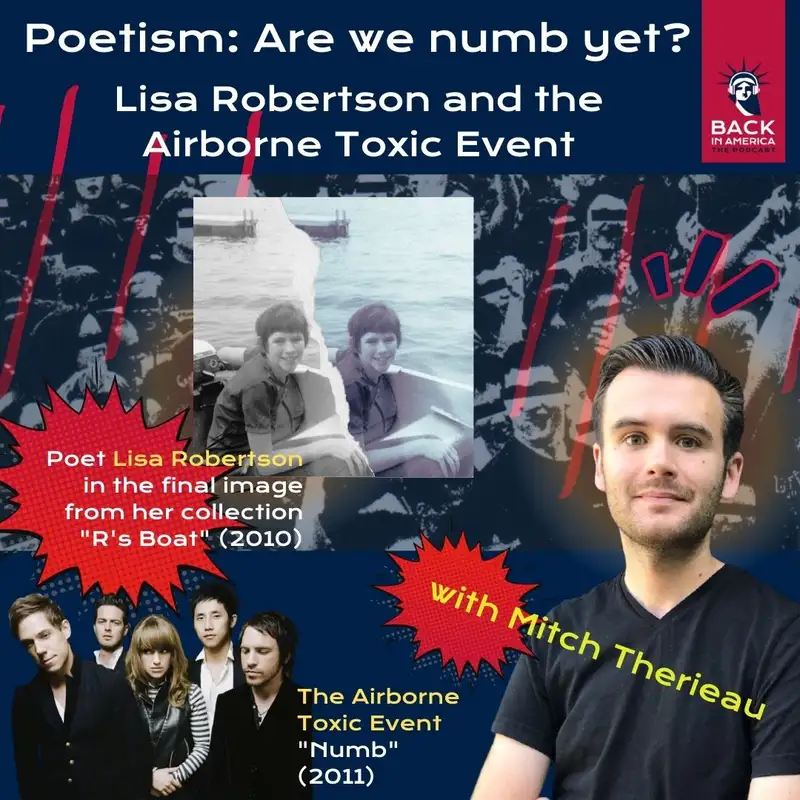
Poetism Part 2: Are we numb yet? Lisa Robertson and the Airborne Toxic Event with Mitch Therieau
This is the sound of Mikhail Jilets' air-worn toxic events, a band haphazardly forged in a chaos early 2000s Los Angeles. Amid the thrust of Jilets' own traumas with genetic disease, his growing up amid a cult and the generic struggle of being a writer among a city of writers, a band of bands, all of which you can read about in his 2020 memoir, Hollywood Heart.
In our second edition of Poetism, back in America, correspondent Josh Wagner is joined by Mitch Terry-O to pull apart the sensations of loneliness in Lisa, Robert Stone, Oz, Boat and the airborne toxic events Numb. If you're tired of arguing with strangers on the internet, try talking with one of them in real life. Welcome to Back in America, the podcast. This particular track, Numb, off of 2011's All at Once, seeks to create the very action it describes, much like the band's namesake, the infamously unspecific airborne toxic event. Taken from Don Delilo's 1985 novel White Noise, the airborne toxic event haunts Delilo's
pedestrian pages, hanging on the edge of the abyss and pockmarked by academic departments of Hitler studies, characters who talk more like credit card commercials, and endlessly interesting comedian stories. You're listening to Back in America, a podcast exploring American culture, values and identity. I'm Josh Wagner, your podcast editor and host for this summer's podcast series, Poetism. Poetism explores the interconnections between American poetry and music. What makes it run? In this second episode, I want to explore the minute and effervescent impact that poetry
and music can have on our collective subconsciousness. To this end, I am joined by energetic tweeter and Stanford Humanities grad student Mitch Terry-O, who researches contemporary literature and material culture, to talk about Lisa Robertson's arse boat along the airborne toxic events numb. Welcome to the podcast, Mitch. Hey, Josh, it's great to great to be here. Thanks so much. Yeah, likewise. Super excited.
And before we get too far into the poetry and the music, I have to ask you, what about poetry excites you? Oh, man. Well, you know, I feel like I've only recently caught the poetry bug, I have to say. I think the thing that I have found really exhilarating about reading poetry recently after being so immersed in novel reading, both in my own kind of recreational reading and the reading that I do for my research, is that like you get these stretches in novels that are descriptions of stuff or these kind of inconsequential events or side plots that go nowhere. But then in a poem, in the best poetry, to my taste, there's this
incredible compression where every line is just so jam packed with sensory stuff and, you know, emotion potentially, but not necessarily. There's just so much jammed into so little space. And I think that that's something that I really admire about poetry. Yeah, I was thinking about in terms of force, something like the being chiseled down into like the smallest possible form while still being itself. Yeah. Are there any poems in particular that you think do this particularly well or that you
turn to? Well, I mean, Bisa Robertson is definitely up there not to be too on theme. But I mean, I think Dickinson does it really well. I think that her poems have this incredible compression. There are these really just astounding condensed objects. I'd say that I think Dickinson would be the paradigm of that thing that really excites me about poetry. Yeah, it's actually really interesting that you mentioned Dickinson, because in some way
she seems to be not the total opposite of Robertson, but definitely playing a very different game. In this book, Ours Boat, it's mostly a collection of single lines that are loosely tied together through a lyric I over about five chapters. And the last chapter turns into a series of couplets. And it really has this feeling of expansiveness that grows over you. I mean, the last page of the poem has the image of the author sitting on a boat on, I assume, a lake or open ocean. Part of what the poems work on you, sitting through, I think about 80 pages, is a sense of
a lack of clarity or a sense of jumping around and thrusting you into a sensation. In that mode, I'm really drawn to this line in the first part. And it goes,
I think doing a little bit of digging about this poem, lots of the lines or the ideas come from Robertson's own journals, which is part of the fragmentary form of the poem. When I'm journaling, I don't often write essays or poems. I write ideas that are totally unformed and unfinished and often never get finished. And it almost seems like this is like a revised journal. Yeah, it's an interesting question. And that first poem is so riveting to me because in a lot of ways, as you said, it's kind of like a remix or like a greatest hits album in a way.
Of some of these ideas and themes that Robertson has been working through both in her essays and in her poetry over the years, there's this recurring idea of sincerity. There's this recurring fixation on description, which has to do with this accuracy issue that you were talking about. And those you can trace back to these essays that she was writing and this collection of poems that she comes out with around 2000, 2001. And it's called The Weather, a Report on Sincerity, the earlier poetry collection. She's looking for, I'm not quite sure how to describe it actually, because it's this
really polemical thing where she talks about what she wants to do and what she doesn't want to do. And there's a lot of talk about method. And you have the sense that she's this naturalist or something where there's this environment that she wants to explore, that she wants to capture in some way that she wants to inventory, describe. Indeed, there's a lot of nature imagery, even though it's very domesticated nature imagery. You're taking a walk through the suburbs and you enjoy the nice bushes and trees and stuff
like that. You know, still you get the sense that she's trying to come up with the language that can maybe not just accurately describe what things are in her immediate environment or in the immediate environment of this lyric I, but try to describe how one relates to those things over time. All of her poems are really distended in time. Like what? Monday this happened, Tuesday this happened, then we go back to Sunday this happened, or
in one of the poems in this collection that I think we'll be talking about a little bit later, we skip around among the seasons in this kind of random order. All that is just a long-winded way of saying. The description thing to me, or the accuracy thing to me, is about how can we find language that captures the subtle shifts in the ways that we relate to our environment over time and how those meanings fluctuate over time. And what does it mean to freeze that flux into an object? Like the poem I really do think is this compressed little object and it's this really tough formal
problem. I think a lot of Robertson's work is an effort to work out that problem. Yeah, and I'm really drawn to use the word domestication. When I think of poems that use that the lyric I, you think of the sonnets by Shakespeare where the I dominates. And here I think part of the question is how do I write a poem that is accurate to my experience that leaves room for what the content of that experience. I think there's a line on page 57 where she says, seeing is so inexperienced.
And that it seems like there's not an obvious way for those 10 suppressions to be converted into language, into a poem. And I think the question, how do we represent our lives to ourselves? Yeah, no, it's such a great point. And it makes me think that, I mean, going back to your thesis earlier, which I totally agree with, that it seems like Robertson is at odds with Dickinson, who's super compressed. I mean, it makes me think that really, I mean, Walt Whitman is the, I mean, it's a little perverse because, you know, Robertson is Canadian.
Walt Whitman is this in your face, jingoistic, poet of American-ness. I mean, he looms large in the history of these poetic efforts to rethink what this I is, this I that has been dominating poetry as long as there's been a thing called poetry, really. And yeah, I totally think that Robertson is involved in this project of rethinking what this I is, this I just mean, you know, myself as an individual person or an individual subject. I mean, you get the sense for Robertson that she really is not satisfied with that easy definition of it, that she wants the I to be this porous container that takes in all
of these crazy impressions from the world and makes new things from it rather than this enclosed bubble or this sealed off monad. Yeah, and Mitch and I were talking before program that Robertson reminds me a lot of John Asbury. And so I pulled this one line from Self-Portrait in a Convex Mirror about the soul. The soul is not a soul. It has no secret. It's small and it fits.
It's hollow perfectly. It's room, our moment of attention. The connection I'm seeing there is just the soul being this very miniscule and tiny physical space everything is jam packed into. And so there's a density and the same amount there's a lack. Both those moments are combined together. Absolutely. And I'd also say that, I mean, attention, that last word in that Asbury quote that you
read is such an important concept for Robertson. And it comes up over and over again in her poems and her essays. for her attention means something similar to what maybe it sounds like Asbury is talking about in that excerpt, which is this practice of emptying out all of that content, all that baggage of the eye as we traditionally conceive of it and seeing if you can let things in from the outside world. That seems to be this making porous of yourself seems to be a lot of what is going on in her account of attention, which I find compelling.
Maybe do you want to read the excerpts? Yeah, absolutely. So at one point in one of the poems that's called Utopia in this collection, there is a cluster of lines. What was I to understand of it? Its intent is mordant. It's weak and at once beauty. It was here that I first observed the question of withheld Arcadia.
It leans on the transparent balustrade. It is a continuous astonishment. It arrives at nothing but the rolling year. It always means everything. For instance, to do, to be, to suffer, to bark, to like, to crumble, to sit. In each verb, I've entertained ambition. I think the last verb I think is also very striking to me, to sit, is a little bit of an odd one out.
I think there's lots of these very strong action verbs to do, to be, and then you're just sitting there. And I think the sitting is perhaps the motion of the poem. Right after sit, there's a colon and then there's a word in. And so there's a collision between sitting and sitting in each verb. I guess my question for you here is like, was it me to sit in a verb? To sit in a verb? Oh, that's interesting.
Yeah, because I guess I was beating it maybe more. Maybe I was taking her more at face value that in each of these verbs, sit, crumble, do, I've entertained ambition. So I was just thinking about the ambition of sitting. I was thinking that seems to have a pretty clear connection to what we were just talking about with attention. I mean, there's almost this meditation type imperative or like a colon or something like that where there's an ambition in sitting, because when you're sitting there, it's an
opportunity to focus on making yourself, making that eye more quiet and more empty and more porous and more alive to all of the sensory input. And so, yeah, I think I agree in that sense, even though I'm coming at it maybe from a different angle, I feel like I'm reaching the same conclusion as you. That sit is it totally seems like the most important verb there. Yeah. And I think the other aspect of this passage that's really striking is this repeated instance of the part of it. Part of the moment here is the instability of the word it and what it can contain.
I think it was a Bishop poem about poetry. Is it the one that starts out with I to hate it or something like I to despise it? Yeah. Thinking about this idea of rhythm, this does seem like a very rhythmic poem. It's like building perhaps the lack of formal structure. And yeah, I'm really well, that's the idea of the it. Yeah, no, definitely. That's so interesting because I hadn't thought about the it until you put it that way. But it is so true. Like, as Robertson's poems are really expansive, like we were talking
about earlier, they kind of wash over you like a I don't know, like a wave or a cloud or something like that. I feel like they're very breezy, but not to say that they're unserious. I think they're deeply serious, maybe some of the most serious poetry that I know that's being written today. But in any case, reading them then becomes this interesting challenge and looking for patterns and looking for rhythms amid this apparent formlessness or this apparent nebulousness. And that repetition of the it is totally one of those kind of secret micro rhythms going on there.
When when Josh and I discussed some of Robertson's other work in the context of a working group, a research group, our colleague Ben Libman in English over at Stanford made an amazing point about another one of Robertson's poems where he noticed this subtle dimension of consonance, I think it was, that was tying together all of these lines that were just, you know, when you look at them on the page, just look like this undifferentiated blob. And he made the point that there's this kind of subtle rhythm, this subtle account of causality. I think his phrase was humming along in the background, which I think is so perfect for as a phrase for describing how these structures, these
rhythms work in Robertson's poetry. They're very background and you have to kind of attune yourself to them. Yeah, and maybe that's a good place to end our conversation on this first. Do you want to go ahead and read the second one that we picked out?
Money is ordinary and truly vernal. Intensities and climates pass over the face. Form is not cruel. I couldn't then reach my thoughts or recognize the details of my subject, who the lover was, the distant tile walls of the public transportation facility. That's such a great, that plunge into the banal at the end of that, when she has this high philosophy language, she talks about intensities, which is this, you know, for listeners who don't know is this kind of charged word that has to do with this branch in philosophy, often called affect theory, talk about money and topology, geometry, all this really high falutin stuff and this plunge back into the transportation facility. I absolutely love that.
Yeah, I think I was asked you like, what about this line you love? Because I might show you earlier, you had this immediate reaction of joy. Totally, absolute delight. Yeah, I mean, I feel like everything that I'm identifying as a formal characteristic that I like about Robertson's poetry is going to sound really banal. And I'm not sure how much of that is an artifact of me being new to poetry, or like thinking about it and marinating in it in a serious way. Whatever the case may be, the thing that delights me about this section in particular, and but I also think can be generalized to a lot of her work is just the way that she makes the abstract and the really sensory and particular and like experience related stuff
just collide in these delightful ways. Like weeds were accurate, these little spiritual boughs of movement, even boughs of movement is kind of interesting, but these boughs of movement hid the lyric. How can an abstract ideal form be hidden out somewhere in nature? It's I think the way that she tries to bring this airy up in the sky stuff and really tangible on the ground stuff onto the same level is just really rich to me. Yeah, and thinking about like this oscillation between like smallness and largeness, the Lying Red starts off on a Monday morning in June last summer, and then expands out into this cosmological, mystical communion of trees taking on the color of the sky, which again is another one of these very subtle but impossible images that somehow like location
and locality changes the structure of what you are. Yeah, and then we're back at the transportation facility. Yeah, and can we say more about that transportation facility because that also being that phrase is so bureaucratic. Is it a bus stop? Like what I have no understanding like what that actually looks like there is. Yeah, no, that's interesting, right? Because my knee jerk reaction after reading it out loud was, oh, wow, this is like a crash back into the ignominious particular after we've been flying high in the stratosphere of abstraction. But really, I mean, now that I'm looking at it again, in light of what you were just saying, I couldn't then reach my thoughts or recognize the details of my subject to the lover was the distant tile walls of the public
transportation facility. Even this image that feels sterlingly and maybe literally concrete to the reader. I mean, it's still distant. The walls are distant, you can't make out what it is. And maybe that's part of why it's just an abstract public transportation facility rather than a bus stop or something specific like that. Yeah. So there's a way in which it's not just this mixing of these abstractions and these really tangible images. Like they're just kind of these unmixed lumps of flour, you know, not incorporated into the batter. There's a real cross contamination between the two of them. That is between the abstract and the really tangible and sensual. And I think you can see that where this high flown abstraction is being pulled down to the level of
the transportation facility where it's like, is that a specific image? It's not really. Yeah. And it's really drawn to the colon. And I didn't even notice it at first, both paths as we chose end with a colon. Yeah. And I think the, again, the unfair question I want to ask you is who is her subject? The line goes, I couldn't then reach my thoughts or recognize details of my subject colon, who the lover was, the distant tile walls of the public transportation facility. It's super weird that the tile walls are her subject. And we, I think, assume, or as I assume that it's just her. It's weird that you can't recognize the details of yourself. Partially, like partially that's a trivial thing to say. You can't like see yourself, can't see your face
without a mirror. But also the moral, literal ring of that line just goes to show that her subject is not her. And we're back into the soul is not the soul. Definitely. And I think that maybe it comes back to this model of the poet as naturalist that Robertson talks about a lot in some of her earlier essays, where she talks about doing all this research about 18th century, 17th century meteorology and naturalism and these efforts to find a new language to describe these phenomena that we're now just becoming legible to science. I mean, so I'm kind of tempted to read this subject business in light of that words, like her subject is the stuff that she's observing and making her observations on, which is of course, I mean, there's the scientific lineage, but there's also,
of course, a long lineage of the author and more specifically the poet fancying themselves an observer of nature and observer of life, et cetera, et cetera. And Robertson is interested in how these two lineages could be related to each other, how the kind of the hidden symmetries between the scientific observation and this poetic observation might be brought to the fore a little bit more. Yeah. I think of the dealing with the subject here as the scientific observatory or observing observational mode. The thing that I love perhaps the most about the observational mode is the idea of invention. There is a phenomenon out there that you know exists, but you have to think of a series of words, series of metaphors to describe it. I think one
thing else comes up is clouds, an invention of what clouds are, how to understand them in a structure. So this is the extra, this is the ending of the poem. And the last couple of lines of this poem seem to be fairly widely quoted among people who write about Robertson's work. All that is to say, this is like the, this is the crescendo. This is what it's all been building to. Yet nothing was imitative. Two o'clock, four o'clock, what still grows in Utopia's Deer Fence Garden? Tansy, thistle, foxglove, broom and grasses shoulder high, some bent plum trees persevering, the pear tree chandeliering, geodesic components rusting in the second growth forest. This is one part of the history of a girl's mind. The unimaginably moist wind changed the scale of
the morning. Say the mind is not a point of origin, but a skin carrying sensation into the midst of objects. Now it branches and forks and coalesces. In the center, the fire pit and log seat, a frieze of cello and foxglove, little cadmium berries. At the periphery of the overgrown clearing, the skeleton of a reading chair decaying beneath plastic. This is the beginning of Utopia. Its material is time. Yeah, that's the mic drop moment. Absolutely. Yeah. When you're reading out loud, I think maybe two things stuck out to me. The first is, again, this idea of listening. The tansy, the thistle, the foxglove, the broom and glasses, and the foxglove coming up later. I'm curious what you make of all of that imagery here. Now we have this idea
of time slipping away, two o'clock, four o'clock, what still grows in Utopia's Deer Fence Garden? And there's this little sense of Utopia is almost no place here in this like, biological meaning, but as one, we were just still tied to something that's immaterial. This is the beginning of Utopia. Its material is time. There's a way in which, you know, I mean, the structure of this poem, we've been talking about how it's kind of amorphous and formless, but really, I mean, the impression that you get when you read this whole poem, and I highly recommend that anyone who's listening and peeked by these sections should definitely do. It's kind of like, I mean, it is diaristic, like that other earlier poem that we were talking about,
where it's this melange of scenes that are explicitly time stamped, and they have times and dates and seasons and years and the both particular and kind of abstract vibe memories or senses that are associated with these episodes, you know, these are spots of time to use the words word phrase, and they don't appear in any sort of chronological order, if I'm not mistaken. And so there's a way in which the poem seems to be giving us this vision of time or episodes, these scattered episodes of time as materials that one can remix and rebuild and reconfigure in different ways. There seems to be something utopian about that, which is puzzling, because as Josh was saying, it's so personal. It feels so personal a lot of the time when you're reading these memories that
this poem seems to be conveying. And yet there's a way in which I feel like you can read this poem as trying to explode that photo album or Facebook retrospective or backward looking type form that has to do with shoring up the solidity of the self and the eye in this really neat way to kind of take that grammar, that form or that logic and explode it and be like, well, what if this were the logic of utopia on some sort of level that exceeds the self? It's a political gesture, kind of. It's not for me to say whether it's successful. I'm often suspicious of when people make claims on the behalf of poetry that it's doing something revolutionary or radical, but there's an energy or an effort in that direction that's nicely not oversold in the poem. We're never told that this
is really revolutionary, which is not the case with all poetry that tries to do this kind of thing. So I think there's something to be said for that. If poetry is generally is not revolutionary or political in the way that a speech might be, what can a poem do? Yeah. What can a poem do? Well, on an individual level, it can definitely sensitize you to the world in different ways, I would say, or to use that word again, attune you in different ways to different things. I find that when I read a poem that really resonates with me, use another vibrational metaphor, not only does it change the way that I experienced the world in some subtle little way, which I think is a common way of talking about how literature moves a person. And I think it's common for a good reason. I think
it's accurate, but I think also it just unlocks a certain genre of phenomenon or vibe or sense that may have previously not been within my attention or below the frequency of my attention. So there's a tuning into the frequency of phenomena and relationships that I didn't have the codes for, or that I didn't have the frequency number for, the dial for, whatever that a poem can give me. That's an individual thing. I feel like I can only speak for myself as an individual. I'm not sure how that can be scaled up in any way, but I think that's a significant thing and it's not to be underestimated. Yeah. And maybe this is actually, again, a segue over to our musical selection for today, thinking about the ways in which poems attune your body, that's what music does. You
hear the sounds and you can't help but tap your foot. Even if you hate the song, you're always going to move your body two and some way. And so this is a very physical way in which you're tuned versus the kind of attunement you're talking about. We decided to pair Robertson's poem with this airport toxic event song called Numb from 2011. I think part of what's going on in Numb is some of a sense of the rhythmic ocean of experience. The song starts off in this musical monotone. There aren't a lot of power chords you'd imagine in a rock adjacent song. And then when Nicole Jollett's voice comes in, it stays in this very muted tone. As a listener, I find it hard to distinguish the words he's saying from the sounds of the rhythm section. And it does feel like it
tries to achieve this one note of nostalgia and attachment. It's trying to both lean into it, but not as an end in itself.
It definitely makes sense to me the vibe that you describe of that opening guitar figure, this tremolo picking type of gear. On the high strings, there's a lot of reverb. It's very cavernous. It is actually, I mean, you mentioned that it's from 2011. I think that's significant because this is kind of a nice core sample, I think, of what a lot of quote unquote indie rock music sounded like at this point in time, you know, 10 years ago now. And the thing that was happening, it seems to me, in this vein of indie rock 10 years ago is people discovered that, they didn't discover, people started getting interested in making quote unquote soundscapes in their music, which is something that, I mean, there's a history in rock and pop music of doing
that and thinking about your instrumentation and your arrangements as these textures, as these environments to be inhabited rather than just parts of a song in a more straightforward sense. You know, I think that this kind of wavy, washy guitar intro is very much a soundscape type figure. It kind of wants to be environmental. It wants to kind of wrap you rather than just be a part of a song that's serving a purpose within the context of the song as a contained object. Obviously, the song is not this music video, but I'm also struck by the opening images of that music video, which obviously black and white silhouettes playing against essentially the void, which means this placelessness, it just takes you out of whatever the immediate experience.
But there's a way in which the lyrics of the song in general fits in this archetype of a particular flavor of rock song that has a long and venerable history, and that's the tour song. This is kind of my roundabout way of getting to your point about this placelessness. Apparently, there's some interview somewhere where he talks about how the song, he wrote it when the band was on tour. I think they were on tour supporting their first album, which flew up in a big way. And he was just feeling really alienated and like every night they were in a new city, never staying anywhere for more than a few hours, just feeling really placeless to go back to this void and placelessness motif that you were just bringing up. And this song is kind of a chronicle, a way of relating
that experience. So yeah, absolutely. I think it's definitely placelessness all the way down. I think part of the difficulty I'm having in talking about the song is that it creates this mood and I don't know what there is to say about that mood. I think this is like one issue that I think we were talking about before, though, talking about art objects that we both enjoy, it's hard to describe what it is about that sensation that is desirable or pleasurable or exciting, besides saying, oh, listen to the song.
Yeah, yeah, yeah. And I definitely encourage those listening to it, if you haven't already, to listen to the song. It's an interesting song. It's a catchy song. I don't quite know what to say about the mood of the song either. And I feel like there's a tension going on in it. And maybe I'll try this out and see what you think of this. I think the tension, you can like read it on two levels. You can read it on an emotional level. The concluding line of the chorus every time it happens, which is punctuated by the instruments dropping out, is just want to be numb. This is kind of the culmination of this chorus where he's talking about how terrible he feels. He wants to be numb to get away from that. But, you know, he's singing it really passionately.
There's a lot. He's got this growl, this grit in his voice that it's almost, maybe this is horrible to say, it's almost like Springsteen-esque at times, I find. Like this really quite overheated emotionality that he's bringing to this vocal performance where the lyrics are about just wanting to not feel anything. And that's an interesting tension because I guess it makes sense because the unfeeling state is like the goal. And because you're longing for it, you're not there yet. So, you know, if you were singing about it in this flat affect, Mazzy star kind of way, you would need to reach for it. You'd already have it. You'd already be numb. So it doesn't make sense to sing about wanting to be numb in a numb way. So I guess that tension works. But also, I mean,
you could probably read that tension on the level of like micro music history, because I think this was 2011. Who were the big indie bands back then? I mean, definitely Airborne Toxic Event had their brief moment in the sun. You had bands like Phoenix who had a similar kind of sound, these twinkly guitars and synths, a little bit more detached sounding vocals. Kings of Leon had their last real significant hit, I think, that year before fading into radio silence, kind of. And Kings of Leon, of course, being a really bombastic band with lots of yelling. So I feel like this was like a crossroads in indie music, I want to say, where the dominant affect or feeling or vibe in a lot of this music was like really overheated emotionality. And I think that you could best see that in songs
like Use Somebody by Kings of Leon. It's like really the pathos is like almost unbearable to listen to. But then there's a transition into this more flat, numb, more affectless style that you can kind of see is I think bands like Phoenix probably are good emblems of it. You could read the contradictions in his vocal performance and in this song is kind of trapped in this nexus, this crossroads, this tension in music history too. Yeah, and I think part of what I think is really interesting about what you're talking about is almost this idea of the nexicality or the sense that this part of the song wants to not only be numb, like a biographical, biographical level, but also to produce like desire in others. There's a difference between being numb and having that feeling and like wanting
to train others to feel in that same way too. Definitely, yeah. And I think that that definitely ties back nicely to the soundscape thing. There's still the tension there, but the song wants to wrap you in this gauze of washy sound, which is kind of a numbing effect in and of itself. And it's numbing gauze as a protection from, I don't know, from the world being too much, from life being too hectic and disconnected, from what have you. You know, there's a protective function that this numbing serves. And I have to shout out another one of our colleagues, Gabriel Ellis here at Stanford, who works on what he calls the anesthetics of recent popular music and kind of the rise of this recent fixation on not feeling, not only at the level of the content of lyrics
in recent pop music, but also kind of on the sonic level that we were talking about, this numbing sound. He's definitely an authority on that. He's doing some amazing work on that. But what I was going to say is that the tension is still there because there's this arena rock ambition behind this song. You know, it wants to wrap you in this gauze and numb you, but at the same time, he wants to yell and be a rock star on stage. And the song is bombastic. I have to say, it is a bombastic song. And I mean that in the judgmental way. That's interesting, I think, that it's bombastic, but it also like it wants you to be awed by it. But it also wants to make you numb a little bit. I think that it wants to do both as an interesting tension that tells
you something about a certain moment in music history, if nothing else. Before I say anything else, I want to preview that Gabriel Ellis will be joining us in a future episode of Poetism. I'm thinking back to our end of our session about the Robertson poem and about what poetry can do. And it seems like you're presenting a very clear case of what music, what this song does for you. I'm curious if we can plumb that tension or that difference between these two art objects in the sense that Robertson's poem is hard. It's hard to get into. I think once you get into it, it's much easier to have some kind of visual reaction to it and see how it might perform. Not so yet, like a numbing sensation, but some kind of attunement as you were talking about earlier.
Numb is catchy, right? It's arena rock. It's very easy to get into. And once you're into it, I'm not sure where to go from there. That's my difficulty with that song. Yeah, definitely. I feel like that gets into the more formal problem that you were talking about earlier. What are the differences between the ways in which a poem lingers in your mind and your body and the ways that a song does? And it's an interesting question on a general level, but on the specific level of this song and these poems, this song gets stuck in my head. Like you were saying, it's catchy. It repeats itself. It replicates itself over and over again, which is a different way of survival in your brain or lingering in your brain from this kind
of attunement that I feel lingers from the Robertson poetry. I feel like because her poems are so amorphous and open and challenging that they make me do some work. They make me do a certain kind of work. I feel like they're training me somehow, but not in like a sinister Pavlovian way. But I feel like they're gently asking me to do something that I'm not used to doing, to pay certain kinds of attention that I'm not used to paying. And I feel like that tends to carry over into my everyday life in a way that is different from the way that that song in particular carries over into my everyday life. Are there songs that I feel like attune me to different things? Yeah, I think so. But in general, a song is such a pop song, a good pop song, I think is such a
confection and it's such a self-enclosed object and its beauty for me, a big part of its beauty, is how self-contained it is. And music has gotten more and more background-y over the years, not the music itself, but the way that people listen to it, engage with it. Spotify has signaled the dawn of the age of universal background music at all times. But really, a great pop song, I think, eclipses everything else when you hear it. And it just, you totally enter into it and nothing gets outside. You are in the song or the song is in you. There's nothing else going on in your attention and your brain. So this vacuum ceiling effect that I feel like attends or lingers on with the greatest pop songs is almost like the inverse motion on an abstract level to this kind
of attuning and paying attention to the world and shooting the tendrils of your attention farther out into the world that can come after reading an especially good poem. Yeah, and I love that comparison because the pop song seems like if you iterate infinitely, then you derive at this tendril continuity, social consciousness mode of expression. But it is itself like one moment is distilled into like, I think matching as a cube, like floating in the sky. But if you're talking about it, it's totally a cube. I definitely think about the pop song as a cube. Is there anything else that I haven't asked you that you have a burning desire to say? Oh, just like a really small asterisk note, just to say that there is one place where this sound concern, the soundscape
thing and Robertson meet. She has this essay about kind of walking around Paris and noticing different overlooked things. And it's paired with this series of soundscapes that she recorded. The idea is that you listen to the soundscape while you're reading the portion of the essay that's not about the soundscape, but kind of paired with it or responding to it in some way. And so there's a way in which these forms are so, or they can be so enmeshed with each other and they can do things directly with one another. And I think that's really interesting. Yeah, thank you so much for that. And I was thinking like Mark Fischer's curated little like, they're not soundscapes, but they're a whole pair like movie lines, movies with songs and these like hour long little objects.
I need the last question for you, which is the question we ask all of our guests, which is what is America to you? Oh, what is America to me? Yeah, it's a really hard question. I think that America, whatever it is, it's not an experiment. It's the country that we've got. I think thinking about it as an experiment is an unfortunate mental habit or rhetorical habit that kind of abstracts away from the fact that this is the place that we've got. It was founded on deep, deep, deep violence. And, you know, it said often said more and more these days, I think it bears repeating. I think that calling it an experiment kind of allides that in a lot of ways. I don't know what it is. I can just say that it's not an experiment. It's the country that we've got. We've
got to do something about it. Thank you so much for taking the time today to talk to me about Poetry and the Music. I appreciate that. My pleasure. Thank you so much, Josh.