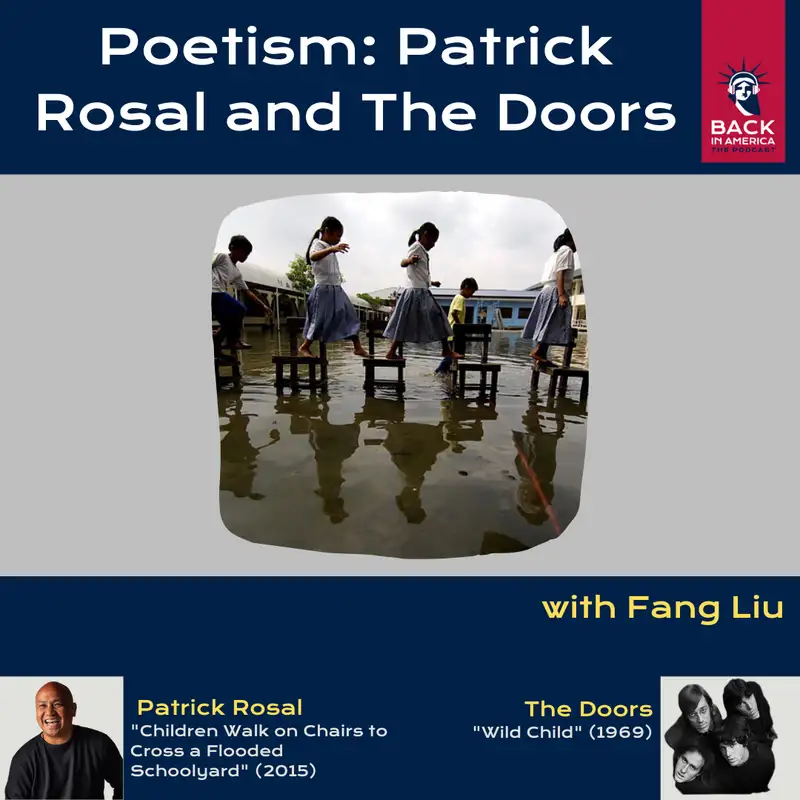
Poetism Part 1: Patrick Rosal and The Doors with Fang Liu
On the first installment of Poetism, back in America, correspondent Josh Wagner takes a look at Wild Child. Alongside Patrick Roswell's, children walk on chairs to cross a flooded schoolyard with an eye toward artistic imagination. If you're tired of arguing with strangers on the internet, try talking with one of them in real life. Welcome to Back in America, the podcast. Hello everyone. I'm Josh Wagner and this is Poetism, a new summer series on Back in America, your podcast questioning American culture, values, and identity. This episode is part
of a new series called Poetism, where I'll be joined by guests, tap dancers, grad students, to talk about the different ways in which American poets and musicians approach ideas and influence the American subconscious. I've never been especially good at remembering lines of poetry or song lyrics, but something about the two forms has always struck me as similar. Questions of what makes a poem a poem have been answered by scholars for hundreds of generations to know definitive results. Instead of a dense academic discourse, I want to use the opportunity Stan gave me to take over this podcast for the summer to share my passion for poetry and ask why we need to read poetry today. Over the course of the next eight or so weeks,
Poetism will guide you through a variety of artists and conversations about the necessity of music, its relation to poetry, and how the form of thought changes thought and the thinker themselves. In this inaugural episode, I've been joined by Feng Lu, a linguistics major who I met in my undergrad days, who is here to talk about Patrick Rosales' acrostic poem, Children Walk on Chairs to Cross a Flooded Schoolyard from 2015, alongside the Doors 1969 classic Wild Child, off of the Soft Parade. Welcome to the podcast, Feng. Hey, Josh. Before we get into the poetry, I have to ask you, Feng, what about poetry excites you? How do you read poetry? As compared to other things, I think I just happened to have better poetry teachers in college than teachers
of other things, and it helped me to separate the things that you just kind of find sentimental or nice or pleasant or pleasing from the stuff that really drives you crazy and takes up permanent space in your head. I guess I just kind of got lucky and I kept reading it afterwards. Yeah. What do you expect from a poem when you're reading it? I guess it's a hard question. What do you expect from a poem when you're reading it? I don't know. I think I know we talked before about like pleasure in poetry and whether the thing you want to feel in a poem is confusion, excitement, just like enjoying the moment. And I think there's also a divide between like poems that are easy to read and poems that are hard to read. And I'm not sure which ones you gravitate more towards. But
yeah, I think it's an open question like what poetry does or why people gravitate towards it. I don't have a very good answer, which I think is why I was asking you. Yeah, I mean, I remember we were talking about that. I think that we both seem to feel drawn to being challenged by a poem. Like maybe that's what's particularly exciting about it compared with maybe like the way people conventionally think about fiction. Like I think it's not really fair to say that poems are more challenging than, you know, prose or anything like that because just because something might be more literally explicable doesn't make it less difficult to understand why it really moves you or what it's trying to do. But yeah, I mean, I guess in general
and principle, like it's nice to be challenged by what you're reading, right? Like it's really important to be challenged by what you're reading, whether just because it's difficult to understand, which I think sometimes in poems, that's the sort of like the low hanging fruit way of being challenged by a poem. But I think it's also fun to be really challenged morally by a text. And I get really excited when a poem can do that to me too. Do you remember like the last poem that did that for you? Well, I didn't read it last, but I think we were doing Frank Vidard. He's always like a slap on the face, like a nice corrective slap. Like, well, we read Borges and I, and we also read the Yoke. Oh yeah, the Yoke was the one. Thank you for indulging me through that. Yeah,
I guess as we're turning to the poetry, would you mind reading this week's poem for us? Sure. So it's by Patrick Rosale and it's children walk on chairs across a flooded schoolyard and it's based on a photo right in Teite Rizal province, the Philippines by Noel Celis, I think. Yeah, so hardly anything holds the children up. Each paused midair, barely the ball of one small foot kissing the chair's wood so they don't just step across but pause above the water. I look at that cotton mangle of the sky post typhoon and presume it's holding something back. In this country, it's the season of greedy gods and the several hundred cathedrals worth of water they spill onto little tropic villages like this one, where a girl is likely to know the name of the man who
built every chair in her school by hand, six of which are now arranged into a makeshift bridge so that she and her mates can cross their flooded schoolyard. Boys in royal blue shorts and red rain boots, the girls brown and bare-toed in starch-white shirts and pleated skirts, however like bells that can choose to withhold their one clear true bronze note until all this nonsense of wind and drizzle dies down. One boy even reaches forward into the dark, sudden pool below towards someone we can't see and at the same time without looking seems to offer the tips of his fingers back to the smaller girl behind him. I want the children ferried quickly across so they can get back to slapping one another on the neck and cheating each other at checkers. I've said time
and time again, I don't believe in mystery and then I'm reminded what it's like to be in America, to kneel beside a six-year-old, to slide my left hand beneath his back and my right under his knees and then carry him up a long flight of stairs to his bed. I can feel the fine bones, the little ridges of the spine with my palm, the tiny smooth stone of the elbow. I remember I've lifted a sleeping body so slight I thought the whole catastrophic world could fall away. I forget how disaster works, how it can turn a child back into a glistening butterfish or finches and then they'll just do what they do which has teached the rest of us how to move with such natural gravity. Look at these two girls center frame who hold out their arms as if they're finally remembering they were made for
their altitudes. I love them for the particular joy of returning to earth, not an ounce of impatience, the simple thrill of touching ground. Thank you for that, Fei. I guess what really draws me into this poem is its seeming simplicity and yet its very paradoxical nature. You can look at the photo online and find the photo. The poem has a very clear set of images at its center. There's the children walking across and children remembering the past life as a bird or as a kind of butterfish in which they are caught almost between past and future. And I'm just curious Fei, like what stands out to you in this poem? I think maybe it'll be useful for us to talk about how the poem sort of develops in a chronological way because I think on the surface it seems like a pretty standard
first person speaker who's probably pretty close to the poet's self narrating a picture that he sees. So there's something almost quite literal about it, but I also think that it has some leaps in the way that it develops. So maybe it'll be useful as an exercise to think about what it describes first and what it describes second and what it describes third in a very literal way and then why it goes from one to two to three, right? Okay, so the first section is trying to lay the groundwork for the poem. I'm really drawn to that for the first line. Hardly anything holds the children up in a way in which this idea of fragility and flight is right there contained in the first line. Anything stand out to you about this first part? Yeah, I mean, the right
that it gets set up, it's an introduction to the key feature of the poem, which is the fact that they do appear to be floating in somebody even though I think he also does assert that some physical contact is present, like the kissing I particularly draw the attention to the contact that you can argue is barely there, but the fact is that it is present. And I think the word kiss is a kind of intimacy where the fact that the touch is very important. I think that relates to how the poem ends up ending, right? But so that's kind of like the physical setup to the poem, the visual setup. And there's also some history when he relates the typhoon to the colonial past and like the cathedrals and the Catholicism in Philippines. Yeah, I guess that kind of covers
the first 20 lines or so. I just should return to this history for a second. So Patrick Rozaal goes to the Philippines in 2009, right in between two different typhoons. And he's there in person to witness the destruction it's having on the people living there. And I'm curious if you could just talk a little bit more about this post-colonial angle, how you see the South American cathedrals worth of water spilling down, informing the colonial history of the Philippines. Okay, so I'm not Filipino and I didn't study the colonial history of the Philippines. So let's get that out there first. But I'd like to know a little bit about it because I grew up in South East Asia and like, you know, high school history and stuff. So bearing that in mind, like the way I
think about Zion is basically like, he starts by saying in this country, that's a very clear, assertive claim that there is something particular about this natural disaster occurring in this country. And it's not just the fact that typhoons happen in the tropical climates, but it's relating this natural disaster, which is at heart random and basically immoral or amoral with a kind of much more ethically charged historical idea of colonization, which is basically about exploitation, right? And it's saying that the greedy gods and the several hundred cathedrals, I think there's something very tense and very argumentative about putting it like that, because obviously the gods in the cathedral might not be, you know, the gods that the people had before the Spanish came to
the Philippines. And their sense of greed in Everest is obviously also about colonization. And it's interesting in Christianity, like it's monotheistic, right? So like you're supposed to think of God as being like a pretty great dude in general, but the idea of multiple and greedy gods makes you think back more to maybe like even Greek or Roman gods or just pre-Christian gods who are more like humans in the sense that they have vices and they don't have a great plan. They're kind of like out to get to you as much as anyone. I think that's very terse little comment about the religious history of the Philippines and how it ties into the moral claims the poem might be making. And then it's kind of like setting the vastness of this history and the vastness of the cathedrals
in the rain against the little tropical villages. It's like it's already contrasting the size, like smallness and minuteness of the children and the ability of like the place where they grew up. Yeah. And also the sense of like expectation that comes through and also anonymity, because we have the greedy gods, the cathedral standing in for some colonization or some exploitation. At the same time, the girl in the village knows the name of the man who built the chair and that there's a sense of intimacy and this total knowledge and that there's this sense of presence in a way that the people who are from this village, see in that village and they know each other and they're there for each other in a way that like the face of gods or the face of cathedrals just are not. I think
one thing to say is that they have like bells, right? In midair. They're both located in the world. You could go to this village, you could find the photograph online and see what they look like. But in a sense, this poem is also talking about their paradoxical unknowability or maybe the way in which they stand in for some kind of unseeable moment that you have to be there to witness. And I guess I'm really drawn to this line of the one clear, true bronze note and the way that that line itself is drawn out or that phrase is drawn out and you expect to have some kind of clarity by the end and you're just left in confusion. Yeah, it does have a nice tinkling bell quality, doesn't it? Like all those monosyllables. That's quite clever. I think
it is a pretty almost naive kind of reference to how the girls look, you know, like the big flaring skirts and then, you know, like the little legs or the bells. Like I almost want to say it's kind of sexual, but I don't, I really don't think he's going there. But I think that at the end of the sentence, it's remains a secret even to the person reading it. You don't even know that what is mysterious about them. You can't even characterize the mystery, let alone actually understand what is being withheld from you. Right. So it's quite hard. Yeah. And I think there's almost a very extreme sense of like inside and outside and that if you go to the school, you're going to know who these people are in the picture and what the school looks like,
where they're going, whether they're on recess, whether they're in class. But as someone in a totally different continent, in a totally different country, we're almost left at, not in disadvantage, but just with less knowledge about what's going on in this scene. Like no one in this poem is named. It's the ways of the gods, the boys, the girls. Yeah, like it's trying to withhold the intimate details from you almost out of respect. Like it's withholding the facts to give you a more truthful sense of what you don't know about these people. And I think you make a really good point about poem trying to situate you at the right distance from these people, the distance that you should feel as opposed to the fault, the more false intimacy you
might feel if it was said in a different way. I am curious what you make of this though. So they hover like bells that can choose to withhold their one clear true bronze note. That's, there's like a little bit of fudging done there, right? Because their one note, it could mean that for each student there is one note that is particular to them and that is all equally unknowable to you. Or it could be, you know, there's a kind of one, or like, you know, they all seem to like share in this kind of like resonant music and like this huge hurray communal experience that is like not a secret to them, but it's only a secret to outsiders. I guess I'm curious whether you buy into the more particular or the more general reading. Yeah, so I think in my first
reading, I didn't even notice the tension between the there and one. And I definitely read it in this very individual way. But now looking back at it, I do think there's something collective here and that like, it's something that these children are locked in a certain space together that creates that note in a way that if you saw them individually, maybe perhaps they would not have that same kind of experience. And I'm also really drawn to this idea of choice or like the withholding the note is not given, but it's one that they can choose for themselves, whether to conceal or reveal the thing that's precluding that it is the weather is a typhoon, and that they're withholding it until the everything clears up and their beautiful skies is no longer this like, perpetual threat and danger
hanging over them. Yeah, I think you make a I think I think that's right. I mean, I think the one line that probably it's the closest to what you were saying just now is I want the children ferried quickly across so they can get back to slapping one another on the neck and cheating each other at checkers. And, you know, that's like a pretty that's a pretty unsentimental account of what children are likely to be spending their free time doing once they emancipate once they're emancipated from this environment. But at the same time, like, it's also a fairly wry, quite affectionate description of a kind of sociality between the children, right? And maybe, you know, maybe the right way to think about their what their one clear true bronze note is not to
make it exclusively private or exclusively public, but to think of it more as being a kind of sociality, right? Like, in the sense that, you know, they know about each other because they dive out themselves to each other through trivial or enter or amusing or just necessary interactions, really, like, like the kind they're described here, like stepping on the door in the neck and stuff. And, and that's, and that social existence, that context is what you're separated from as the viewer. So it's not just it's not just some teenager whining that no one understands me, you know, because I have this secret role in my head that I don't tell anyone about it's these children are telling each other about themselves all the time. But it's just not in a way that you
can participate in by nature. Yeah. Yeah. And it's also the sense of like, on a way in that hat in which that happens. I know the land I'm thinking about is when this boy draws his fingers back to the girl behind him, like unknowingly, he's reaching towards something that we can't see it's out of the shot. And at the same time, he's reaching both back and forward, which I think almost stands in for this like tension of the heart bone between, I guess, the past and the present between flying and being grounded is between this like motion, this this like moment of motion and captured in a static form. Yeah, that's, that's, I mean, I didn't think of that at all. But I think you're, you're probably completely right. I mean, it happens pretty much in the center of the poem,
just in terms of lying counts, right. And it seems to be stretching in both directions. So, and I think the reason I didn't pick up on that is, when I first read this, I was, I thought there was describing a really dangerous scene, like, it's one of those lines where your heart actually kind of worries for what is, what is being described, right, like, one boy even reaches forward into the dark, sudden pool below the dark, sudden pool and towards someone we can't see. And there's almost this, there's almost like an impulse for self emulation there, right? Like, it's like this curiosity about like the pool that, I mean, if you look at the picture, it's actually rather a shallow water. And like, you know, like, you wouldn't be too scared about drowning, and it doesn't add
out or anything. But in this boy who, who's, who doesn't even seem to, who seems to be described to you as being too young for either notions of suicide or self preservation to reach towards it, it's, I think it's pretty clearly a moment of fear for, for any person reading the poem and observing this thing being described. Yeah, so I guess like what I'm trying to say is that when I first read this, I felt really the danger more than anything, and it didn't seem to me to be, I guess I just didn't really see it as being very symbolic. But I still, I still think it right. I think it's just something else on top of that too. Yeah, I think it's a moment of fragility that is perhaps universal, or we can carry throughout. And that I love how you were talking
about the typhoon and this whole scene in both in terms of the dangers children are in being in this like, and also trying to like, walk, do something very, very normal, that should not be dangerous. And I think one striking thing is in the photograph and not in the poem itself, is that there's one child in the background who just walks across the puddle of out the chairs. He's in his head down, he's wearing long pants, he's, he's not trying to fly or escape, or, you know, be with his classmates, but he just muddles through on his own. I wasn't in a sense that like, he is almost the antithesis of mystery, which is almost maybe why he's in the background, why he doesn't quite make it into the poem. But I just want to, I just want
to think about this idea of like, the relightness, or this idea of the danger that is both dangerous and also innocuous and gentle. Yeah, I think that there's definitely a feeling that, you know, that he's looking to these, to the scene with his children as, as a lesson. I hate that word, but let's call it a lesson about how that other people who seem to be more strong or more tough, or like more seasoned, don't haven't learned yet about how to deal with the world. And it's like, these children have some kind of originary wisdom for that. And so there's a sense in which, um, I think what's, what's weird about the line that you said is that he says, so slight that I thought the whole world could follow me. So it's not even the fact of their
dearness, but the fact that they're smallest and this is their smallness and their slenderness that makes them sort of exert force over the whole catastrophic world. So there's something very deliberately paradoxical about that statement. And yeah, I think that the, the, but the idea that you mentioned about it being possible for these children to instruct us in the lesson of everyday disasters or something like that is a way in which that slenderness and that ability to be harmed by almost anything in the world around them, you know, becomes a sort of power and a source of life force in the poem. Um, I'm actually really drawn to the previous lines before the line that you read out just now, where, you know, he says, but he just describing the body,
I can feel the fine bones, the little ridges of the spine, the tiny smooth stone of the elbow. I think, and I think what's interesting about these lines is that they make the body sound very architectural. It almost sounds like the smooth stone of the L in particular, and the ridges, like he's looking for handholds and in flesh and in a, in a organism that you think of, that you should think of as being soft and, and it's certainly your feelings towards are, I like your feelings towards a human being, but at the same time he makes the way he talks about it is sort of like, of like some person trying to touch something quite hard and quite concrete and quite large, like a, like a structure with real height and depth and stuff. And I think it's almost
like a reminder of the cathedrals he was talking about, like each body being almost like a religious building or a site in that way. And, um, and I think in that sense, he's like imbuing these children with like a kind of, I don't want to say their own mythology or their own sense of, you know, all that. Yeah. Like I don't want to go there, but I think that there's definitely, it's one of the feelings that this, that this evokes, right? Yeah. And so I think I'm entering this line right after, um, the Bay Raiders cradling these young boys and talking about, I remember I've lifted a sleeping body so slight, I thought the whole cash off the world could fall away. And this idea of latency and this idea of both and, and that we
can read this overly in at least two different ways. Um, one is in terms of the duty of holding that body in your arm, that all the noise in the background, the chaos, the world just folds, just floats away as you're focusing on like the purity of life on this sleeping child has this very angelic or Christological resonance. But at the same time, um, I think as you mentioned earlier, the child could fall and could just drop the child and have that moment shattered. And the sense of this double motion between just the danger in every moment, um, regardless of whether there's a hurricane or colonization, there's still something dangerous about life itself that transcends and moves between those registers. Yeah. I think you're right about how
neither the state of being supposedly airborne or the state of being earthbound is, um, is particularly mystical. I think you're right that it's the act of transformation or the moment of trans, the moment of transformation in which you still feel the oddness of your previous state, um, versus like your transitional state or where you are right now that, that seems to have like a kind of magic associated with it. And that's also very much in tandem with that. I'm withdrawn to the last few lines about this idea of returning to earth for just a second. And the thrill of touching ground once you have been up there in the air and that there is part of the contradiction or the tension, the heart of this poem seems to be necessary return or the way
in which nothing is total. Neither disaster in our life is the law of the universe. The thing in the heart of home, the picture is the mystery that actually happened, which I think is a sense that you're talking about here. Yeah. I think you're right about how neither the state of being supposedly airborne or the state of being earthbound is particularly mystical. I think you're right that it's the act of transformation or the moment of transformation in which you still feel the oddness of your previous state versus your transitional state or where you are right now. That seems to have like a kind of magic associated with it. And that's also very much the magic of children, right? Like the fact that they're going to become something else or that they just
recently transformed from being something else previously before they left out of the womb, so to speak. But at the moment, like they're all very much themselves. That's kind of disparity or that kind of weirdness that makes them kind of magical. And so yeah, like to go back to, but you were talking about the land versus the water. I thought you said, you made a really beautiful point when you said that it can turn a child back into glistening butterfish or finches, like either fish or birds. One of those things in the water, one of those things is in the air. And the nice thing about the image is that with the typhoon, like covering the ground and this glaze of water, what's in the water looks like it's in the air. What's in the air looks like
it's in the water. So it's a nice callback to the picture. And yeah, there's a sense that exactly where you are physically, like what kind of creature you are, be it bird, fish, kid, it's not where the magic comes from. It's sort of like seeing all of those things in one organism or one brain or one consciousness. That is where the poem seems to find its sense of mystery.
Awake, shake dreams from your hair, my pretty child, my sweet one. Choose the day and choose the sign of your day, the day's divinity. First thing you see. Choose, they croon, the ancient ones. The time has come again. Choose now, they croon, beneath the moon, beside an ancient lake. Enter again the sweet forest. Yeah, and I guess thinking about this idea of one brain, one consciousness, that might bring us towards the other piece we're going to talk about today, which is Wild Child by the Doors. So the song Wild Child is off of the Doors 1969 record, The Soft Parade, which is the fourth studio album. And I think what really drew me towards it is both the vision of the song between
this prose poem, mystical opening, and then when the music comes in. And the music that comes in is not what you think of when you think of The Doors. It's not this overwhelming, heavy power chord, rock, synth, bass kind of amalgam, but it's more simplistic. It's paired back. It's very repetitive. And I think it really reminded me of the lyric voice from Rovzal's poem, just in so far as it is presented as in this very simplistic, straightforward way where you don't really know what Morrison is talking about. There's a wild child who seems somewhat independent from his culture or her culture and her background. Not your mother is your father's child. You're our child screaming wild. And there's something here of this idea of like detachment from history,
a sense of that even if you know the child, the child, you know, both in the sense of a real child or as a metaphor for the whole revolutionary students of 1968 is missing. Yeah. And I'm not sure what you saw in the song thing. I don't know this song as well as you do, but as I was telling you earlier, I always feel like rock of that generation can be a little naval gazing. So whenever they talk about, you know, some revered, beautiful, free, wild object like the titular wild child, I always assume with a self-address. And I think that, you know, in this song, like either be the cell or it could be some beloved other. But I also feel like a lot of alternative rock and self-absorbed rock singer types tend to write this kind of song where they're ostensibly
singing about some beautiful person who's suffering, but they also seem to make the beautiful suffering person that they're in love with take on some qualities of themselves. Somehow the other ends up being a self-reference.
Savior of the human race, your cruel face
still within the lyric I, which I think is one point of difference between the poem and the song was we're in the poem. There was a sharp division between what the lyric I want for the children and then the children themselves. There is this more collective consciousness in the song. And the song is made up of all these commands awake, shake dreams, choose the day, choose the pool, choose now and tear again, come with us. And even if it is coming from this place of beckoning or this place of the song that sound like it's trying to control you, the lyrics themselves are very direct in what they want. And yeah, I just love this idea of talking about or trying to sing, not necessarily the other, but sing about other people in order to understand yourself.
And there's something about the way in which looking outside is actually the most radical turn in towards the navel gazing. Where do you get the looking outside from? Let's see. That's a good question that I'm not sure I have a good answer to. I think I'm getting it from the imagery and this sense of being in this not saying otherworldly natural, but being in a natural place, pruning the moon, this ancient lake, the forest, the hot dream and this moving between locations so quickly and frequently. I think that's where at least the song presents itself as being about other people. And also the fact that, you know, there's no I, there's no me,
which might be a lame reason. No, but I think you're right. Like, I think you're right in the sense that one thing that is true both of the song and the poem is that they're both remarkably unbiographical. There is some grand historical and mythological context and you get some of the 60s here and you get some kind of weird religious rite going on in the background. And with the poem, you get like, you know, the colonial history and you get some religious stuff there too. But in both cases, you don't get that much about who the I is and who the most important people in the poem are in like a historical sense. So that's a nice parallel.
Ancient lunatic rains and the trees of the night
With hunger at her heels, freedom in her eyes, she dances on her knees Irish friends at her side
Stirring into Apollo idols' eyes
Yeah. And I think I was almost struck by what you're saying at the beginning of recording about the moral or ethical whole of songs. I'm curious if you see any kind of any of that happening in the song or in the lyrics. Well, I think the one thing in that sense that struck me about both of them is what you said before, like for the song, I think it's this refusal to make sense. It's this disinterest in explicating his logical thought process, which I think is, I think that's quite admirably unnarcissistic of the songwriter to be that uninterested in trying to make his words make sense and to, you know, try to argue a certain agenda or to assert his cleverness to the
listener. I think that's quite nice of him. And there's this insistence on mystery that I think is part of the song's ethos. It's part of its aesthetic principle, right? And it's also part of the way of telling a story that it's trying to create, not just the act of telling the story, but trying to have a different way of doing that. But with the poem, I think the one line that seems almost completely, completely opposed to that is what you were talking about earlier. Let me try to read it. Oh, it's the one line when he says, I've said time and time again, I don't believe in mystery. That almost, I feel like what he's saying there, it's not that he doesn't think that mysteries exist. I think he's saying there that he finds mysteries somehow objectionable on principle.
And I find that very, I mean, I think that's, it's always fascinating when a poem makes a claim like that. I wonder how it relates to his style. I wonder how it makes you think about the rest of his poem right here. And I don't know what you think about it really. Do you agree with him? Do you not, do you think it's wrong to have mysteries?
Occupy
Occupy
Occupy
Occupy
Occupy Occupy
Occupy
Occupy
Do you remember when we were in Africa? Well, I think the poem is itself a mystery. So I think that there is some kind of tension or like, I think that the poet falls down on the side of mystery even as much as he wants to deny it. And yeah, I think the why is the part that's delighted. Like I think I'm one reading that you don't believe in mysteries because you don't believe that they exist or you don't believe that they're the right form to convey anything. And the mystery is a power relation between someone who knows and someone who wants to know or wants to learn and can't be told directly. And there's something of the like, that indirect glance that's contained in the mystery and I think in the poem and that the
thing that you want to convey can't be said in as many words as x, x is y. And so we have the recourse to the photograph to the poem to send serious images or convey that sensation in a way that is mysterious, but that there seems to be an end to the mystery that you you can solve. If only you paid close attention to the workings of each metaphor, everything would fall together in place. Yeah, and I think you're absolutely right in saying that. I also think upon some more reflection. So to have some context, I think that the line that this I don't believe in mysteries thing makes me think about is Ashbury, right? Like when he says, our days put on such reticence, these accents seem their own defense. And in some trees, like it's a poem that's about love as a kind
of as a kind like flirtation and love as a kind of exercise in hedging meaning basically, and in being reserved and in refusing and refusing to explicate while having the potential, while having the possibility of explaining and coming clean, but only the possibility is attractive, not the actual fact of understanding. And so that's completely opposed to this to what Rosal has to say about mystery. I mean, I love Ashbury's poem, but I think what wrote, but to me, like the contrast between that interest in aesthetic and between that kind of romanticization of like purely aesthetic principles and saying that I almost went to refuse the explication of meaning that Ashbury talks about and contrasting that with Rosal. I think one reason Rosal might
find that unattractive is because I think for him, this poem is clearly like talking about things that seem to be outside of poetry. I don't want to say bigger than poetry, but outside of poetry, like history and politics and religion and just various kinds of oppression and social and like just things with a lot of social consequences for like a lot of people. And I think one way to understand this disenchantment with mystery maybe is also like a disenchantment with writing or doing things for purely aesthetic principles. Like in some ways, like history and what happened before, like there's almost like a moral imperative to understand it. And to make sense of it. And I think that might be what's being refused here as much as anything
else. Yeah. And I think there's a way in which both senses of mystery are combined in one another,
whether it's like the mystery in its own terms or the mystery that needs to be solved, like I guess can we do caper? Like they're not totally distinct from one another. And I guess thinking about more about the Dora song, is that one line about staring into a hollow idol's eyes? There's a way in which the existence of the mystery perpetuates the status quo, right? If there is this unsolvable mystery, it almost forecloses the possibility of even trying to resolve it or arrive at any kind of resolution. And I think that's why the ending of that song devolves into this mantra of your cool face, which sounds eerily similar to your two-faced in the sense that the attempt or effort to resolve a kind of mystery is itself a double
bind in which you could be betraying. But there is this tension between
buying into the mystery and then buying into the mystery that controls your entire life. And I feel like you will talk about conspiracies today as the awful mystery. If you read the signs in the whatever, the steel at the World Trade Center, Twin Towers, then you will understand how whatever, I don't know. I don't feel like you're going to have a little conspiracy, but that is some kind of world bending mystery, which is, I think, distinct from the mystery that Morrison and Rosara are talking about, but not obviously so. Yeah. I mean, I don't really know that much to say in response to that. I think obviously the song airs a side of sexiness and the poem airs in the side of wholesomeness, but they're all doing their own thing and they all
have this nice mythological quality that Josh was very clever to have picked up on and putting them side by side. Yeah. And maybe in closing, could you talk a little bit about this last line of the song? Do you remember when we were in Africa? Oh, I'm just going to repeat what I already said to Josh about this before. And what I said about that was that I think that, look, it's like a throwback to what the song started with, because there's this portion of the lyrics that are sung, right? You know, it's saying, awake, shake your dreams from your hair, my pretty child, my sweet one, choose the day and choose the sign of your day, the day's divinity, first thing you see, choose the pull of the ancient one's time has come again, choose now, they prune beneath the moon beside an
ancient lake. It goes on. But I think what's remarkable about this is that basically this poem has bookends, right? In the middle section, there's all this loud child stuff, it's free association. And that seems like an address to this amorphous being that isn't really present. So it's about as abstract as it could possibly be because it's pure utterance and the subject of the utterance isn't present. So it's like a speech act with no one that is being enacted on. But before the middle section, the start of the poem is more concrete. It gives you almost a mythology of these fake places and fake times, and it's more physical, it's more geographical. And I think the fact that the very last line of the poem, do you remember when you were in Africa?
It's a reference to that sense of situatedness in the first half of the poem, in the first half of the song that it later discards. And I think by having this kind of reference, it seems to state that in the course of the middle section, the places and the situations that were imagined in the first half of the poem have become true, they've become real, and become capable of carrying reference. And it's quite magical, really. BF I'm happy to make a note to end on. And I guess before we go, I have to ask you the same question we ask all our guests on this program, which is, what is America to you? LH You know, that's an excellent question. All right, let's put it this way. I mean, I think that a lot of people that went to school in America, same time as I did,
who went to college like in about 2015 or 2016, and then Trump got elected in our junior, in our freshmen, sophomore, junior years, probably have a pretty even version of America in their heads that they had when they first came to America, kind of a little more wide eyed. And so I guess, I guess I'll be evasive and say that my my idea of America now is pretty different from what it was five years ago. BF Thank you so much for taking the time to talk to me about Pro Trim Music Society. Really appreciated it. LH All right. Thank you, Josh. Have a good one.