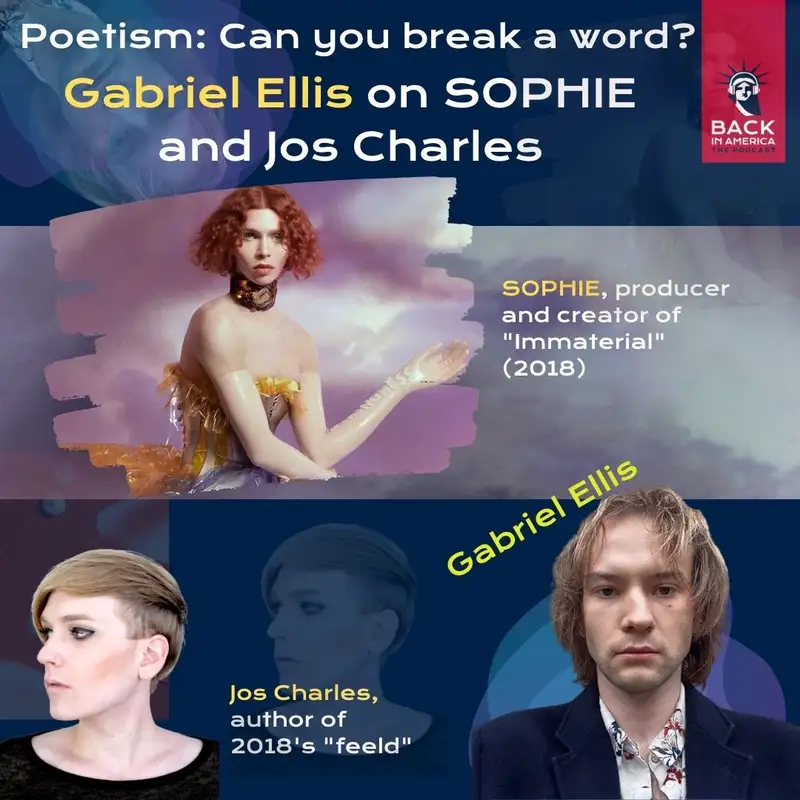
Poetism 4: Can you break a word? Gabriel Ellis on SOPHIE and Jos Charles
This is the thrall and the rush of Sophie's immaterial. Are you an immaterial boy or immaterial girl? Welcome to poetism. At the midway point in the series, poetism highlights the faux old English rhythm of Joss Charles Field, comparing their fantastic logic and puzzles to the late Sophie's immaterial. If you're tired of arguing with strangers on the internet, try talking with one of them in real life. Welcome to back in America, the podcast.
Hello there. I'm your weekly host of this program, Josh Wagner, the current podcast editor at back in America, a podcast exploring American culture, values and identity. If you're just joining us this week, I'm in the middle of a summer takeover of very usually scheduled broadcasting content, bringing you the latest and deepest cuts straight from the brainstorming team here at back in America. Each week I choose a poet and my guest chooses a musician, and we try to uncover the ways in which each art form thinks in, through, and around each other, building bridges and
other unnamed geometric surfaces. This week, the question at hand is, how to find a language to express our ever-changing selves? How can I and you listener also be a self? To answer these questions, I'm joined by Gabriel Ellis, an occasional countertenor and full-time graduate student in musicology at Stanford University, where he studies popular music narcotic intoxication of everyday life or anesthetics, as he likes to call it. Rumor has it that Gabriel also played in a pop band in college.
But today we're here to talk about Josh Charles's second poetry collection, Field, from 2018 alongside Sophie's In Material, of which you've already heard a glimmer off of 2018's Oil with Every Pearl's Uninsides. Welcome to the podcast, Gabriel. Thanks so much, Josh. It's a pleasure to be here. Likewise. I'm really excited to talk to you today.
Yeah, me too. And I really appreciate you introducing me to these fantastic poems. Yeah. And before we get too far into the poetry and the music, I'd like to ask you, why are you studying musicology? Yeah. Thanks for asking. I guess I've always been interested in music.
I was a trumpet player for a long time. I was a singer. I think in high school, what you do musically is you play in a band or you sing in a choir, right? I really looked up to my band teacher, my choir teacher, and I kind of thought that was the way forward if I wanted to keep being involved in music. I went to undergrad and started a degree in music education. After a couple of years of that, I started to get exposed to music history and theory
and the philosophy of music, and I found those things really interesting. And at the same time, I went back to visit my old high school and I realized, I don't know if I want to be around high schoolers for the rest of my life. At that time, I kind of transitioned to studying music history just as a way to keep being involved in music, thinking about it, communicating about it, but not necessarily standing up in front of a group of students for five hours every day. That makes a lot of sense. What are anesthetics?
Yeah, thank you. So this is my dissertation project slash conspiracy theory. I've been thinking about it a lot lately, but I'll try and boil it down to the bare essentials. Basically, when I started studying aesthetics, I got really excited by it. This is the philosophical discipline that studies art, what art is, how we experience it and so on. But the language of aesthetics, all of this talk about beauty and the sublime felt quite
alien to the kinds of art that I really like and that I listen to. Those didn't feel like they were very useful terms necessarily for interrogating pop music or culture or TV. A revelation came when I realized that a lot of the music I listen to is really about certain kinds of absence of feeling, whether that's numbness or whether it's narcotic intoxication or whether it's sleep. I think you hear this in a lot of different contemporary pop genres, and you also see it in other areas of pop culture, right?
There's this wonderful book by Otesa Mosfe called My Year of Rest and Relaxation, which is about a woman pursuing a chemically aided unconsciousness with the hope of some kind of transformation. You see it in HBO's new hit show Euphoria. You see it in the popular craze for sensory deprivation tanks. So I'm coming up with the word and aesthetics to describe this, because the word aesthetics comes from a Greek root, which means feeling or perception. It seems to me that you get a really interesting problem when you then are faced with works
of art that thematize the very absence of those things. Anesthetic, of course, in the medical sense, means that which blocks or dulls perception and feeling. In my project, I'm really trying to come up with a philosophical vocabulary with an experiential vocabulary that's capable of dealing with things that don't aim to produce strong emotions or strong feelings, and they're actually trying to do the opposite of that. Yeah. Thank you for going through that.
I'm sure you've given that sales pitch many times. One question on my mind is whether there's a difference between a song that's trying to produce this anesthetic feeling or a song that is itself without feeling or emotion. Yeah. I think you're really getting to the heart of the issue there, and that's something I'm still grappling with, because at the most basic level, obviously, a song can simply describe a certain absence of emotion lyrically. I think there's a new Playboy Carti song, I Want to Get High Till I Can't Feel Nothing,
but that's still over a musical text that does feel very intense. You can also look at particular songs which do feel like they're trying to musically describe or evoke this, using these very static textures, these kinds of immersive sound qualities, or maybe intense degrees of repetition, things like that. And then I would say even beyond that, there's maybe a third level in which songs or other kinds of cultural artifacts actually try and produce this in you as a listener or invite you into these states. And I would say, for example, that one strategy that some artists use, for example, is this
sensory overload. I've been listening a lot to this fantastic hip hop duo Death Grips, and a lot of those songs, there's just such a barrage of intensity sonically and visually in the accompanying videos that it almost feels like they're inviting you to experience this sensory overload that wraps around into sensory deprivation. There's almost no way to respond to the music other than to just tune out and let it wash over you. So I think juggling back and forth between those three levels is something that I'm
going to be trying to do as I write this dissertation. Yeah. What's the most anesthetic or most boring song? That's a tricky question, and I think I actually want to slightly question the terms of the question itself. One thing that I really want to emphasize in this project is that anesthetic and boring are definitely not always the same thing. I think one problem I'm dealing with is that a lot of people won't use the word anesthetic,
but they'll use that kind of there's no feeling in it, there's no emotion in it as a pejorative thing to describe a musical style that they don't like, and which frankly, honestly, they usually just don't understand. I'm trying to make the case that it actually takes a great deal of creativity to take an art form that's historically been concerned with producing strong feelings and find ways to take those tools and use them to do the opposite. Now to respond to the actual question, which is still a good question, one song that is paradigmatic for me is actually a Death Grips song called I've Seen Footage because it both
describes this kind of stimulation overload, this sense of numb paranoia that's been induced by constant exposure to videos of police violence, of gang shootings, executions. But it also has this sonic language that's so intense that it really forces you to experience that very same process of sensory overload that the lyrics describe. On the other end of the spectrum, there are other songs that do the same thing much more chill way, right? There's music for sleeping, there's bedroom pop, there's chill pop, and those feel like they're really actually trying to lull you in rather than overload you.
Yeah, so maybe this is actually a good point in our conversation to switch over to the poetry. And so for this week, I chose Josh Charles's Field, which came out in 2017 and was selected as the winner of the National Poetry Series and was a finalist for 2019 Poulter Plyas in Poetry. I guess before we get too far into the episode, I think I should acknowledge that both Sophie and Josh Charles are trans women. And that's something that's important in their work.
It's something that I and I don't think Gabriel have that experience or won't be able to speak to that part of their work. But we still think that there are themes that are relevant, even if our perspective is somewhat limited. And I guess the other thing that I want to say before we enter Field is that it is such a cool poetry collection. If you're not familiar with it, what Josh Charles does is take all these poems about and transform it into his Chalcedarian English.
So when you're reading it on the page, it looks so different than any kind of contemporary poetry collection that I've ever read before. Oh, yeah. I first opened the link that you sent me and I thought, what is this? And how are we supposed to read this out loud? But after exploring it more and more, I really started to see the possibilities of it and why it's exciting to be writing in this way. I told Gabriel in advance that I was going to make him read some of these poems out loud.
And I'm very glad that I'm not the one who's going to be at the mic because there really is a very old English proper way to pronounce lots of the words of the poetry, but also very modern equivalents. Yeah. And I listened to some recordings of Josh Charles reading these and she actually reads them basically as though they were written in standard contemporary English. So there's definitely an argument to be made for doing that. But I think it's also really important to get a sense of this Middle English flavour.
So when I read these poems, I am going to try pronouncing them in a fairly accurate Charles-Aryan way. And then I'm also going to maybe try reading them as if they were written in quote unquote standard contemporary English, because the meaning will be rather obscured if I do my job right. Yeah. And we're going to talk about a few different poems in order, but maybe it's a good time to jump right in to number four.
Yeah. So this is the fourth poem of the collection and I'm going to try and read it now in the best approximation of Charles-Aryan English I can. And apologies in advance to anyone listening who speaks Middle English because you will be justified in calling me out for some of this, but I'll do my best.
Whoa. Maybe I now try and do that again. Take two. Gather the whole in the garden, count the rites in a stream. It takes so many fields to make a whole. See the surface before the rupture. I know these gastric exercises are boring, but please. I see the boys in the playpen juggling my holes.
I see my trauma lit like candy in their cotton mouths. They whisper, where's your bird suit? You said you'd wear a bird suit. And I touch the urinals. I wash each ancient claw again and again and again. I get real specific about the hemorrhages I tend in my yard. Each hole is a vote, they tell me. Tend your hole, they say.
Where the country comes first, your fields are private. This is God's country. First of all, thank you so much, Gabriel, for going through that. It's such a powerful poem. I hear myself say that and that's such a meaningless word, but these poems are very hard to talk about in a constructive way, which is part of why I wanted to try to talk about them today. Yeah, I think that's right.
I think that's really one thing I was thinking about in terms of why it is that Charles is choosing to use this very obscure form of English here and also to mix it in places with something that's almost text speak or internet slang. So most of this is written on the page in a way that looks like Middle English, but then sometimes you get the numeral to instead of the word to, or you get you spelled just with a U. So it feels very strange because there's at once the most present current form of English we have and also one of the most antiquated.
One way of thinking about that is, and this is something that a lot of reviewers say about this collection, is the idea that Charles is really searching for a vocabulary that's capable of describing experiences that maybe we don't quite have words for or that feel kind of alien in contemporary standard English. Does that make sense to you? I would definitely buy that argument. And I just love the idea that somehow the most old thing that you can find is somehow also the most new and contemporary and modern.
And I think also the part of the difficulty of the poem is parsing out what the words mean. It's like reading James Joyce or like Finnegan's Wake, which is full of these puns, these long hundred character words where it deconstructs what a word actually is and means. Yeah, exactly. There's a kind of estranging or alienating effect even when you see these common words spelled in this very antiquated way. This is something that Charles talks about.
It opens up new possibilities for punning and for ambiguity. She said in an interview that the title of this collection, Feel, is at once meant to the pastoral sense, you know, fields of grass, whatever. But it's also supposed to evoke the word feel. It's supposed to be like the past tense of feel almost like I feel this. That's something that you can really only get if you're spelling it in this strange way that she does. Right.
Or I almost see it as like I feel like a very slingy way to. Yeah, yeah. I'm only drawn to the first line here, gather the whole in the garden. Or I'm mostly drawn to this dialogue line in the middle that I tallisize. Where's your bird suit? You said you'd wear a bird suit. Yeah. I don't know what to make of those.
Because it feels like it does have a very strong emotional charge. It feels accusatory, but in such a surreal way. I mean, why a bird suit? Why did the speaker of this poem say that they were going to wear a bird suit? Right. And this is at the same time, such a serious poem, but also so funny and absurd in this twisted way. Yeah.
I think you're right that it's a serious poem. There are these very literal constant invocations of trauma, presumably. I mean, it could be any trauma, but presumably the trauma of being a trans person in a society that subjugates you and that doesn't have room for you. And yet at the same time, it does feel like there are these constant little moments of play that emerge in the poetry, some kind of playfulness with identity that is maybe the counterpart of the trauma that's described. So just for example, these dialogue lines that you're talking about when this mysterious
other speaker says, each hole is a vote. I mean, that feels like a very funny way to describe. I mean, I don't even know exactly what it is describing, but the idea that somehow just like your body and the holes of your body are sort of like what's important here. Right. It's getting really kind of political legitimacy through having holes. Yeah. I guess what's really interesting about the last few lines of this poem is that in this
dialogue, it becomes clear that this mysterious other speaker is really trying to legislate the body and the experience of a lyrical subject, tend your hole. And then in the last line, the other speaker says, your fields are private, which is really funny because normally you'd expect it to be the other way around. Right. A field is something out there in the open, something that's public and it's your own body that's private. And yet here, obviously the point is the opposite.
And it suddenly is your body that becomes the subject of legislation. And I can say a little irony in that line because they're not private. The last phrase, this is God's country, it just so set off from the rest of the poem. Again, I don't know what to say about it. There's something very declarative of this. I can define one thing, I know what it is. But then the other me resonance strikes me. It's just the idea of privacy, common and belief, you repeated that you're never alone
with God because God's always listening. And there was something interesting going on with privacy and who's listening and when. Yeah, that's really good. I also found that line, this is God's country to be really disorienting. I mean, it feels like a punch to the gut somehow, but it's hard to know exactly why. I guess this mysterious other speaker presumably to stereotype is that's the justification for all these other things they're saying. Right.
Like this is God's country. And yet it does almost feel like in a strange way, the poem almost wants to celebrate that and to say like, this really is God's country, just not in the maybe not in the way that you think it is. And you see that I think throughout this collection, both the religious references, but also just the references to nature and the countryside and to birds and plants and trees and the sun. Like it feels like part of the point of this collection really is to explore kind of this
naturalistic imagery that's traditionally been something only for, I mean, to be frank, only for white male elite poets and something that other people don't tend to get to write about in the same kind of celebratory way. Yeah. Do you want to move on to the next poem, maybe Josh? You stole what I was going to say. Yes, that's a great idea. Okay.
So we're turning now to the sixth poem in the collection. And again, I'm going to do my best Chaucerian English and then one more time in Standard English. The cops in my garden inspecting hoos, And they am depositing meself like a fume, I'm trapped in their black and blue. Invagination means every harle is an extremity, You reach long enough into its surface, It reaches into you, ha! These trees cannot be in seed me, Not with all these cops around, please.
I am afraid, I am reading meself metonymic of death, again. I am so afraid of what is it you're holding, In your sour hand, This surface has a color. The cops in my garden inspecting hoos, And they am depositing meself like a fume, And trap in their black and blue. Invagination means every harle is an extremity, You write long enough into its surface, It writes into you, ha! These trees cannot be in seed me, Not with all these cops around, please.
I am afraid, I am writing meself metonymic of death, again. I am so afraid of what is it you're holding, In your sour hand, This surface has a color. Wow, thank you again for proving Chaucerian English to bring to our ears. You're very welcome. I think immediately two things are jumping out at me. One is this word again that was repeated in the last poem we read like three or four times in a row.
And I think that really gives a sense of timelessness or a sense of a mind at work. And can you say more about that, the idea of a mind at work? Part of what threw me off about the last poem so much were those lines of dialogue. I think on some level this is how my mind thinks to itself. Like rather than text, this is like unedited thoughts that have not been codified into language, into sentences, into words, into proper grammar. You have all these slashes that break up the lines. Yeah, so again, it's unfortunate that we can't show these poems somehow.
But one thing to say about them is that not only when reading them do you have to contend with the Middle English thing, but as Josh is saying, there are these slash marks that sometimes break up lines, but sometimes occur halfway through lines. The lines themselves are also just thrown around on the page broken up by these big chunks of white space, which makes it very hard to know what the rhythm of the poem is, what the form is, where to break it reading. So what were you going to say about the slash marks? Well, I was going to say that you're almost thrown into it and that it's just part of
the narrative voice is still thinking through what's going to happen next. I'm also thinking in terms of those breath marks in musical notation, where it's a pause as the other key person thinking about the Emily Dickinson. Yeah, of course, with the M dashes, yeah. Right, but the M dash is so present and there's still no white space there. Whereas you can imagine in your head there are M dashes throughout on all of this page, but it's still totally absent, it's not there. Yeah, and the slash does definitely feel somehow more unexpected or maybe almost aggressive
than an M dash, right? It's not just a gesture of continuation, but it also slices something, it holds things apart. Yeah, the other idea I had while listening to you read this poem is just how it folds in on itself through all these repeated lines. So there's I am afraid, I am so afraid. There's this idea of the whole back from the last poem, we have the cops in the garden, and so one question I have for you is, what does color have to do with anything? And so on one level, this poem seems to be trying to build up a world from nothing, or
that is a way in which all this folding in one another is just trying to get to a base level, best baseline or a ground where you're not afraid, where you're writing yourself, a language that you control your ownership over. And so that line is disorienting, partially because the other colors were black and blue, which I think you have some kind of violent resonance. And this last line doesn't, there's no color named, right? Like if she had said this surface is blue, or this surface is red, that line is the pride of a lot of this power, just the fact that there is a color there, even if it doesn't
matter what the color actually is. Yeah, I just like in the last poem, I think that last line does kind of come out of the blue, as it were, and has a certain kind of emotional force that's hard to describe. One way I might think about it, and this is going to get a little bit tricky because I haven't worked this out in my head, but as we're going to see in the next poem especially, but even as we've seen so far, this feels like poetry that's really obsessed with surfaces, with masks, with the outside of things, with the sort of identities that we curate and with the identities that other people impose onto us.
And it's also poetry in which things feel very interchangeable, right? Whether that's in the language itself, the Middle English mixed with the internet text speak, or whether it's all of these different themes and topics in the poem, right? We have nature, we have this seemingly almost unblemished natural world, but we also have cops, we have the police, we have bird suits, and we have things like that. I think what's exciting about that very last line where she says this surface has a color If you're thinking about everything in terms of surfaces, which I feel like this poetry is doing, on one hand that can be exciting because it opens up these possibilities for
playfulness, but it can also be quite scary in that it seems to collapse the world, right? It seems to sort of deny us the idea of depth or some higher truth or some deep truth, some hidden truth. And it feels like this last line is her saying, no, even if everything is surfaces, they're still also color. Surfaces themselves do have quality and there is a kind of richness of experience there. Yes. No, I love that idea.
And it reminds me of that earlier line where she describes herself as being like a fume entrapped in their black and blue. And so there's a sense of immateriality or non-being that is not the gate selfhood, but just an alternate way of conceiving it. I think that's what I love about your reading is that the color is adding an extra layer to the surface. It's not depth. It's not operating as the kind of geometric logic.
Even the other part of that is there. The color doesn't change the surface. It doesn't change the nature of it. There's going to be a number of colors and some change in its quality, but there's some kind of aesthetic or otherwise shift that the color represents. Yeah, I think that's exactly right. One other couple lines I would like to talk about in this poem, if that's okay with you, there's these wonderful three lines.
These trees cannot be inside me, not with all these cops around, please. And I had a hard time making sense of these lines, but I think I've eventually decided that there is a pun there, right? So there's trees in the literal sense of trees and very literally trees can't be inside you not with cops around. This is cops, C-O-P-S-E, like a cops of trees. You know, if the trees are in the cops, they can't be in me. Also, we've already had the idea of cops as cops, as police, which makes me think, okay,
maybe here trees is actually marijuana. So it's like, oh my God, I can't be hiding cops outside. And that also is suggested by the use of the word fume earlier. It's got me thinking about sort of smoking and vapor. So that could just be my own overinterpretation, but it does feel like, again, this is an instance where these creative, I mean, not even misspellings because they're the right spellings just in a very distant form of English, allow a real kind of play with language that would be much harder to do if you were just writing in contemporary English.
That's such a good reading. When I saw cops, I've seen corpse or like somehow being both alive and dead. Oh, that's good. It does also look a lot like corpse on the page. Yeah. Right. And I did not think about cops at all. And I read this a few times and there's something of the dead and the things that needs to be
re-repeated in this poem. Absolutely. Before we move on to the final poem, I just want to draw our attention to the second to the last line. I'm so afraid of what is it you're holding in your sour hand. And the word sour, S-O-U-W-R-E is just so harsh. So the W comes out of nowhere. I don't know what to say about that, but I just wanted to highlight that before we move
on to poem number seven, which I think Gabriel is going to once more attempt his best impression of a Charlton Scholar. All right. So here's the seventh poem. Petran, like all metal, is a series of surfaces in falda. We call many of these faldas identity. Some spas a shoefless betweene trama or hemorrhage or other. This is one membrane, one fold in yet another membrane.
A fold of one membrane may be connected to or similar to a fold in another and yet still smaller membrane. When a falda squishes or collapses a membrane or inhabits another falda upon falda upon falda, this is structure or gender or television or a unit it starts. You may be many faldas, but not. I think the wire and arse of both is and isn't connected to this char. Phaza. Like.
A tran, like all metal, is a series of surface in fold. We call many of these faldas identity. Some space shuffles between trama or hemorrhage or other. This is one membrane, one fold in yet another membrane. A fold of one membrane may be connected to, or similar to, a fold in another and yet still smaller membrane. When a fold squishes or collapses a membrane, or inhabits another fold upon fold upon fold, this is structure, or gender, or television, or a United States. You may be many folds but not, like the way an ass both is and isn't connected to this chair, face, lake.
Because if I'm not mistaken, the way it's spelled would in Chausserian English invite us to pronounce it like. But you see earlier, just in the line right above that, you see a word that is unambiguously like, and that's actually spelled L-I-K. So I think this second one must be lake, unless it's something else that neither of us have thought of. And as in terms of meaning, what does that shift do for you? And I'm asking you because I'm not sure myself. Yeah, it really feels like this is a common theme in these poems, these last lines that come out of the blue and really invite a reinterpretation of everything that's come beforehand. And I guess what's tricky here is that those last two words set off by slashes, face, lake, or like, it's not clear whether those are just a continuation of the previous sentence. You know, an ass can be connected to a chair, or I guess to a face, or to a lake, which would take us back to what we were talking about in the last poem. The idea of just everything potentially coupling with everything, this real sort of a nudity, this flatness of everything.
But those two words could also have nothing to do with chair. They could just be there. One thing I love about what you're talking about is how connected all these poems are to one another, both in terms of theme, but also like you see these words keep on unfolding. Surface is one that comes to mind, and of course the numbers come back. Yeah, just to speak more on that, it does feel like sometimes, even though these poems are numbered and are split off onto separate pages, it does feel like sometimes they want to connect to one another, right? If we do read that last word as like, that could be an invitation to just keep going onto the next poem. It's not just the individual lines that are split up in a sort of confusing and ambiguous way, it's also the poems within the work itself. Exactly. There is a structure, there's an order, there is a beginning and an end, but it does feel like you're in a mood, you're wading through an ocean. Absolutely. And I think to me that's ultimately the most exciting things about these poems is that obviously there's a desire here to, if not to resist interpretation, then at least to challenge interpretation, to make it more difficult for us, right?
To try and describe something that maybe is illegible or that something that contemporary poetic language doesn't really have the vocabulary for. And that itself is interesting, but I think it's actually quite easy to do that. It's easy to be deliberately illegible or deliberately obscure. And as a reader, you can then either try and engage with that or you can just not. What I think is not easy and what I think George Charles does incredibly well is to at once resist interpretation and also to invite it, because it does feel like there's a real, a sense, a kind of poetic logic or logic of experience here that does ask to be unpacked or to be thought through or maybe just to be felt through. It's a once pulling you in and pushing you back. And I think that's what's so cool about it, because it does feel like there's some kind of message here, but it's a message that I would have to change my whole life to be able to understand. Yeah. And I think that's why the image of the fold is so striking to me, is that there's a fold in the sense of like a community or one that were in the fold or a full piece of paper that unless you're on the inside, you have no idea how to interpret, how to access, how to unfold. Yeah. So the idea of fold is clearly connected to this idea of surface, right, and of membranes, which is something that Charles keeps saying. And I will just briefly say without explaining it too much, because I don't fully understand it, that this is almost certainly a reference to the philosophy of Deleuze, who has written a great deal about folds.
And especially when he's talking about the philosophy of Leibniz and of the Baroque era. And for Deleuze, the idea of a fold is important because Deleuze, I think, like Joss Charles, really believes in a kind of what he would call a flat ontology. Like there is no metaphysical order above us. There is nothing below us. It really is just all matter and we're all living in it. And then you still have to account for like, well, how are things different? How do things differentiate themselves? So he always comes up with these crazy metaphors, like at one point he says something about the idea that a ship is just the folding of the sea. And that's a very, very beautiful image. And say what you want about it philosophically, but I think it has a lot of poetic potential. And that's what's being explored here. Yeah, and I also want to think about the more philosophic language of this poem, because it definitely feels less specific. This is one membrane, one fold and yet another membrane. A fold of one membrane may be connected to or similar to a fold or another, and yet still a smaller membrane. Yeah, hard to know what to do with those. These feel like, in a way, the least poetic, frankly, lines that we've heard in any of the poems we've read so far. They start to feel a bit laborious to get through, but it feels like this goes back to what you were saying earlier about repetition. Maybe this is a moment of intense repetition. And it reminds us that, you know, on one level, repetition is something that's fundamental to identity, fundamental to poetic structure. It's something to draw in a musical metaphor. You know, a repetition is what makes a groove a groove or a riff a riff. It's not just like something added onto it. It's fundamental of it. It's constitutive of it. And yet, once you push repetition past a certain point, it almost seems to break down identity, right? There's this, you know, that psychological phenomenon, the semantic satiation, where you hear a word so many times that it starts to lose meaning. And it feels like we're almost being invited to experience that kind of effect here, where the idea of folds and membranes just stops referring to specific things and just really washes over us. That's one more thing I want to say is it also feels like a recipe. If you were like into the right folds, you could build a really cool membrane. This is structure or gender or television, right? Yeah, I love that. I think as we were talking about earlier, there's something expressed in these poems that is really traumatic, really challenging. But there's also a certain field, literally field of play and experimentation that's being opened up. And I mean, this almost feels like a poetic version of Judith Butler's work on gender performance and gender performativity.
Once you're no longer beholden to establish gender norms, there do open up all these new, exciting ways of being in the world. And maybe this poem is a recipe for one of those ways. Actually, maybe this is a good point to transition over to Sophie. I have thoughts and feelings. I mean, mostly I just love the song. But yeah, it feels like it's treating a very similar sort of theme to these poems, maybe doing it in a more celebratory way, right? There is again here a literal focus on the fluidity of identity, but it doesn't feel quite so...
Without my legs or my hair Without my jeans or my blood With no name and with no type of story Where do I live? Tell me where do I exist?
I was just a lonely girl In the eyes of my inner child There could be anything I want And no matter where I go You'll always be here in my heart Here in my heart Here in my heart I don't even have to explain Just leave me alone now I can't be held down I can't be held down I don't even have to explain Just leave me alone now I can't be held down I can't be held down Rise in my material, material, material In my material, girls, in my material, material It doesn't feel quite so traumatic or involuntary maybe as it does in the Joss Charles poem. You feel like you have very little control in Joss Charles, you're like in a world that is hostile you have to build your membrane or build yourself in a way that survives.
Yeah, whereas Immaterial, this song by Sophie, really does feel like the flip side of that, all the joyful possibilities that are opened up, maybe. Although, just to jump to the very end of this song, there is a strange thing that happened in the last few seconds where all of the materials of the song itself fade away and we're left with this very strange static buzzing texture. It sounds like you're standing underneath a telephone pole in front of my refrigerator and it focuses on a pitch that's very dissonant with the musical material we've just been hearing and it really feels like there's something kind of eerie or sinister about it. In a strange way, that almost feels like the last lines of the Joss Charles poem. It's like this weird little
gut punch out of nowhere that really forces you to reevaluate the entire rest of the song. So maybe that's the dark side hiding at the very end of the Sophie song. Why did you choose this song? I chose this song for a few reasons. One, I just think it's a fantastic song and two, it's a song that's been on my mind a lot lately since Sophie's tragic death a few weeks ago. But it also feels like a perfect pairing for the Joss Charles poems because there's a very similar theme but the way that it's kind of constructed formally, stylistically, feels quite different actually from the Joss Charles poems I think. So we saw in the poems
that what's really being challenged there is language, it's being defamiliarised, you're really forced to reinterpret words that you thought you knew. In this song, it feels like the same effect is really happening to the voice more so than to the lyrics. Sophie is an incredible, incredible producer and does these fantastic things with vocal processing. Everywhere in the song, the voice just multiplies and proliferates and sort of swirls around you. She's not only taking her own voice and doubling it so she sings in harmony with herself or dialogue with herself, but she's also actually moving it around in the sound stage. You sometimes hear these vocals that are panned hard left and hard right and they're very slightly different
and it creates this kind of interesting textural friction between them. And then in comes a third Sophie in the middle who's slapped a load of auto-tune on the voice and it does really just feel like this infinite proliferation of identity. Yeah and even before the voice comes in, even the background track, or I'm not sure what instrument it is, it's almost like a bell that tells you you can enter some other world. In the same way that the voice proliferates, you also get the sense that these instruments are also proliferating. I must feel like I'm being pushed into a no-place, a nowhere, where I find it very hard to cue in both to what the lyrics are actually saying, which is how they express, and have any kind of visual image
besides just like this expanse. That's a really good way of describing it. I hadn't actually really thought about the instrumental, but you're right that it proliferates and that feels right. On one hand, it's a very bouncy pop synth beat, it feels like something you could hear in a lot of really upbeat dance tracks, and yet there is also, it's never static, it's constantly being moved up into a new register. So there's this strange tension between the kind of organic form of the instrumental, which does feel like it's constantly growing, shooting out new tendrils, and the texture of it, which is extremely hollow, extremely synthetic. Maybe that's another part of the reason that you find yourself in this no-place, is that it's really hard to tie
anything in this song, whether it's the vocals or the instrumental, to a particular kind of location or to a particular body or identity. Even the frantic hand claps that form the backing beat for the song, they've been pitched up so much that they feel really inhuman, and they're repeated so frequently and so robotically that again, it's like, I don't know if I can call this a human sound or a machine sound or what. That is also the membrane, this thing that can go in any direction, it can be any form, any shape, anything you want. Yeah, and you're quoting lyrics now from the Sophie song. Yeah, I think this is something that you see actually throughout Sophie's music, is this kind of play of surfaces, and it's not always just in terms of identity
either. I mean, the first singles with which she got big are called things like Bip and Lemonade, and they're collected on a compilation called Product, and these are songs that really are about advertising. The songs feel like advertisements for themselves. The song Lemonade was actually used in a McDonald's Lemonade commercial, and those songs too feel like, okay, music today is complicit with advertising. Let's not try and pretend like I'm going to be able to do something really, really deep and profound here, but let's also try and find some kind of joy or sense of play in that, right? One other point of connection maybe between this and the Charles poems is that there are a couple moments in this song where language itself as well as voice do kind of get
called into question or break down a little bit. I think this song is obviously a sort of response to Madonna's Material Girl, a fantastic song. Sophie flips the whole thing on its head, but at the end of that Madonna song, there's a strange moment in which Madonna takes the words a material girl, and she kind of deconstructs them almost, you know, a material, a material, a material girl, and it feels like that, a material, is what becomes immaterial here, and then that itself is subject to further deconstruction with the very strange rhythmic way that Sophie will sometimes say this time, right? Like immaterial, immaterial, immaterial, like again, this feels like such repetition is being pushed to such an extent that the words
are almost breaking down and becoming something quite playful and fluid. You said it right, but that is like how Joss Charles is playing with language here. There's a more literal or sonic deconstruction. What is immateriality? Because I think that's the word that's kind of hovering around our conversation because we knew we were going to arrive at this Sophie song, and tell us about immateriality using material language. Is language material? I guess people go back and forth on that. That's a tough one. I think you're right that that's been hovering over everything so far. I guess for Madonna in material girl, material basically means money, right? She's a material girl, but she's also a materialistic girl. To her, men are actually
fungible, interchangeable, because what matters is only how much money they have. Because she's living in a material world, she needs to provide for herself, and she's a material girl. Sophie seems to actually find immaterialism to be something quite liberating, right? And yet, it's really hard to know what immaterial means for Sophie. I guess the strange thing is that the Sophie song feels both more and less material than the Madonna song, right? So this goes back to the Joss Charles thing. If you believe in some kind of… I don't want to use the word ontology because I don't know who's listening to this thing, but I might just have to use it. If you believe in something, if you believe that this is God's country, if you believe in
essence, if you believe that things are supposed to be a certain way and that surfaces always conceal depths, then you're really hamstranked, right? You're locked into your identity. And it feels like both of these poems and the song in a way are saying, if everything is just material, that's also immaterial. These two things almost converge, because as long as you're no longer dealing with truths and appearances, as long as you're just dealing with the play of surfaces, you can be both as material and as immaterial as you want. I have to ask you about the chorus. I love this repeated phrase, immaterial girls and immaterial boys. It keeps on recurring throughout.
And we have all these other permutations and other Sophie's voices get directed. It does feel like a song directed at children, in a weird sense. Calling all immaterial boys and girls to the song. Yeah, I can see what you mean. It does feel like… I mean, yeah, you could sort of see it as a liberatory anthem for the youth in some way, especially for trans youth and queer youth. Maybe that's something you can also hear in the music to a certain extent, right? I mean, most of the people I know who listen to this are probably not kids. Maybe they're in their teens or twenties, but just the pitch-shifted vocals, the kind of bubblegum pop vibe does make it almost sound
like something that's quite playfully childlike or that's playing with the idea of childhood. I think one last thing to say about this is that it's hard to know what genre to attach to this. Some people call this hyperpop, some people call it bubblegum pop. And I don't like the phrase bubblegum pop because it seems quite dismissive. You know, on one hand, it captures the idea of something that's playful and fun and bubbly, but it's also something that you throw away, right? Something that's disposable. But I was having a conversation with someone a couple weeks ago about this song and I decided that if this is bubblegum pop, it's bubblegum pop that chews you up and spits you out rather than the other way around. I asked about the question of genre.
You're just talking about how you're trying to find exactly what this song is and why would you want to do that? Yeah, yeah, I think you're exactly right. And certainly this is not a song that needs to be put into a box, you know, like that doesn't need to be labeled and packaged up and sold. That would seem to go against the very point of the song. At the same time, though, I think just like the Charles Charles poems, this is a song that at once resists that and kind of invites it because there clearly is a very specific and interesting phenomenon happening here. And it's tempting to try and find some kind of language to describe it, right? So I think that's why people are gravitating toward these these labels like hyperpop and bubblegum pop, even if they don't
quite fit and even if they're not really adequate to how interesting this music is. Fun and trying to think of a language with you on this podcast over the last hour, just to try to make something up to kind of fit so it's even does never get actually described a thing. Yeah, struggling to describe the ineffable artworks. And sometimes I mean, I read an interview where Josh Charles said, you don't need to interpret these will make sense out of them. Sometimes you can just feel things and and she's right. And maybe it's wrong of us to be trying to read a lot into these poems. But there is so much there to read and to unpack. And it does feel like with all the different punning and layers of meaning, there's just a kind of richness there that I think is fun to uncover
and is interesting to uncover, even if we're still not exhausting the poems or saying anything authoritative about them. This is all really just like an exercise in play like the poems themselves are. I think that's actually a great point to end on. But as you know, every guest on this podcast asked the same question, which is what is America to you? Yeah, I was warned that I would have to answer this question. And I don't know how anyone's supposed to answer it in a way that's not deeply embarrassing for everyone involved. So I think rather than try and come up with something profound, I will just say this, there's a single by pop singer Bonnie McKee called American Girl that was released in 2013, I think. And there's a couple lines in there. I want to see all the stars and
everything in between. I want to buy a new heart out of a vending machine. And to me, for better or worse, America is the only place where those lines could have been written. Wow. Thank you so much for talking about Sophie and Josh Charles. I really appreciate hearing your thoughts. Thank you, Josh. It's been wonderful. And I'm definitely going to go and read some more of Charles's poetry now. And I hope our listeners will go ahead and do the same thing.
Where do I live? Tell me where do I exist?