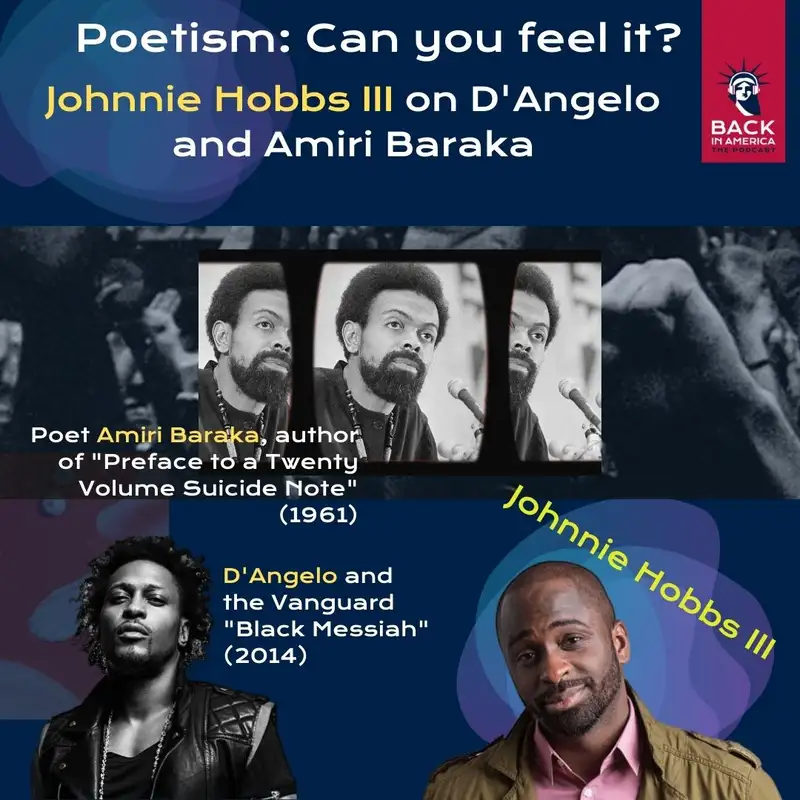
Poetism 3: Can You Feel It? Johnnie Hobbs on D’Angelo and Amiri Baraka
In this week's installment of Poetism, back in America's Josh Wagner invites tap dancer Journey Hobbs to talk about black representation in film as well as Amiri Baraka and D'Angelo and the Vanguard. Welcome to Back in America, the podcast. I'm Josh Wagner and this is Poetism on Back in America, your podcast questioning American culture, values, and identity. In case you're just tuning in, Poetism is a summer series that I've launched on Back in America to explore the interrelations and connections between American poets and musicians. How do thoughts express themselves in art and what do we hear when we
listen attentively to them? A moment ago, you heard a few bars from this week's guest, Johnny Hobbs, an actor, filmmaker, and occasional tap dance instructor based in Los Angeles. And then, you heard the opening vamp from D'Angelo and the Vanguard's Back to the Future Part 1, the sixth track off of their collaborative 2014 album Black Messiah. 14 years in the making, Black Messiah marks a decided shift in D'Angelo's discography towards rock and funk. Following his own study of American music, D'Angelo in Black Messiah nominates rock as the nucleus of blues, hip-hop, soul, and funk, or in his own words, as the thread that holds it all together. Before we dive into D'Angelo's timeless tomes, or as Questlove might call it, his utter disregard for time, be it
quantized meter or be it musical references, Johnny and I talk about his path towards Los Angeles, his film career, and Black suffering on the silver screen. As Black scholars have noted for decades, it is impossible to depict Black suffering without replaying and reliving that suffering, even if from a remove. Here, Sadia Hartman has refusal to directly quote from the beating of Aunt Hester and Frederick Douglass' slave narrative in her own book, Scene Subjection, invokes that violence through its very absence. But that work of rediscovery and reflection does something, and it is in this something that Johnny and I tunnel on this week's episode of Poetism. Along the way, we tune into the stark music of Mary Baraka's Preface to a 20-volume suicide note.
Welcome to the podcast, Johnny. What's up, man? How are you doing? Thanks for having me. Yeah, it's my pleasure. And before we get into anything too serious related to the poetry or music, I was just wondering if you had to describe yourself in three words, what three words would you choose? Oh, if I had to describe myself in three words, some of them might sound pretentious. Oh, you know what? Actually pretentious, charming, and neutral. Neutral? Yeah. We love it here. Yeah. And I found through your work at Colburn as a tap dance teacher, and I'm just curious, how does one get into tap dance? Yeah, man. My parents are in the arts. I'm from Philly, so my mom is a dance teacher. My dad is
an actor and an acting teacher. And they worked together. So I was surrounded by all kinds of arts, singing, dance, all types of styles, acting, plays, musicals. I went to go see shows with my parents or I was in shows that my parents were a part of. So tap dancing was really close in there with things that my mom used to watch growing up with me. I took like a tap class when I was seven. I just did it because karate wasn't available. I say that to say about my parents because when Bringing the Noise, Bringing the Funk came out. Do you know what that is? I have no idea what that is. Yeah, man. Bringing the Noise, Bringing the Funk was a Broadway show that came out in the mid-ish late 90s. It was an all-black Broadway musical that talked about
the black experience in America from 1619 slave ships to the present day of the 90s. And it starred Jeffrey Wright, who everybody knows. He's the light-skinned gentleman. I think he's Arnold in Westworld. He was in it as a narrator. There was Anne Duganay, who was the singer. She won Best Supporting Actress in a musical for that. And then Savion Glover, the great tap dancer that everybody knows, light-skinned brother with dreadlocks. And they were tap dancers and they talked about the black experience through tap dance. It blew me and my best friend away, my best friend Khalil. And we started tap dancing, not knowing what we were doing at all. We just loved the fact that these men that listened to Puff Daddy and the locks and they
listened to Wu Tang and they wore Timbs and they wore baggy clothes. I'm actually really curious about those early days. Was it hard to get apps? No, man, it wasn't hard to get shoes. Because I mean, like I said, my parents were already doing it. So I had access to... My mom was already a part of the... She tried to teach me and my best friend tap dancing, but we weren't really trying to hear it from my mom. Because my mom, she was probably like 30 something, late 30s or early 40s. But we thought this was an old woman who was trying to teach us the old style of tap dancing. But really she was trying to teach us technique. But we weren't trying to hear that. We were young and we were just trying to do what we saw. But I know that, I mean, like you probably,
right? You probably had a lot of hobbies and your parents were like, oh, he's into that now, or he's into that now. So it was one of those things for my parents. Okay, well, he'll get out of this. Because I was into archeology, karate, I wanted to be an astronaut. I wanted to be all the things. So they weren't really trying to hear it. So I went down in my basement and they weren't going to give me tap shoes because I didn't want to spend money on it because they thought it was going to be like a two week thing. But then I put bottle caps, soda can bottle caps on the bottom of my Nikes and I ruined my Nikes. And my mom was like, it would be cheaper to buy him regular tap shoes if he's going to keep on ruining his fucking shoes. So she got me shoes. So there you go.
Hearing you talk about the early part of your career, what's kept you going from then to now? Man, you know, it's been so weird because I didn't want to be a teacher, number one, and I didn't want to be a tap dancer. I went to school for acting. I just happen to love tap dancing. That's the truth. The life that I live now is not the life that I thought I was going to have at all. I thought I was going to be acting on stage, which I did. And I thought I was going to be acting in TV and film, which I didn't do as much as I wanted to, but I did. I never really had the life of I'm going to go to this dance audition. It was always, I'm going to go to this person's place, maybe take a class, but really we're going to just jam and improv and, oh, I have an audition
tomorrow to act. So I didn't live the life of a dancer and I barely tapped. Most of my tap dancing has been teaching. It's weird because I think my first like found you through tap dancing. Now it's weird to like refocus. I know it's so weird. The fact that I even teach like my parents and the fact that I teach tap dancing for a living. I mean, I love tap. Don't get me wrong, obviously, and I love the history of it and the culture and I am truly appreciative of it, but this is not the thing that I thought I was going to do. I literally started teaching tap dancing for money because I had made a short film called Nostalgia and Filian in New York. I had left my job at Apple computers to make that movie. And then what ended up happening is I was like, okay, I'm just going to leave
this secure job that I had and just try and be in the film business. And I was PA-ing, being a production assistant, not really working, broke as hell. And it wasn't good enough. So then one of my boys was like, yo, do you want to just supplement some income with teaching tap over the weekend? And so I made my little monies, whatever it was, nothing crazy. One thing led to another, led to another job, led to another job. You allow it to sort of happen if that's what's happening. And I love this shit enough. So it was no problem to do it. I guess thinking more about tap dancing, I feel like a lot of our listeners are, maybe probably have heard of it, but don't have any firsthand experience actually tapping. And
I just love when you're talking about the kind of the improvised nature of the history of tap dancing, of evolving around time jazz. And I'm just curious if you could just talk a little bit like what it's like to be in the moment on the stage or just even in front of a classroom, demonstrating a move or a choreographed set. I mean, that would depend on the production, that would depend on the piece. And so let's say it's like a music video, they probably have choreography that I've learned. And then from there, if they say, hey, just improv to the song, just so we have like B footage of you doing something or y'all doing something. If I'm learning something, if I'm learning, well, hold on, let me step back. So if I'm learning somebody's
choreography, then it's how do you interpret that person's choreography? So you learn it the way that you need to learn it, whether you're learning by counts or by movement or by terminology or by looking at somebody. And then the second time, third time, you try and put your own thing into it. And then they'll probably tell you, okay, that's too much of you, let's pull back and let's be with the group. But the improv counting is involved, balance is involved and all those kind of things, but you don't think about them because that would hinder you from that would stop you from being truly creative. The end result, I'll say of improv is for you to know all your shit about the thing that you're doing, that you are no longer thinking about the shit. Like you're no longer
thinking about it because it's like walking and talking. Like we've done it as human beings for so long that we don't really have to think you just know how to do it in one step, the water just flows and you make the decision, you make the decision of how much comes out or not. You have control over that. Do you let it breathe? Do you fill it with a lot of stuff on purpose? Are you off tempo on purpose? How much emotion are you putting out? And you're controlling it because you know enough. Right. Yeah. And I love hearing you talk about the personal nature of it. It's about you as your body becoming an instrument. Yeah. I mean, it's nothing but personal, man. I mean, if you know the history of tap dance, to even a little degree, I mean, it's nothing
but personal. And I'm talking about the history of tap dance from the 16, 17, 1800s up into now. If you know even a little bit of each of those moments, the shit is personal, especially as a black person. Could you talk a little bit more about the history of tap, especially for people listening who aren't as aware? This is a really, really condensed version, but African movements and steps mixed with Irish movements and steps through indentured servitude and enslavement of Irish and the Africans, West Africans specifically moved from the Caribbean's to to America in the north and the south, mainly in the north. And they all worked together. And lived together and made their own steps together and tap dancing became what it is
because of one man, William Henry Lane. Also, there was a rebellion in where white people or the people, you know, white people took Africans drums. They took their form of communication from them. So instead of using the drums, they hand clap, they stop their feet, they used rhythms to communicate with each other because they took their drums because they no longer, they didn't want them to do and have another rebellion on their hands. All of these things sort of cultivated and meshed and made what we have today as like one of the truest American dance forms that we have. If anybody wants to know more, I would read Tap Dancing America by Constance Vance Hill. And there's another book called Jazz Dance by Marshall and Gene Stearns. But yeah, tap dancing America
and jazz dance will really sort of get you straight. And time my last like preliminary question, which I think will get us in the direction of Emiri Baraka and D'Angelo is about the Hobbes test. So what is the Hobbes test? Oh, I didn't think I didn't think we were going to talk about that today. Just to give you some brief history of my feelings about movies and period pieces. So black period pieces, traditionally speaking, the ones that are successful that we all know about and I'm talking period pieces from like 17 1800s to like the 70s. Most of the period pieces that when we think of all black cast and period pieces, they are black folks are always getting beat white people are always beating them, or they are calling them all kinds of names or we
are trying to as black people trying to reach being equal to a white society. I think these movies should exist. Don't get me wrong. I think they should exist. I've been exposed to them since I can remember. But I think the older I've gotten, I've looked at those movies and said, Wait a minute, why is this always the only thing that I'm seeing of black people for black people in period pieces? Why are we always getting traumatized and beat and called names and we can't live here, we got to live here like it didn't make any sense to me over a certain amount of time. So last year, I tried to put my feelings into words. Now there are multiple tests like the Bechtel test for women. There's other people that have made tests that are similar to mine. But I am specifically
talking about period pieces, you know, with black people can we have a movie that is period that the black people in it are not being traumatized and they are living their normal everyday lives, because listen, there were doctors, there were politicians, there were milkmen, post office workers, there were grocery store clerks, there are people that own their own businesses, there were people, everybody. And there's like not a lot of movies when you think about it that you know that are popular that give a story of a period piece of a black people's lives where they're just being themselves and being individuals that have no trauma linked to them, except for the trauma that happens in everybody's life. Oh, this person broke my heart. Oh, this person, I love this person. I
hate this person. I'm angry with this person, but it's nothing dealing with race per se. And there's a few movies that do it. Obviously, there's several recently, One Night in Miami on Amazon Prime did it or Sylvie's Love on Amazon Prime, Color Purple, you know, etc. There's a few offenses that came out with Denzel Washington that that did it. So, you know, I think the test is like a series of points that the movie can't have this thing to pass the Hobbes test, it has to hit these five points to pass the test. And the major one is like black people just cannot be traumatized in any kind of way or like trying to be equal to a white person. Right. And as you're talking, I'm writing this like theorist, Sadia Hartman, who talks about there's no way to talk about like slavery or
trauma without kind of re performing that same trauma. Right? Like by professing on screen, you're just doing the same thing that was that you're instilling people, you're harassing them. And even though it's fictional, it doesn't change what you're showing. It's important for those stories to be told. It is important for people to know their history. Just like I know my tap history, it's important for my improv and for how I teach. It's important for you to know the history of the saxophone, whatever that means to you. It's important for black people and every American and every person to know something about a culture that is not a part of your life, especially when we're talking about one of the sins of this country, which is slave and racism.
It is important to know. However, it is impossible for somebody to move forward and not fully acknowledge that those people in the past maybe went through those things, but they also made their beds, fell in love, walked a dog, wanted to be a detective, grew up wanting to be a basketball player or wanted to be a doctor or wanted to be or gossip eat with each other. Just regular shit that white folks do all the time in movies, especially in period pieces. White folks just do regular shit all the time, bro. Okay, cool. That's what's up. But can we get that? And can it be popular? Can it get eyes on it? Like, does it always have to be black trauma? And so you have those movies from the sixties and seventies, those black exploitation,
those slave exploitation films, not black exploitation, slave exploitation, drum and mandingo, where they are literally almost like watching porn. It is just a bunch of white people beating the shit or a white woman seducing a black man and threatening his life. And I'm sure that those people that made those movies probably thought they were doing a good thing. Like, oh, we're showing it as it was and we're showing it. Well, no, man, you're making a fucking movie. You're just trying to get butts in the seats to cause more trauma. You're giving us a fetish. And that's not fair. That's not fair. So, you know, I want to see more of those movies and I want to create more of those because I think that that's what the world needs. That's what black folks need.
We need to know that people live outside of trauma. Yeah. And I guess kind of closing this conversation, what's your favorite film? Network 1976, directed by Sydney Lamet, written by Patty Chavayesky, Faye Dunaway's in it, Robert Duvall and Peter Finch. It is a really great satire on media and entertainment and it is so well done. And I saw the play with Brian Cranston on Broadway and he does a great job and people do a good job. But then seeing the play, I was like, oh, there is only one way to make this movie work. And that is how they did it in the movie. It is just so it's so lovely and so funny and serious. And one of the reasons why I love it the most is, again, we have these sort of memory, these snow globe moments with things.
And then that's why we enjoy something so much. My father introduced me to network. He liked it. And so me growing up wanting to probably, I'm sure, be like my father and looking up to him, I liked it. And then I ended up really enjoying it when I watched it. My second favorite, I won't go in my top five, but my second favorite is If Bill Street Could Talk. It should be on Hulu. And that is a James Baldwin book directed by Barry Jenkins, who directed Moonlight. And it's absolutely fantastic. And it's one of those movies that it's a period piece that doesn't harp on race too much. And it is a beautiful, beautiful, beautiful love story, a beautiful slice of life of these people that live in New York. And it is absolutely stunning. I cry at every single scene.
Thank you. Yeah. So I think now might be a good time to pivot towards D'Angelo.
Yeah, man. I remember when that album came out and D'Angelo hadn't dropped an album like over a decade. And he was so impactful when I was in high school, from the way that he sung to this kind of music that he had to the way that he looked. You know, it was so huge. That album Voodoo, I danced to Stevie Wonder and I danced to D'Angelo. Those are the things that I know for a fact that I danced to growing up and how I figured out how to put tap dancing and put phrases together. When that album came out, I remember like putting on my headphones, leaving my apartment and just listening to it and with a smile on my face in the middle of the night, walking from my apartment and just walking away from my apartment until it stopped. And then on the way back, I listened to
it again. And that song passed by, like I was listening to the whole thing and that song sort of is in the middle. And then I heard it again. And then I listened to it a third time later that like the next day I was trying to find that bass. I was trying to, I was like, what song is that? So I had to listen to the whole thing again to find that thing. And I would just lit up and it reminded me so much of gospel music and those chords bro, like those chords mean so much to me, like that kind of organ or whatever that is. I mean, I just cannot get enough of that shit. And then I think the lyrics too, the chorus, he's talking about time and he's talking about memories and going back. And I have a big fascination and love for talking and thinking
about time and thinking about memories. And so I think that's another reason why that song feels like a gospel song and has those organs, it has that deep base, has those chords, they're singing their asses off and they're talking about something that is meaningful to me. And they give you enough space as a tap dancer. It just grooves so well. We're listening together and we can't not dance to it, at least a little bit. You can't help but smile. And that was just part two. There's a whole other part one that has a whole other portion to it, but that chorus and that hook for part two, they sound so beautiful and so in sync. I'm not quite sure what to say about this song just because you listen to it, you hear it and like anything I can say about it
is so pathetic. No, man, go ahead. Try it. Try to. You kind of just feel it. T.S. Elliot has his line that poetry has to be felt before it can be understood. I definitely felt that with this song, even like know what the lyrics are. I don't pay attention to them as much as I just you'll. Yeah, and I have been in a lot of churches in my life, but that very particular sect of Baptist Christian church, I have not been in that much, but I've been in it and it is a show.
They and they're not trying to perform, by the way, they are really trying to get after something, get their souls in order for what they believe is is the right path. And so I haven't been in a lot of those, but I've been in shows with people that have lived that life and shows that have had that kind of organ and that kind of church feel being in those churches and being in those shows, those chords, whether it's ancestral or just my own past or my gender or if it's generations calling out to me from the past, it is something that calls to me so hard. And I think most people enjoy it because it feels like jazz, but it feels like church. It's an amalgamation of a lot of different genres that call out to people. And I think you feel it too. Hey, how'd you get into
poetry, bro? How'd you get into liking it? That's a great question that I don't have a good answer for. The short answer is that novels are too long. The thing about poetry is that a lot of poems are fairly short and you can go over every single inch of that poem and memorize it and know exactly how it functions in a way that is absurd to reread a novel or use no way you can memorize or know how the whole thing fits together in a way that is totally possible with a four strands of foam or a sonnet. And then the puzzle there isn't that it's a max list and that you can't get through it all, but it's too simple. You don't know how the words fit together or how they gel together and whatever that connection is, is the puzzle that draws you in. Whatever answer you
get to is always disappointing. My family doesn't understand my interest in poetry and I always struggle to explain to them why a poem is good or bad or why I like it. Or I just read it, but I don't have a good language describing what about it is so appealing or attractive or enticing. Poets historically have lived really hard lives. It seemed like the greatest time to be a poet was like 1800s. No, I'm not going to say more because I don't know what I'm talking about. I don't know what I'm talking about. I literally don't know what I'm talking about. This is the part of the improv that was fucked up. This is the part that didn't work. I have known that information, historically speaking, most of the poets that are really well known have not lived a great life.
I don't know if I believe that. I think you're right. There are lots of poets who have done that, but I'm wondering if that has to be that way. I think that plays into this tortured artists. You have to be suffering to work hard for great art. If you're not starving, then you have nothing to write about. There are these great books about the wives of all these Victorian poets and novelists who went to such a great lengths to provide for their husband. I forget who it was, but this writer could not stand the sound of chickens. He started to wipe out to every house around them to either get them to move away because chickens are too loud or just go and kill all their chickens. She was running around the neighborhood with a meat cleaver trying to kill
many birds so her husband could write some novels and pay their rent. Yeah, man. I was just curious on your history. That's what I think about that. I feel that like T.S. Eliot. I felt that song before I understood it. Can we actually talk about the lyrics for a little bit? I think the two lines that stand the most are, the season may come and your luck may just run out and all that you have is a memory. The closing little refrain used to get real high, now it's getting a buzz, which I think is echoed in part one of Back to the Future.
That used to get real high, now I'm just getting a buzz that always reminded me of youth is wasted on the young. You used to get real high, used to do all these really extravagant and sort of extreme feelings and extreme, I'm going to change the world and I don't care how I do it and I'm going to date this person, I'm going to get this person's number and I'm going to do this and I'm going to smoke this and I'm going to drink that and everything's too excess because you're living it out for the first time. The older you get, the more your mind and body will say, okay, I've been there, done that, I can no longer do that or I no longer want to do that or that is no longer fulfilling for me. So now I just get a buzz. Yeah, no, I love that point. And also the
thing that you're so passionate about, you thought would change the world, you had the memory of it, you have the memory of like that initial passion or reverve, but about the experience like why not? It doesn't know and it's okay. It's okay. You know, a lot of friends who are older than me, like in their 50s or 60s, some of them, you know, are like, man, the things that I wanted to do with my life that I didn't do, they don't mean that much to me anymore. I've done other things with my life that were just as fulfilling. So it's the same thing for me in acting. I have found something that fulfills my life and are there moments of regret? Sure. Are there moments of seasons may come and go and my luck just ran out and all I have is some memories? Sure. But I have
learned to sort of compartmentalize and love the thing that I have and desire more from the things that I have. And that for me, in my life is a fulfilling life. Do I still want to pursue things and do things? Of course I do. Not with the same vigor, you know, as I once did. Maybe this is a good time to like move over to the poem. Do you want to go ahead and read it? Okay. Preface to a 20 volume suicide note by Amir Barraque for Kelly Jones, born May 16th, 1959. Lately, I've become accustomed to the way the ground opens up and envelopes me each time I go out to walk the dog or the broad edged silly music the wind makes when I run for a bus. Things have come to that. And now each night I count the stars and each night
I get the same number. And when they will not come to be counted, I count the holes they leave.
Nobody sings anymore. And then last night I tiptoed up to my daughter's room and I heard her talk to someone. And when I opened the door, there was no one there. Only she on her knees peeking into her own clasped hands. Wow. I really love how you read that. And I think one thing that comes out for me is the rhythm and how the first few stanzas are a lot more action packed. And I think you're reading a little more quickly than later on and you get to that line. Things have come to that. Things have come to that. Nobody sings anymore. And you feel the stanzas are broken up. So those are lines on the room. But you feel that the mood of the poem is dropped. And these very simple words. The growling gets taken out from under you. Yeah, man. He's getting after something on this too,
because reading it is so sometimes can be a little disorienting because of how it's broken up. And so there were moments when I was like, wait, what's the grammar here? What's the syntax? What's the way that it should be? Then there's moments that sort of hit you. Like you said, things have come to that and nobody sings anymore. And she's praying into her own. She's peeking into her own hands. You sort of understand that he's going through some form of desperation, whether it's being a black man, being a father, not feeling like he's adequate for whatever reason. It does connect. It does have a sort of like a cousin to Back to the Future. Why'd you pick this? Well, this is a little bit literal, but I feel this is a poem of someone's luck running out or
realizing where they are, where they want to be and seeing everything collapsing around them. And for D'Angelo, I think that that moment is redemptive, but in a very different way. I think for D'Angelo, it's the memory of having done something that renews. Whereas in this poem, it's his daughter, right? The second line always trips me up. The ground opens up and envelopes me. It's a really awkward play on words, but the sense in which the ground swallows you, it digests you, it kills you, but also it turns you into an envelope. It breaks in this very straight linear way in which there's no way off the path. Yeah. It's a sense of linearity that I think is really shocking. I guess the other thing on my mind was the way someone's music totally works into this
poem. The style of music the wind makes when I run for the bus is almost akin to a kind of high that's been lost. It's just like the air wrestling. We wouldn't go to a concert hall to listen to air. It's mundane. Very mundane. Very mundane. He's aware of it and he calls it silly. Those are the words that drive home this very tired point that you really feel suffuses throughout the poem. I think he cares about it as being late for his bus and that the wind's holding him back. But I think if his daughter was there, she would be like, the wind was the thing. That was cool. You missed your bus. Okay. You're late to work or late to wherever you're trying to be. But there was a moment that happened and you were there for that. I liked that, man. Yeah, man. When I
saw you print this poem, it reminded me that I mean, probably any actor that grew up around my time and before the Dutchman by by by by Emma Barak, it was was a big deal, man. And I did that. I did a couple of scenes in college. In fact, right here, I have a Dutchman movie poster. I don't have it on my wall anymore, but I have the I have a Dutchman movie poster frame. This is scary poem. I mean, look, I mean, he's talking about suicide. You know, I mean, it's a suicide note, bro. It's no joke. I mean, he's going through something. I mean, I read it a couple of times and I'm sure that Shakespeare or hip hop or other poems like it comes back, you'll read it over and over again or movie music lyrics and you'll say, oh, that's what that meant. Lately, I've become accustomed
to the way the ground envelope, the ground opens up and envelopes me each time I go out to walk the dog or the broad edged, silly music the wind makes when I run for a bus. Things have come to that. Yeah, it's like, well, this is it. This is this is what this is what I got. Yeah. And I do wonder how seriously to read the suicide note nature of this poem, because I do think it relates to what we were talking about earlier with the Hobbes test. I was reading some other poems in the collection and the collection ends like these two lines. My so-called people, Africa is a foreign place. You are as any other sad man here, American. And so I think part of what Raqqa is working through is like assimilation to like white American culture that he's feeling and this kind of
disorientation or alienation from his roots in Africa, from wherever his ethnic identity. And that the more you assimilate, the more you rise up in the culture, the less of you you are. And that I wonder if the suicide is of the white part, the assimilated part of his thinking.
Oh, I dig it. I dig it. And that like is a way he was he is like trying to kill a part of himself to become even more himself. And that's also something that, you know, you have to kill a part of you to become the next version of yourself. I mean, Jay-Z talks about that in the song, Kill Jay-Z, where he's like killing off the one part that was his youthful part to come into this next phase of his life as a father, as a better man, as a more enlightened person. And I don't know the Hobbes, him talking about like, you are an American, you are, what did he say again? You are as any other sad man here, American. Yeah, I mean, you know, he is coming at it from an angle of pessimistic, you know, it's like, man, it sucks to be here. But but there's also some goodness in
that where you can look at the next person, like I can look at you, Joshua, white man, and I can look at and we and we are American, uniquely American in our own ways. And that is one of the beautiful things about the second movie I talked about, if Bill Street could talk that the people in that movie happened to be black, happened to live in an inner city, happened to be dealing with their own personal lives, but they are dealing with their own personal lives. And it is a beautiful thing to watch these people navigate their love for one another, their hate for one another, etc, etc, etc. And they are uniquely just people living in these vessels, trying to get by trying to make it through. And does race play a part in the movie to a certain degree? Yeah, it does to a certain
degree. But it's not the movie. It's not the reason why you're watching. You're not watching it for that. So I guess you're right. That poem that you just mentioned does have something to do with the Hobbes test and has something to do with with being an individual outside of the color of your skin. I think about the last stanza really of the poem when Barack is talking about his daughter, how she's she's praying on her knees, peeking into her hands. And so I think one thing to say is that there's a massive contrast with Barack trying or the narrator trying to count the stars up in the heavens looking to escape the earth and feeling trapped. Every time he counts the stars, an uncountable number of planets and stars are out there. He gets the same exact number. Everything
he tries to do to escape his own position, his own body, his own whatever is going on in his life results in more of the same. But when his daughter looks inside of herself into her own hands, that's when something changes. And we don't know what changes the poem is the ends on that symbol came into where there should be nothing and finding something. It's up to you to make those decisions. People have this is not either or really, but you know how people say, oh, pull yourself out by your bootstraps. You can do it your own self. Yes, you should be able to. And there's things that you should be able to do that in. But then there's another part, you know, people need help. People need assistance. So you can only pull yourself out by your bootstraps if you got boots
to begin with. You know what I mean? So when you're talking about her looking into her own hands for herself, she's looking from from your interpretation. She is looking for her own destiny. She is looking for her own destiny outside of her father's. She's looking for her own destiny outside of society, whatever that is. But I'll say this. I also looked at it as, oh, she's just a little girl just praying and peeking into her own hands. Because I know when I used to pray back in the, you know, when I was a kid, I used to put my hands together like this and then sort of peek through and try and see who was there or who wasn't and all those kind of things and not really taking it seriously when I was at the dinner table and sort of like looking to the side of playing
with my cousins or whatever it is. It could be also one of those things too, right? Where he's taking life so seriously and she's a kid just living life. Just like, okay, like you said, the wind is the most important thing when he's worried about more adult things. That absolutely might be a good point to end on. Let's just, anything else you want to say about what happens when you put these two are objects next to each other? You know, it's all up to interpretation. And again, that, you know, what you talked about feeling before understanding. This poem is something that I'll look back at often and be like, oh, I don't really know what that meant, but I know that I feel it. It's the same thing with movies. I don't really know sometimes how movies start or end or
little things about it, but I know how I felt when I was watching it. You know, I like network so much and I call network my favorite movie of all time because I know what I felt when I watched it. And I know what I felt when my dad told me to go and get it at the video store because I should watch it. I remember that I know what I felt. So it's my favorite movie of all time. And just like D'Angelo's Back to the Future 2 is hands down, probably at least in my top five favorite songs of all time. One last question. And it's a question we ask all of our guests. And I'm actually excited to hear what you're going to say. And it's actually really hard. What is America to you? Complicated. America is complicated. America is complicated. You know, it's like that Facebook
status or that MySpace status where you would like you can put like, like I'm single, you know, or so and so, so and so, or I'm in a relationship or married or don't think then they have something that's complicated. I mean, it's a I'll tell you this. I wouldn't want to live anywhere else or be born anywhere else for these two facts. I don't know anything else. And from what I have been told, this is the best version of life that I know, again, what I've been told, again, my me and my lady say this often, well, she says this, this is the best time for a woman to be alive. Now, she is talking about specific specifically America, right. And I can say the same thing to that for me, as a black man and her as a woman, this is the best time for us to be
alive. But I would say that America is super complicated, because it's a beautiful place to be. We have a lot of freedoms, but but we also are not told a lot of things. And things are hidden from us. There's a lot of corruption, a lot of hate. But I would say that that's also a lot of places and a lot of a lot of places are like that, right? We're not the only country that has those things. So you could probably ask a Guatemalan, what does Guatemala mean to you? What does Australia? What does you know, Tokyo? What does bubble bubble bubble bubble bubble? What does Mars mean to you? If you ask a Martian or whatever, they're going to give you their version of what our version is of that same question, because all they know is their life. They don't know anything
else. And they are told this, whatever that this is, some people are like, yo, I hate where I'm from. And I'm told America is dope as shit. So then they want to come over here. Do you know what I'm saying? It's all relative, man. It's case by case basis is all relative. And that's what I'll say about America. Great. Well, thank you so much. You're taking the time to talk to me. Yeah, man. That was it was a great I love doing it. It was so fun. Thank you.
Traveling at the speed of lightning. At the same time I'm in the same spot too.
Room was kept in by the same way you left it. But what about the sweat and messing attitude. Oh
Uh I'm with all your good Don't turn me on your pretty Turn me back on you
Been missing Over what you've been missing Can't be just like cousins kissing That's not true