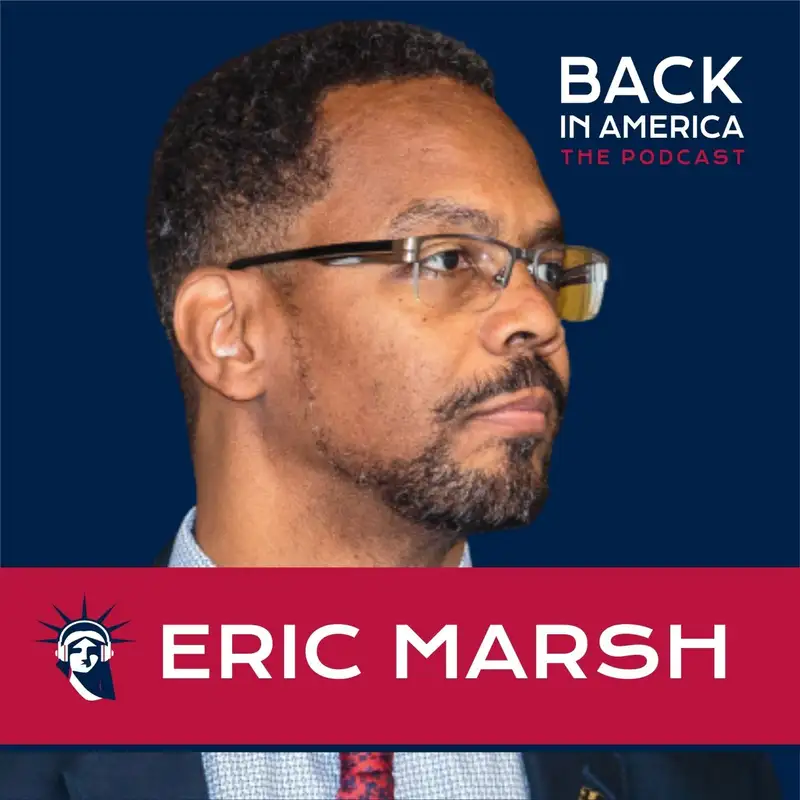
Part 2/2 - Eric Marsh, Black Activist on the George Floyd's Mural
If you're tired of arguing with strangers on the internet, try talking with one of them in real life.
Welcome to Back in America, the podcast.
This is the second episode dedicated to the George Floyd mural in Minneapolis. If you haven't listened to episode 1 yet, an interview of the lead artist, Kadex Herrera. I strongly recommend you do so before listening to this episode. Hi, Eric. Can I ask you to please introduce yourself? So my name is Eric Marsh. I am a community activist and father located in the city of Philadelphia. Thank you. Yeah, I see on your LinkedIn profile that you indeed describe yourself as a father, an educator, an entrepreneur, a community leader, and an advocate for fathers and family. And we last spoke in November last year. We spoke about the experience of being
a black man in this country. And the reason why I'm reaching out to you today is to share your experience as a black person and a community leader in regard to a controversy that has surrounded the George Floyd mural in Minneapolis. I read that Keno Evol, the executive director of Black Table Art, an organization promoting black artists, has voiced his concern about the lack of black artists in this mural production. And I was really wondering how that makes you feel and what you make of this controversy. So first, let me start off by saying, one, thank you for having me back on as a guest. I really appreciated our conversations previously and your sensitivity to this subject. Two, I also want to say, not being a resident of Minneapolis,
there are some dynamics that I can't speak to. And I certainly don't want to appear to speak on behalf of the arts community or the black community in Minneapolis specifically. But having said that,
I am concerned about the disconnect between the artists involved, both the black artists and the artists who led the mural creation. I do feel like that there is an ongoing issue in this country with this idea of Black Lives Matter, black liberation, anti-police brutality movements that target and predominantly harm African Americans. But African Americans aren't necessarily always at the forefront of the issue. I think there is an important dialogue to be had around it, which is why we're discussing this. But yeah, I feel like there's almost a blindness when it comes to these issues that some activists, many well-meaning activists and allies, approach the issue of race and racism in a way that may appear to be or they may profess to be
colorblind. But that just negates the actual subject matter and importance of the black experience in America. So I feel like that there is definitely a disconnect when it comes to white allies and black Americans when it comes to this conversation around race and racism.
Hmm. So there is a lot here. What do you mean by a disconnect? I mean, this is very sensitive and I am
white. I took part in the Black Lives Matter march here in Princeton. There were a lot of white people and at the time I heard that many black people said we are happy to see that white people start to engage in this topic. And we heard a lot of black people say, you know, our condition, our experience, we kept it for ourselves. We rarely shared it. It was something that we only discussed within our family, among friends. And now we start to discuss what it is to be a black in this country. So I felt that there were some positives out of the Black Lives Matter movement after the killing of George Floyd. And yet I hear you say that there is a disconnect.
Can you speak on this disconnect? I do agree. We are, as African Americans, very happy to see the outpouring, the global response to George Floyd's murder, Breonna Taylor's case, and the numerous other incidences of not just police violence against African Americans, but systemic racism. Right? And so I've always said that, you know, racism is actually a white problem with black victims. And so, yes, it's great to see this outpouring of support. I feel like that the disconnect that I was speaking about earlier comes in where there are opportunities for leadership and guidance and for African Americans to be centered in the discussion and spaces made for African Americans in this country to lead these discussions, these movements, these events.
And in this case, this mural. Right? And so the disconnect often comes in where you have white and brown allies and other allies who are rightfully outraged by systemic racism and violence and oppression acted upon black people. Right? But are so engrossed in the act of protest that they actually fail to elevate the voices of the black people around them. It's very easy to be upset about a thing, but it's also easy to go off in the wrong direction if you're not centering the people who are most directly impacted by the thing that you're upset. So in this case, we're talking about police violence, the death of George Floyd, and systemic racism. And so in relation to this mural, you know, as the mural was considered to being developed
and there being three lead artists on this project, it would have just made sense to look around. And I hate to use that phrase, it would have made sense because clearly that is not what's happening in it. And it's a condition, almost a tradition that black Americans have had to face even when working with allies who are non-black. We often are failed to be asked to what our opinion is or asked to lead a movement or an event in some kind of way. And so yes, it's great to see allies of all colors and backgrounds and ethnicities and identifications. But when you have something so central to black life and African-American life, to not include someone who is African-American at the forefront and at the very beginning of the conversation, I think is a disconnect,
it's a missed opportunity. Yeah. At the time you spoke about the experience of being black in the US, you spoke about systemic racism already. And since then, obviously a lot have happened since, among other things, the killing of George Floyd. We spoke about the white ally, you spoke about the disconnect. I am wondering, do you think or do you notice in your experience any changes? Well, I mean, it's definitely become the biggest topic of conversation.
Previously, America was able to just brush it in a rug or push it off to the side
when the reality is it is central to what makes up America. And so in terms of changes, what we've seen as we spoke about the increase in protests that the number of non-black allies and protesters and people who are coming out into the streets to speak out against this system has really exploded as a result of not just the murder of George Floyd, Breonna Taylor, Ahmaud Arbery and others. But I think the pandemic has had a lot to do with it. People being on quarantine, we've been able to get out of the rat race, off of the wheel of being caught up in this capitalist, consumer driven, work, work, work mentality. And people have had a chance to take a step back and look around and actually see what African Americans have been talking about
for generations. And that is the systemic racism that's happening around us. And so as a result of that, people are becoming aware and awakened to this issue. I think that's the biggest change that we've seen. However, we also see a lot of pushback in the other direction, which is typical for American society. And I think probably human nature. We see a lot of people who are taking offense to the term Black Lapse Matter. We see a lot of people who are taking offense to other instances of people protesting and crying out. There was a lot of conversation, particularly here in Philadelphia, about so-called looters, right? Where property damage. And people were offended at that and outraged by that. But the reality is that materialistic items and goods
and property should always be secondary to human life. And if it takes that kind of action to raise awareness and raise some sense of outrage, or to at least highlight the level of outrage that people are feeling. Have I seen things changing? Yes. Do I feel like they've all changed for the better? That's harder to discern. Only history will be able to tell. I do feel like the rhetoric in our country, the language itself is becoming more and more divided and divisive. So I don't know. I don't know if we're definitely changing, but where we end up is anyone's guess. I want to stick to the art world. And I was wondering, do you think that you have to be of the race for which you fight when you are not activist? No, no, not at all. I don't feel that
it's necessary. I think that's one of the things about art that provides that creative license, that we can step outside of ourselves and into another person's life or existence in a way that allows us to create and to be creative. Now, that doesn't negate the fact that if you are trying to pass something off as being authentic to another person or people, and the lived experience that you haven't lived, then that's where the disingenuous comes in. That's where the phoniness, for lack of a better term, comes in. And that's where the pushback comes from. I mean, it happens within the art culture, in art circles, amongst people of the same groups as well. And the example that comes to mind, I think about specifically hip hop culture.
There is an ongoing debate inside hip hop culture when different MCs and rappers talk about experiences in their songs, there's always this question, well, did you really live those experiences? And so as artists, there's this debate that's always happening internally. However, it just becomes more exaggerated and heightened when there is this sense of cultural appropriation or misappropriation, as I prefer to say, when someone from an indifferent culture or lived experience tries to replicate or recreate the experiences, the life, the words of someone or something that they've never lived. I want to go back to the original story about the mural and the fact that one of the lead artists was actually a person of color. I think he described
himself as Miss Diesel. Again, the license, the creative license of an artist to be able to express themselves and to express the allyship for a Black Lives Matter or Black life in general, I feel like we need to honor that and there is a space for that. I think the offense that is taken by Black artists who feel like they have been left out in some kind of way needs to be heard and it needs to be validated. But I also would encourage Black artists to also step up to the forefront and don't allow these other projects by people who are not of African descent to upset us to the point where we stop creating our own stories. I think it's important, the number one thing that we have to do as African Americans is tell our own stories and that is in whatever medium
that you as an artist are capable of, whether it's your spoken word, you're telling your own story, whether you're writing it, whether you're painting it, whether you're singing it, whatever it is, the only way that the rest of the world will hear and know and understand not just our stories, but the nuances that are different in what a Black man or woman would create versus someone of any other ethnicity or culture would create is by seeing the thing that African Americans would create. So we have to create our own, we have to tell our stories and if somebody else wants to come along and they want to share, I encourage allies to just be mindful, encourage allies to just be mindful about centering and elevating and uplifting the voices
of the people who you want to be an ally to and in this case is we're specifically talking about African Americans and Black Americans. Thank you so much, thank you for sharing your insight and your experience on this very difficult matter. Thank you for having me, I appreciate it.