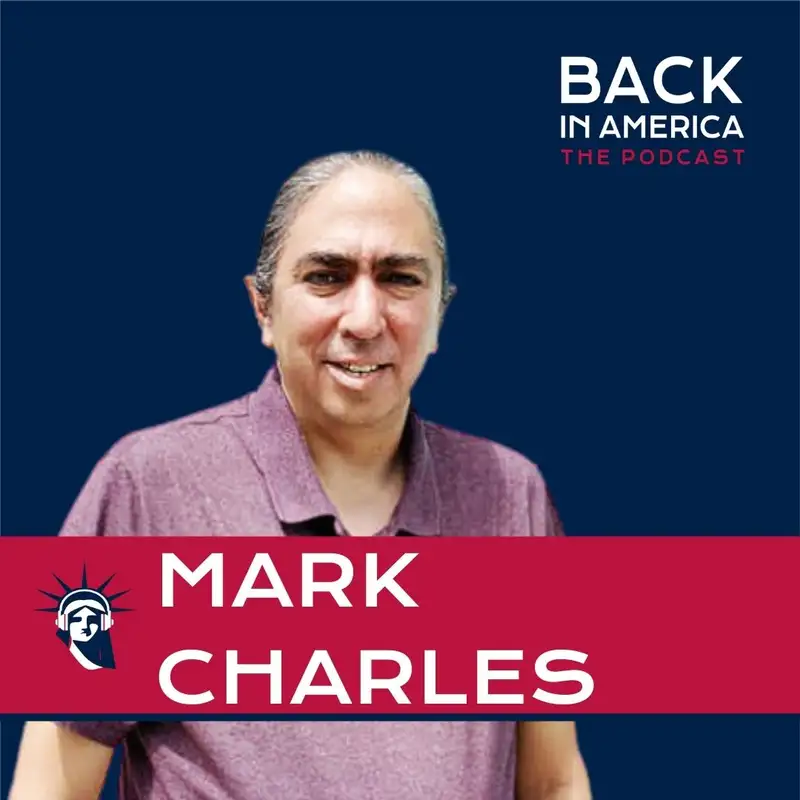
Part 1 - Mark Charles - Native American 2020 candidate Asks does 'We The People' includes everybody?
I am Stan Bertolow and this is Back in America, a podcast where I explore Americans' identity, culture and values. My guest today is a candidate running as an independent for president of the United States. A man who's not white, not black, but a dual citizen of the United States and the Navajo Nation. For three years, he lived with his family in a one-room Hogan with no running water or electricity out in a Navajo reservation. He dreams of a nation where we the people truly means all the people. Yet, as we prepare to celebrate Memorial Day, he reminds us of the ethnic cleansing and genocide the United States carried against the indigenous people of this land. Welcome to Back in America, Mark Charles. Thank you, Stan. It's very good to be with you. Please let me introduce myself.
So, Mark Charles, you know, In the Navajo culture, when we introduce ourselves, we always give our four clans. We're matrilineal as a people with our identities coming from our mother's mother. Now, my mother's mother is American of Dutch heritage, and that's why I say, Loosely translated, that means I'm from the wooden shoe people. My second clan, my father's mother is Tohuglini, which is the waters that flow together. My third clan, my mother's father is also Sinbake Dene'a. Then my fourth clan, my father's father's Tohuchitni, which is the Bitter Water clan.
It's one of the original clans of our Navajo people. I just want to acknowledge as well that I'm speaking to you today from the traditional lands of the Piscataway. I live in what's now known as Washington, D.C., but it was the Piscataway who lived in these lands. They hunted here, they fished here, they farmed here, they raised their families here, they buried their dead here. These were their lands long before Columbus got lost at sea. And I want to acknowledge the people whose land no matter where I go around the country. And so I honor today the Piscataway. I also want to honor that you're speaking to me from Princeton, New Jersey, which is the traditional lands of the Lenape.
And I also honor the Lenape as the indigenous host of the lands where you are conducting this interview from. But it's great to be on the on the show with you. So thank you for having me. Thank you for making time for me today, Marc. So let me start with a burning question I've got. Is this country ready for a Native American president? I understand why you would ask that question. I would actually say that that question is coming from the wrong perspective.
What that question does is it centers white landowning men. And the challenge we face in this nation is the entire nation was founded on, founded for, even founded by white landowning men. So our Declaration of Independence, which says all men are created equal, refers to natives as savages. Our Constitution, which starts with we the people, first of all never mentions women. It specifically excludes natives and it comes to African just three-fifths of a person, which in 1787 that literally left white men and it was white men who could vote. And so the nation, which claimed to be about equality, freedom and liberty and justice, was actually defined very narrowly for white landowning men. And that demographic has controlled the narrative and placed themselves at the center of both politics, economics, social life, everything in this country. And so when you ask, is America ready for a Native president, the question that is really being asked is are white landowning men ready to have a Native American president?
I don't know the answer to that question. That's one reason why I'm running. It's also one of the reasons why my campaign is trying to de-center whiteness. Now, I firmly believe that the marginalized groups within our country, women, African Americans, Native Americans, LGBTQ, other people who are not part of that center demographic, I think there is a very big openness to having not only someone who's Native, but also someone who's African American, someone who's a woman, someone who's a member of the LGBTQ community. That demographic, outside of the center, which is the white landowning male, the rest of the country, I think, is definitely ready for a much more diverse not only pool of candidates, but even actual presidents. The question is, are white men ready? And technically, I'm not convinced they are, but that does not prevent me from running. And it actually helps me frame my campaign, which is literally about de-centering whiteness. Thank you. Thank you. And we'll definitely come back to that.
Before we do, however, in order to better understand who you are and where you come from, I would love you to take me back to your early days. Where did you grow up? Talk to me about your parents, your siblings. Yeah, so I grew up in the southwest of the United States, right near a border town to the Navajo Nation, a small town known as Gallup, New Mexico. This is the area in the United States that in 1862 was ethnically cleansed by Abraham Lincoln. So after signing the Pacific Railway Act in 1862, he literally began very systematically ethnically cleansing native tribes from the states of Minnesota, Colorado, and the territory of New Mexico to make way for some of the early routes of the transcontinental railway. And one of those routes went through the southwest, which was right where our Navajo, the Mescalero Apache, and other pueblos were. And so in 1863, 1864, they began the ethnic cleansing and genocidal policy known as the Long Walk, where they literally burned our villages, burned our homes, destroyed our crops, killed our livestock, and hunted our people, rounded us up and moved us to the north. They set us up and moved us down to a reservation established by Abraham Lincoln near Boscadondo.
They called it a reservation, technically it was a death camp. Over almost 10,000 of our people were marched down there. Nearly a quarter of our people died while in prison there. And then after we came back, after Abraham Lincoln was assassinated, we were moved to a much smaller plot of land north of what was to become Gallup. So I grew up in that area off of the reservation right near the border town in a mission compound that was started by the Christian Reformed Church in the early 1900s. They actually came to the southwest to establish a mission, and they very early on after they arrived started a boarding school. Right. Again, the role of the boarding schools was to commit cultural genocide, to forcibly assimilate natives.
The stated goal of the boarding schools used by the government and the churches was to kill the Indian to save the man. And so young children, native children were taken from their homes, put in these military-style boarding schools, punished for speaking their languages, punished for practicing their culture. The stories of abuse that I've heard, mental, physical, emotional, sexual, that happened in these boarding schools is gut wrenching. And so my grandparents on my father's side, my Navajo grandparents, were both boarding school survivors. And they became Christians, again, a very colonized version of Christianity that rejected their culture and their language and their understanding of the sacred. And so they emphasized Western education and the English language with my father and my aunt. And they worked as translators for some of the early missionaries. My mother then came down as a missionary nurse and she was actually on her way to Africa.
But she was was came to Rehoboth kind of in the interim for some for to get her feet wet on the mission field. And she met my father and they began dating and fell in love and got married. And this was in the late 60s, which is literally right after biracial marriage even became legal in the United States. For much of this nation's history, biracial marriage was not even legal in the United States. Between Native Americans and white people or? Yeah, white people are not allowed to marry black people, native peoples. And so they were married soon after that. And I, my my siblings and I attended this mission school, which was in the process of transitioning from a boarding school into a day school.
And so we attended there. I attended there as a boarding as a day school student. I had other friends and people who were attending. There was a boarding school student and many times our experiences were vastly different. So that's the environment I grew up in, which was highly assimilated. Even though my Navajo grandparents lived on campus with us and I saw them every day. We did not speak Navajo in the home. The school I went to did not affirm Navajo culture. And it was it was a I so I was raised very much in a in a in a white evangelical setting.
OK, how old were you when you realized that Native Americans weren't treated as white Americans? And how did you feel? Again, growing up, I knew I was native. I knew that my father was Navajo. I knew I mean the reservation and my all are my native relatives were literally just across the street or where the reservation began in some instances. And we would go on to the reservation frequently. I was in a gallop of the reservation. And we would go on to the reservation frequently.
I was in a gallop is a center for both native and kind of the settler culture out there. But had you asked me when I was in high school or when I was even early college about what was the daily experience of native peoples, I probably would have told you that while the history was bad, but today things are much better. And things have improved a lot. Right. It really wasn't until I moved. I I went to college, attended and graduated from UCLA in Los Angeles, moved to Albuquerque, moved back to California, got married, eventually moved back again to the southwest. And then after a few years was called to pastor a church in Denver, Colorado, known as a church was called the Christian Indian Center.
And the congregation, which was primarily Navajo, was really wrestling with the question of what did it mean to be native and be Christian? Because the gospel was brought in a very colonial way, which said to be a Christian, you have to be a white cultured person speaking English and celebrating Christmas and the Easter bunny and everything else and giving up your pagan heathen ways of your native culture. There was a renaissance, if you will, going on not just in the US, but globally of indigenous Christians who were asking this question. What does it mean to follow the teachings of Jesus, but yet still be from the tribe and the cultures that we are from? And so I began almost a 10 year process of building relationship with indigenous Christian leaders from all over the world. It was called the World Christian Gathering on Indigenous Peoples, and we would meet every year, every other year in a different nation around the world and would talk and challenge and learn about ways we were begin to deconstruct this colonial worldview. And this is where I really began understanding how deeply embedded the colonial history of our nation was so closely tied to the history of the church. After a few years, our family, my wife and I decided that if I was going to really be leading in this type of movement, our capacity, that I needed to live on the Navajo Nation.
We needed to live there. And so we moved from Denver back to the Navajo Nation. And we wanted to go because I had grown up in a border town on a mission compound, and I attended what essentially was a private school that was also operating as a boarding school. I wanted to actually live as traditionally as we could. And so we moved into a very remote section of our reservation, six miles off the nearest paved road on a dirt road, no running water, no electricity. Our neighbors were rug weavers and shepherds. And we moved there prepared to live off the grid. We moved there, prepared to live off the grid. We moved there ready to haul our water and cook by camp stove or our over an open fire to live by candlelight using outhouse all the things that life was like herd sheep and everything else of life, what life was like out there.
And we prepared ourselves for that. What we what caught us by surprise literally slapped us in the face was how deeply marginalized we realized the reservation community was it literally like we felt like we dropped off the face of the earth. I learned very quickly that living on the reservation, primarily the only non natives you ever see or interact with are those who come to give you charity or those who come to take your picture. Almost nobody comes to get to know you as a person or treats you as a peer. At the same time, I'm experiencing and witnessing and observing the historical trauma of our people from the boarding schools, from the long walks, from the oppressive history. I'm learning more about the history. I'm I'm seeing things from a whole different angle. I'm seeing the oppressive economic policies of our nation and how they've they've caused this unemployment and the challenges of the reservation tribes not owning their lands, but they're being trust lands held by the federal government.
And I'm seeing all these problems experiencing them firsthand. And I'm becoming more and more. I'm becoming more and more angry. I'm becoming very angry. And I'm trying to process through all this because, again, I feel in some ways like a fish out of water because I'd never grown up experiencing this and thinking things used to be bad. But now they're OK. And now I'm sitting in this environment and I find myself just doing. And I'm trying to process through it, even with some of my non-native friends.
Again, we're doing this over the phone or email or or even by letter because they're not coming to the reservation. And every time the topic comes up, I can feel the anger kind of welling up inside of me. And soon I have to hang up the phone so I don't yell at my friends. So I began to kind of disconnect emotionally so I can talk about it more almost like this is something I read in the newspaper. Then I can stay in the discussion longer, but it's not soon after that that my friends' defenses start rising. I didn't do that to your people. I wasn't the cause of that. And soon they would hang up the phone.
So I was searching for a way to engage the dialogue that let me honestly articulate what I was feeling, but didn't drive myself or others from the conversation. And I was writing a letter to my friends. This is after multiple attempts to get them to understand what I was feeling. And in my letter, I said to them, being Native American and living on our reservation in the middle of this country, it feels like our native peoples are this old grandmother who has a very large and a very beautiful house. And years ago, some people came into our house and they violently locked us upstairs in the bedroom. Today, our house is full of people. They're sitting on our furniture.
They're eating our food. They're having a party inside our house. Now they've since come upstairs and they've unlocked the door to the bedroom. But it's much later and we're tired. We're old. We're weak. We're sick. So we can't or we don't come out.
But the thing that hurts us the most that causes us the most pain is that virtually nobody from this party ever comes upstairs, seeks out the grandmother in the bedroom, sits down next to her on the bed, takes her hand and simply says thank you. Thank you for letting us be in your house. And I wrote that. I mean, that's it. That's what I'm feeling. Yeah. That's I begin.
I love the metaphor. I mean, I think this is right on. Why do you think nobody comes to you? Why do you think nobody asks? Well, I think the challenge is, is because of the history, because of the implicit racial bias of white supremacy, because of the dehumanization of native peoples, African Americans and women, our nation, our nation doesn't know how to deal with its history.
It doesn't know what to do with it. And so and so our country, there's this reversal of roles. One of the things our country, part of the national narrative that our country says about itself is that we're a nation of immigrants. Now, that's true for a majority of people. But when you call the United States of America a nation of immigrants, you're excluding two groups of people. You're excluding Native Americans who were indigenous to these lands and did not immigrate to become a part of this country. And you're excluding descendants of enslaved people from Africa who were brought here against their will and then enslaved and forced to build this nation.
So calling our nation a nation of immigrants excludes some of the most unjust and oppressive actions our nation has ever done. And so because we have this narrative, not only of we're a nation of immigrants, but we're a nation of exceptional immigrants, American exceptionalism,
there's this reversal of roles where you literally have 300 plus million, technically undocumented immigrants, people who've never asked for permission nor have they been given permission to be here. And they act like they own the place. And then you have six million, approximately, indigenous peoples, Native peoples who have been pushed to the side and are treated like unwanted guests in someone else's house.
And so we have this reversal of roles. Again, this goes back to the whole myth of America. One of the myths we have is that these lands were discovered. I have a book titled Unsettling Truths, the ongoing dehumanizing legacy of the doctrine of discovery. The first sentence of the first chapter says you cannot discover lands already inhabited. You can steal lands that aren't inhabited. You can colonize lands that aren't inhabited. You can ethically cleanse lands that aren't inhabited.
You cannot discover lands that aren't inhabited. You cannot discover them. There's already somebody there. So the fact that we have this national narrative that says Columbus discovered America, it reveals the implicit racial bias, which is that Native Americans who lived here and Africans who were brought here and enslaved were not fully human. And so this is why our nation doesn't ever think to say thank you, because the belief is, and even if you go back to the boarding school, the goal of the boarding school was to what? To kill the Indian, to save the man.
The notion is that by the presence of white Europeans in this country, even by the bringing over of African Americans, African Americans, even by the bringing over of African people from Africa and enslaving them here, we civilized them and even humanized them. And wasn't that very generous of these white Europeans? I discovered the boarding school while in Phoenix visiting the, I don't remember the name, but the Native American Museum. And so although absolutely, I mean, people were mistreated and dehumanized, what I also understood is that some Native Americans used that experience to politicize themselves and stand,
and start to unify the American, Native American together in order to fight back this oppression. Is that something you agree with? My grandfather was a person like that. He was a boarding school survivor, and he learned English well. He attended college. He didn't graduate due to the Great Depression. And he actually went to, he testified in front of Congress advocating for more funding for Indian education. So yeah, there's a history of people, Native peoples, African people, women,
who have been trying to work within the system to get the system to treat these communities better. And on one hand, you could say that's what I'm doing with my campaign for president. But I'm taking it to a level that our nation has never dealt with it before. Yeah, absolutely. I am advocating that we deal with the foundations because that's where the dehumanization and the white supremacy the racism and the sexism is embedded. And I want to come back to that. And I also want you to talk to me a bit more about the doctrine of discovery.
But before we do that, let me come back to something that you mentioned and that you're also mentioning in your video. The fact that, you know, your experience is somewhat similar to or at least you want to unify the black American with the Native Americans. Yet my understanding is that the relationship between the Native Americans and the blacks have not always been very easy or peaceful. Some Native Americans even enslaved blacks. You know, what's your what's your take on that? I will agree that there there is some bad history in the past between both African Americans and Native Americans. And again, any other group of people, you're going to see this. And I would agree that that does exist there.
My experience growing up was there was very little, if any, interaction between black and white, because the three predominant demographics in the Southwest are white, Latino or Latina, Latinx and Natives. There's very few, if any, African Americans in the Southwest. There are some, but but it's a much smaller group. And so a lot of my experience growing up was there was just a lot of ignorance about even the history. And this is one of the challenges that we face. So because of the way race was constructed in America, again, where the the narrative of our country was these lands were discovered. So there were no people here.
And then African people were captured and brought over here and enslaved. And the way the black race was constructed was in part through what's called the One Drop Rule. So the One Drop Rule states that if you have a single drop of African blood, you're black. Now, the reason we have this rules is because blacks were the enslaved demographic. They were used to build the country. And so this nation wanted as many of them as possible. So the One Drop Rule allowed for a white slave owner to rape his female enslaved women and produce more people that they could enslave. Meanwhile, the Native community, we had what's known as the Blood Quantum Rule that was applied to us.
The Blood Quantum Rule stated that if there was intermarriage or if you could be full and then half and then a quarter, then eighth and a sixteenth, and soon your nativeness could be bred out of you. Why do we have this rule for natives? Well, because the myth of the nation was we discovered these lands. There were no people here. And the U.S. government had treaty obligations to native people. So they wanted as few of us as possible. And so the American Indian race was constructed so it could be bred out of existence and eventually assimilated into the broader nation.
And so because of these things and because most of the places where because of the way enslavement works, the way the black population increased was where there were a lot of white people. And because natives were being ethnically cleansed and removed from these lands and at best put on reservations, if not just genocidally killed, wherever white people came, natives decreased. And so the Southwest was one place where there was some population of native peoples and there was some intermixing between the races. And so but because of this, there was very little interaction, not none, but very little interaction between the white or the black and the native races. And today, what are your personal interactions with black and how does it work out? So I have I have many black friends and I have even my sister, my my sister is adopted and her she is half native and half black.
OK. So her her mother was Navajo and her father was African-American. And so having her in our family has opened our family's eyes much more to the role and the situation and the place of black Americans in the U.S. and open up that dialogue more. And also, you know, beginning in college and throughout my life, I've I've made several close friends from the African-American community. And it's been a learning experience for me and as well as it's been a learning experience for them. And this is one of the challenges is so in most of the country, when the country talks about racism, it immediately thinks white versus black. And it goes to the issue of enslavement. And for I would say 80 to 90 percent of the country, that's the way racial tension is defined. It's rooted in slavery and it's all about black versus white in the southwest.
There's an understanding that it's actually not rooted again, because there's a much smaller population of African-Americans there. So the racial history and the racial tension is white versus native. And so there's a different understanding and there's a very different history there. And the nation tends to keep these dialogues in silos. It deals with slavery and deals with natives. It deals with Latinx people that deals with Asian-Americans and all in these silos. Women are in silos. All the oppressed groups are in silos. And this is one of the reasons in in my the primary plank of my platform, I'm calling for a national dialogue on race, gender and class.
And how is it being welcomed by the community, the black community? Well, again, so a lot of this is helping people understand the value of having this dialogue rooted in a much deeper history, not just in the history of one demographic or one group of people or even one narrative. And there's a there's a native leader from Canada. His name is George Erasmus. And when he was writing in regards to the Truth and Reconciliation Commission that happened in Canada out of their residential schools, he used this quote where he said, where common memory is lacking, where people do not share in the same past, there can be no real history or no real community. If you want to build community, says you have to start by creating common memory. Now, this is a very good idea, not just for white people, but for all Americans to understand that there are so many stories
of the people who live here, people who call themselves citizens, whether it's the stories of enslavement, the stories of of, you know, of the Holocaust, the stories of internment camps, the stories of boarding schools and removal and massacres. There's all these different stories. And we don't, by and large, as a nation, have a common memory. People will know the stories within their silos, but they won't know the stories of the broader nation, the more the narrative of the broader community. And so what I'm really trying to do is to say, hey, there's a value in learning all of these stories and giving giving voice to all of these different demographics so that we as a nation can actually have a healthier community. And I get that. But that vision is is heard well. It's received well. The people who hear it think it's beautiful and really like it. Yeah. And what I'm trying to get at is, you know, what concrete action did you see from other communities, including the black communities,
in joining you to try to create this understanding and this common memory? You know, my my experience looking at my experience of, you know, white guy in this country is that, as you said, this is very siloed. And the blacks say, look, our experience is so different from anything else that we need to fight for ourself. Nobody else but us can carry on this fight. You come with a very different view, saying, let's bring together our common experience in order to create a memory that will enable us fight to be even stronger. But did you see that actually being picked up by other communities? What I find among the demographics is when when we are able to properly educate everybody with some of the true history of all the communities. And when you read the Constitution and there's really three, four demographics that the Constitution defines very clearly, you know, it starts with the words in the preamble, we the people, that sounds inclusive. It sounds like, oh, everybody is a part of this.
But Article one, section two, which is the section of the Constitution, just a few lines below the preamble that defines who actually is included in we the people. And first of all, it never mentions women. And this is important because if you read the entire Constitution preamble through the 27th Amendment, you will find that there are 51 gender specific male pronouns. Fifty one he, him and his. Who can run for office, who can hold office, even who's protected by the document. There's not a single female pronoun in the entire Constitution. So we have to know Article one, section two never mentions women. Second is specifically exclude natives.
And third accounts, Africans is three fifths of a person. So in 1787, that leaves white men. And it was white landowning men who could vote. And so frequently when I speak, I will label these four groups explicitly. Women, natives, and African Americans. And then I will call out white landowning men. Now, obviously there are huge other groups of marginalized people within our community, within our country. Asian Americans, members of the LGBTQ community, the poor.
There are huge groups of people who are marginalized and have not been fully included, but there's three groups that are specifically excluded from the Constitution. And so this is where my work is trying to be inclusive of all these different narratives. But essentially pointing out that these are the three that are most directly left out of this conversation. And so we need to find a way to make the language, make the documents more inclusive. And so there's an expectation that everybody's included. And one of the most clear ways to identify this is this crisis that's going on right now in Indian country known as missing and murdered indigenous women and girls. Where there are literally hundreds, if not thousands of indigenous women who've been reported missing or reported murdered by their families to law enforcement, local, state, and even federal. And not only are their cases not being closed, but often they're not even being opened.
Their families are literally left to go and hunt for them themselves. When I was at the Frank Lemire Native American Presidential Forum, they were asking the candidates about this. Elizabeth Warren, Bernie Sanders, Julian Castro, Kamala Harris. And as they learned about this crisis, they were all responding and saying, we need a new law or a new policy to protect this vulnerable demographic. However, as a native man who's read our Constitution and knows our history, my response was and is when your declaration calls, decades of independence calls Native savages and your Constitution never mentions women. You shouldn't be surprised when your indigenous women go missing and get murdered and society and the government doesn't care. A new law isn't going to fix this problem because the law is ultimately based on our foundations and it's our foundations that state this group is not included. If we want to fix this problem, we have to fix our foundations.
Yeah, I've also read and I'm not clear about that, but that one of the reasons those women went missing is that they were not properly reported for to start with. Would the same happen if men were going missing, a Native American man were murdered and missing? Do you think that would be the same situation? Well, again, the crisis going on is it's missing and murdered indigenous women and girls. That's the very clear crisis that's happening within Indian country. Yeah, that's the demographic. I mean, besides what you just said about the Constitution, why is this demographic missing? And my question is, is it because they are not reported properly at the first place?
I mean, are they tracked? Native American women? Do they have papers? I mean, if they are listing, you know. That's the problem. There's no central listing. There's nothing. Even though they get reported, nothing happens or very little happens on the institutional side of the law enforcement. And that has been going on for years, right? I mean, everybody knows about that. And this is this is the problem. And this is why it's a crisis. And this is also why. And so one of the ways I look at it, there's an author named Willie Jennings, who's talked about this idea of proximity to whiteness. So if you understand, and this isn't necessarily his argument, but this is using that concept of a proximity to whiteness. When you understand the doctrine of discovery, you read our foundations and you realize that technically the foundations were written for white landowning, technically Christian men.
That is like the sweet spot of this country. If you're a white landowning Christian male, the United States of America is your oyster. You have every opportunity, every possibility, many, many, many chances to come and find your fortunes. Now, depending on what other demographics you are. So myself, I'm a male with dark skin because I'm Navajo. And I am a Christian, but I don't own any land. So I fit two of the four categories, right? I'm a male. I'm a native male who's a Christian. So I get to and I miss to. So there's a few ways that I can have this proximity to whiteness to be included within the system. Lower down at the bottom, you have women of color, African-American women, other women of color. They're not white. They're not male. They may be Christian. And if they work very, very, very hard, they might be able to become a landowner.
So they have one, maybe one and a half of the four categories. At the very bottom, the very bottom, the group that has almost no proximity and even very little chance of proximity are indigenous women. A, if they're indigenous and they're living on their reservation, there's a good chance they follow their traditional religion. So they're not Christian because they're on a reservation, which is federal lands held in trust for the tribes. They can't own land. They're not white and they're not male. They fit none of the categories and have very little chance of gaining access to any of those categories. So they are at the very, very, very bottom. And so one of the things that I'm trying so hard to do is until we include the people at the very bottom, we're not going to be able to include everybody. So if I were just fighting for the rights of Navajo men, then I would still be leaving women of color who have no opportunity to have those access points in.
And so this is where I'm saying we have to, and this is why I go back frequently to missing and murdered indigenous women and girls, because again, this is the demographic that has almost zero proximity to whiteness. And therefore we have to take note that this is the group of people that even when they get reported as missing or murdered, society doesn't respond. Wow. Yeah. So Marc, I'm conscious of time. I've got many questions and we could talk for a day, but I know we cannot do that. I want to ask you about the current pandemic. And I realized, or I read anyhow, that for the past few decades, Native American nations have been increasingly taken on a greater responsibility for providing a wide range of governmental service. Yet, as Native American nations cannot raise tax, as you know, the rest of the government, they were dependent on casinos or enterprises that because of the pandemic have been closed. And that makes the situation harder for the Native American people now to deal with. You know, what's your take on this situation? I would argue that the root of the problem comes down to sovereignty or control over their own lands and land titles.
This is at the root of what is causing so much of the challenge for our Native nations. If you follow the news. We are dealing with, you are talking about the challenge when it comes to the coronavirus. Well, I'm just talking about in general, the challenge. Yes. And this fits in very closely to the coronavirus. And I can help you understand why. So how can I do this without going on for 20 minutes? So a few in March, actually, I may go back. In the Obama administration established reservation lands for the Mashpee Wampanoag in Massachusetts. Joe Biden, this was part of the Biden Obama administration in his second term. He established reservation lands for the Mashpee Wampanoag in March of this year, March of 2020. The Trump administration disestablished those reservations. So essentially, if you think of it, if you think of the U.S. government as the landlord and the Native nations as the tenants and the reservation as the apartment.
What happened is President Obama gave an apartment to the Native nation. And then during a global pandemic, President Trump kicked them out of the apartment. So, A, it was unjust. It was it was heartless. But B, the timing of it was horrible. This was like kicking someone out of their apartment during a hurricane. It just it's if there was not only is it heartless to evict evict people, but to evict them in the midst of a global pandemic is like it's just it's completely heartless. And so there was a lot of outcry amongst the general population, people who knew about it. This was a cruel act by the Trump administration. And even President, Vice President Biden responded to this. And he wrote a letter responding to the the injustice of that.
And I want to just read one of the quotes from his letter. He wrote he pointed out how it was cruel of the Trump administration to disestablish this reservation during the pandemic. He reminded the country that the Obama administration with him helped establish this reservation. And then he went on and he said one of the most important roles the federal government plays in rebuilding the nation to nation relationship is taking land into trust on behalf of tribes. It is critical for tribal sovereignty and self-determination. Now, that statement is dripping with white supremacy and dehumanization. Let's just for for fun, let's insert France instead of native tribes. One of the most important roles the federal government plays in rebuilding the nation to nation relationship is taking land into trust on behalf of France. It is critical for French sovereignty and self-determination.
If President Trump or President Obama or anyone said that to another foreign leader, those would be words of war. Yeah, that would be an outcry. Absolutely. This is a this is not a nation to nation relationship. And this is nothing to do with sovereignty and self-determination. And so the fascinating thing about this is in Joe Biden's mind, Trump is bad because he kicked the. Why must we want to knock out he and President Obama were good because they let them in. But neither one of them are understanding the injustice of the indigenous peoples of Turtle Island being considered mere tenants in the lands that were stolen and ethnically cleansed by the government of their people. And so this is and this is where the doctrine of discovery lies.
And so because there is no sense of native rights to land, we are merely tenants. We're merely occupants. And that is rooted in the doctrine of discovery. A Supreme Court case back in 1823 by John Marshall is the first case referencing the doctrine of discovery. It's referenced as recently as 2005. I did a TEDx talk on this called We the People, the three most misunderstood words in U.S. history, laying out the court case in 2005, the United Indian Nation versus the city of Sheridan, New York. I under I lay out how this is one of the most white supremacist Supreme Court opinions written in my lifetime that again denies the United Indian Nation rights to their lands based on the doctrine of discovery. And that opinion was written by Ruth Bader Ginsburg. Yeah.
Again, so so in the midst of this pandemic, the Navajo Nation now has the highest rate of infection of any. If it were a state, we would have the highest rate of we were higher than New York and New Jersey on the Navajo Nation. Health care is rural there. There's not enough hospitals. We have almost 200,000 people on the Navajo Nation because of history and cultural differences and understandings. Social distancing is a challenge to get our people to social distance. Because of the rising numbers on the Navajo Nation, the county of McKinley, McKinley County in New Mexico, became the highest in the Navajo Nation. Became the highest rate of infection in New Mexico, which is where the city of Gallup lives, which is where I grew up.
Right. The end of last month, end of April, the outgoing mayor of Gallup was seeing this rising infection rate. He was seeing what was happening to the two hospitals they have in Gallup, and he was looking at what was taking place on their closest neighbor, which is the Navajo Nation. Now, the Navajo Nation is a food desert. 200,000 people about 26,000 square miles, 13 full service grocery stores. The border towns are absolutely crucial because there's not enough inventory on the Navajo Nation to feed our people. So you have to go to the border towns on the weekends to buy groceries. Many of our people are on fixed incomes and they get a check from the government at the end of the month.
And so the end of the month, you're stretching your budget and your food. And then the first of the month, when you get your check or your money, you have to go to the border town to buy groceries. The city of Gallup, New Mexico, cannot exist economically without the influx of money from the Navajo Nation. It cannot exist without without this business. On the last second, the last day of the month, the outgoing mayor in April sent a letter to the governor of New Mexico asking her to invoke the Riot Control Act so they could shut the roads into Gallup. So they shut the roads into Gallup. Put police officers and national guards there literally to keep natives from coming into town and buying groceries at gunpoint. So what happened?
They shut it down for almost two weeks. How did the people eat? Where did they find their food? Well, they would have to either stand in a long line at the one of the few grocery stores on the reservation or travel to another border town to two hours in the other direction. Again, I fully admit this was a crisis 250 years in the making. There was no good solution to this problem. But of all the bad solutions they could have possibly found, invoking the Riot Control Act on people who are not rioting and who are foundations already dehumanized and to lock them out of this town where they literally just trying to buy groceries was probably the worst of the bad solutions they had in front of them. And so that's happening there. Meanwhile, you have in South Dakota, there are several roads that pass right through many of the reservations in South Dakota and the tribes in South Dakota fearing, knowing how vulnerable their population is because of access to hospitals and access to healthy food and just the challenges they face,
knowing how vulnerable their populations are to COVID-19 decided to set up checkpoints, not to keep people out, but to monitor who's passing through so they could protect their population. And the white governor of South Dakota began challenging them and demanding that they not take these actions to protect their people. And recently, as two days ago, reached out to the Trump administration asking for federal help to stop the tribes from doing this. And so in New Mexico, you have the Navajo, the native nations, the Navajo nation being told by the governor, they can't go into a border town. Yeah. And in South Dakota, you have the governor telling native nations they cannot protect their people on the land that's been established as their reservation. This is... Yeah.
This is the problem. Yeah. And Joe Biden thinks this relationship is just great. As well as Donald Trump does. Mark, we've been talking for an hour and I have three more questions which I really want to ask you. One question is from one of our listeners who is asking, what do you think, what do you make of President Trump's action regarding the world since the beginning of his governance? Regarding what? Trump actions, you know, Trump politics when it comes to the entire world, you know, since he's been the president of this country.
So one of the challenges, because our nation doesn't have a common memory, because we have this mythological history, is there is this narrative coming out of our country that President Trump is ruining our nation. He's destroying our nation. We used to be this great nation. And now we're not. I absolutely agree. President Trump is a problem. But he's not the root of the problem. We, to this day, we have a Declaration of Independence that calls Native Savages.
To this day, one of our greatest presidents as a country that we hold up as our greatest president, Abraham Lincoln, was one of the most white supremacists and ethnic cleansing presidents in our nation's history. People act, and I actually wrote that article, I wrote two articles. They're on my blog on my campaign website, which is markcharlestwentytwenty.com. One of the articles is titled, President Trump and Biden are both peddling nostalgia, and that's a problem. So they're both talking about how America used to be great, and now it's not. So Donald Trump is running to make America great again, implying it wasn't beforehand. And Donald Trump, our president, Vice President Biden, is saying, well, let's bring America back to its former greatness, apparently before President Trump. The only people who can have a nostalgic memory about this country are white people.
They're the only people. There's an ad by President, Vice President Biden just a few weeks ago that it was a brilliant ad. It was about the COVID-19 pandemic. And it said, it basically used quotes of Donald Trump, of his denial of this pandemic and what was happening with it. And it ended with saying it had a quote where it said, President Trump didn't build a great economy. He destroyed one. Now, again, that sounds most Americans are going to read that and say, yes, President Trump is doing all these things to destroy our economy. Well, this is implying that the economy our nation had three months ago was great.
So three months ago, yes, corporate profits were an all time high. Unemployment was an all time low. But we had millennials drowning in debt from education. We have most people working, a lot of our millennials working two, three jobs in the gig economy just to make ends meet. Health care is abysmal. Yeah, for white landowning men three months ago, the economy was great. They were making money hand over foot. For everyone else, we were barely scraping by living paycheck to paycheck.
See, this is the problem. The whole notion that we used to be great, President Trump is ruining this great country, completely ignores the incredible racism, sexism and white supremacy of our nation. I wrote another article a few months ago. This was during the height of the of the impeachment proceedings. And that article was titled If You Think Simply Impeaching Donald Trump is the Solution, Then You Don't Understand the Problem. Absolutely, Donald Trump is a problem. He has appears very narcissistic. He has this very short sighted policies.
He's yeah, he's definitely not a very constructive president. OK, but so were most of our even great presidents. Abraham Lincoln, ethnically cleansed and literally was a white supremacist, blatant white supremacist. Ronald Reagan started war on drugs, which was technically a war on race. Bill Clinton perfected the art of mass incarceration and filled our prisons with people of color. So to think Trump is the only problem is has a very it ignores most of the history of our country. Do you think that this nation whose original sin includes the extermination and encampment of the inhabitants of this land, the claim to have a God given right and the enslavement of other human being?
Do you think that this nation will ever be able to live together? The vision of my country, of my of my campaign is I am calling the question and I'm asking our country, do we want to be a nation where we the people truly means all the people? I don't know the answer to that question. I don't know what my nation is going to decide. If they decide no, then that's fine. That's great. We're doing a good job of that because we're obviously not a nation that's going to be able to live together.
We're doing a good job of that because we're obviously not a nation where we the people includes everybody. If we do want to be a nation where we the people means all the people, then we have to deal with our foundations. We have to do some foundational level work. The United States of America is not racist and sexist and white supremacist in spite of our foundations. We're racist, sexist and white supremacist because of our foundations. And we have to address that. And so I cannot make my nation not be racist, sexist and white supremacist. I can present a vision and I can ask the question, do we want to be this or not?
If we do want to be that, then we have to look at some very serious changes we need to make. And so, yeah, that's really what my campaign is all about. And I, to be honest, I know there's a lot of people who like my vision, but there are also a lot of people who are pretty convinced that things are just fine the way they are. One question I always ask is what is America to you? America is a colonial nation. Founded on stolen lands, broken treaties, enslavement, racism, sexism, ethnic cleansing and genocide. It desperately wants to be something else, but it doesn't know if it's willing to put in the work to become that.
Okay. And that's what I'm trying to ask. In his last State of the Union, President Obama was acknowledging the deep divisiveness that existed throughout his presidency. The opposition he faced at every turn. And he was lamenting that and talking about the need for our nation to build a new politics. And he quoted the Constitution. He said, we the people. Our Constitution begins with these three simple words. Words we've come to recognize mean all the people.
That sounds beautiful, even inspiring. He got a lot of applause for that line. But as I sat in my house listening to him, I asked myself, I said, when? When did we decide we the people means all the people? The founding fathers absolutely did not believe we the people meant all the people. Abraham Lincoln did not believe we the people meant all the people. As good as the civil rights movement was, it did not get us to we the people meaning all the people. President Trump does not believe we the people means all the people.
This is the problem. We've never decided collectively as a nation that we want to be a place where we the people includes everybody. And that's what I'm working towards as a candidate for president. That's the vision I'm holding out. That's the very, very basic question I'm trying to get my country to answer. And I'm being as honest as I can and saying, if we want that, we have some extremely difficult work that we need to do. OK. Finally, Mark, do you have any books or movie that you would recommend?
So I just published a book recently titled Unsettling Truths, the ongoing dehumanizing legacy of the Doctrine of Discovery. It's really the result of 10 years of research. There are many other native authors who have worked on the Doctrine of Discovery. I'm not the first and I know I will not be the last. There's a book by Stephen Newcomb titled Pagans in the Promised Land that really wrestles deeply with the Doctrine of Discovery. And I recommend that even though Stephen, I don't agree on everything. I recommend people read his book. I recommend people read my book.
There's a lot of our history we don't know how to deal with. There's a lot of our history that we've never learned how to talk about. And I really want I wrote my book. A as a way to challenge the Christian church, but B as a way to help my nation understand our history. Because I'm trying to move us into this conversation, into this dialogue to create this common memory. And in order to get there, we have to learn how to deal with our past. So OK, any movies? None come to mind. I'm sure there are some I none come to mind right at the moment.
But yeah, that's good. Anything else you wish I would have asked you? I think I was able to say pretty much everything I wanted to say coming into this. I liked your questions. I appreciate the way you let me talk and expand on a few things. Yeah, I think we covered a lot of ground and we could be speaking all day. I mean, there are so many things I wanted to discuss. And maybe we if you don't mind, maybe we could do a follow up. You know, this is very open to that. Yes.
Especially this relationship between races in this country, between the black and the Native American. I mean, that is to me, it's a fascinating subject. And I being myself a foreigner coming in this country, I could see the divide. I could see, you know, there is a topic that we haven't addressed or maybe we did, but it's the lack of apologies from the white landowning to the black, to the Native Americans. And and that's a big issue. And coming from France, we have only recently apologize to the Algerian and the American for the for the colonies. You know, the government said we are sorry for what we've done.
And that was extremely appreciated by those people that we recognize. You know, we were talking of a situation and all of a sudden we started to say, no, it was not a situation. It was a war. And we are sorry for what we've done. I don't think that, you know, I don't think people are ready to actually apologize. And when they talk about reparation, they talk of financial reparation, which is something. But I don't think it's it's enough. It's not just a transactional thing. It's you know, it has to be felt with empathy and it has to be meant. You see what I mean? Yeah.
One of the things I look most forward to if elected president is appointing a Native American are nominating a Native American as my secretary of state. One of the reasons I want to do this is because not only does the U.S. not have a common memory of its own history, but most of our allies don't have a common memory of our of their own history. And the reason most of the Western Europe is our ally is because we are all very colonial nations. France at one point was the largest colonial landholder in the in North America. And with the Louisiana Purchase sold not only vast amounts of land, but huge amounts of people within those lands to the U.S. I would really look forward both as president and with my secretary of state as being the head ambassador for this nation to the world. Not to break these relationships, but to really challenge them.
And to to to press the question, what does it mean for us collectively? To deconstruct our colonialism and become better global citizens of this interconnected world we now live in. And I you know, a lot of what I see going on in Europe around immigration, around closing of borders, all these things, I see the root of that coming stemming from this unresolved, unacknowledged colonial history. That these countries don't know what to do with. And so I. I'm looking forward to if I get elected president to what can what not only what can we do here in the U.S. to deal with our colonial past, but how can that dialogue also extend out to other nations and even to heads of states of other nations to really challenge and initiate the dialogue about the colonial history that came out of almost all of Western Europe? And yeah, that's something I very much look forward to trying to engage in and to seeing where that goes and what happens with that.
That would be quite interesting. If you are not elected president, would you be ready to work with the president to try to improve the relationship between this government and your nation? One of the biggest challenges is because the things I'm calling for are so foundational. That most I'm running as an independent. I'm running as independent because I am convinced after extensive research and an observation that neither the Republican Party nor the Democratic Party have any interest in making these changes at the foundational levels that I'm proposing. They are too much dependent upon these colonial, racist, sexist and white supremacist systems that they are not willing to address foundational level change. And so I'm still trying to work within the system, not the system of the two parties, but of our system of governance and our presidential
system to introduce this dialogue and get the nation to address these things. But I am quite certain that neither Vice President Biden nor Donald Trump have any interest in engaging the conversations I'm trying to engage at the levels I'm trying to engage them at. Okay. Thank you so much, Mark Charles for this interview and good luck for your campaign. Thank you very much. It's been a pleasure to talk with you today and I look forward to having some more dialogue in the future. Thanks. Do you mind if we take a picture, I will take a screenshot. So, let's see.
I think I can do that there. 123 No, it's not working. Let me do that differently. 123
Yeah, got it. Let me save it. Okay. Thank you. I, I plan to publish it in the weeks to come. Hopefully next Thursday. But if it's not this coming Thursday, it will be the one following that and I usually put it online at 8pm on Thursday night. I will.
Okay. Okay. Is that it is absolutely. And I could, I could tell how passionate you were, which was difficult for me to ask my question. But thank you so much. Thank you so much. I think if I may just say one thing that would make your interviews even more fascinating is for you to inject more personal limit, more, you know, anecdotal facts, something which are more based on your very own experience.
You see what I mean? Sometime. And this is what I was trying to get at with my question around your experience with the black community. And I felt that I had a hard time understanding, you know, I see, I mean, on an intellectual level, I totally see what you're trying to do. Now, how does that take shape concretely? You know, what are things that are coming into place to illustrate how your ideas are taking shape?
Sure. It's still recording. Yeah. Yeah, yeah, yeah. It's still recording.
Yeah.
Yeah.
Yeah.
Yeah.
Yeah. Hmm. Right.
Mm hmm.
Mm hmm. Mm hmm.
Yeah. Yeah.
Yeah.
Mm hmm.
Yeah. Mm hmm. Yeah. Mm hmm. Mm hmm.
Yeah.
Mm hmm.
Yeah.
Yeah.
Mm hmm. That's interesting. Yeah. Hmm. Hmm. Yeah. You are just challenging the question. Yeah.
Okay. Okay. Okay, Mark. Thank you again. And I think that story really brought, you know, always going to add some some flesh to the interview. So thank you for sharing that. And again, good luck. It was really a pleasure.
I'm really delighted that you accepted this interview. Okay. And if you can share your recording with me, that that would be great. You know, you can put it in Dropbox or, you know, Google Drive or anywhere and I will pick it up. Okay. Thank you.