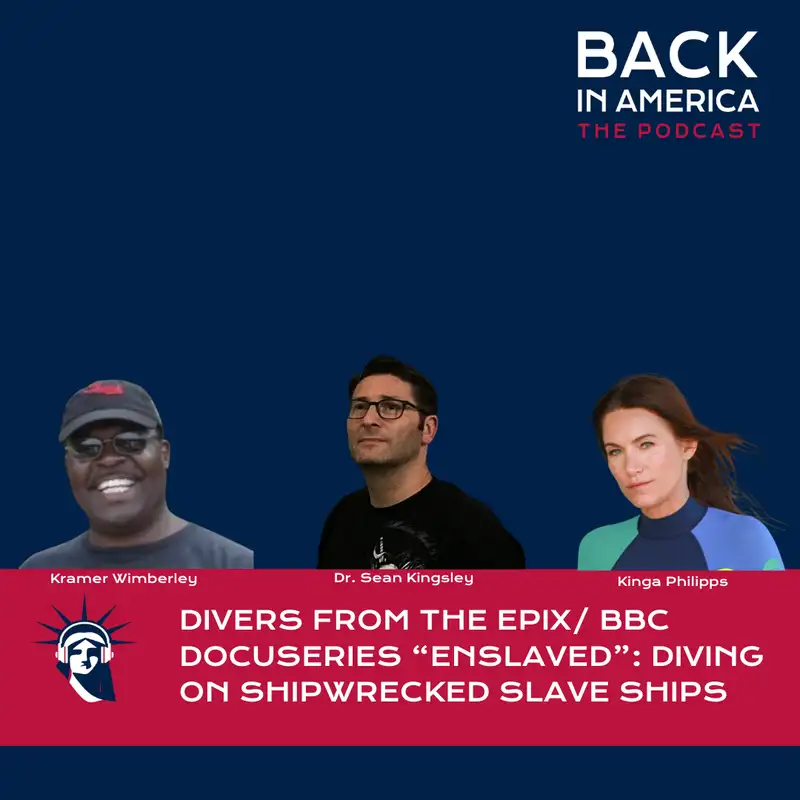
Listen again: Divers from the EPIX/ BBC Docuseries “Enslaved”: Diving on Shipwrecked Slave Ships
The more profound moments for me personally was when we were in the Isles of Silly and we did that dive and we brought up the manila and then we were allowed to go to the museum and look at some of the other artifacts that were brought up from that sleigh brick. And there was a beautiful rosary. My family is Roman Catholic. I came from Eastern Europe and I pictured in my mind the captain of this slave ship in his captain's quarters, probably beautiful and luxurious, praying this rosary while there were men and women chained and squalor below.
And it was such a juxtaposition to me and I thought, what are you praying for? Good weather? What are you praying for while you are enslaving human beings below death? And it was this incredible realization of where in our lives now do we accept something, a status quo, which should never be. And I think that to me, that's the takeaway from a series like Enslaved. And I hope a lot of people walk away with that kind of an emotional recognition of how they might be applying that blase attitude to something in their daily lives when they
should really question it. If you're tired of arguing with strangers on the Internet, try talking with one of them in real life.
Welcome to Back in America, the podcast. I am Stan Bertolot and this is Back in America, a podcast exploring America's identity, culture and values. In this episode, I speak with three crew members of the EPICS BBC docu-series Enslaved, the lost history of the transatlantic slave trade. 2020 has been a year of intense examination of racism in response to the Black Lives Matter movement. Enslaved, however, predated the death of George Floyd.
The series stars presenters Samuel L. Jackson, together with Afua Hirsch of The Guardian and investigative journalist Simcha Jakubovici. You will first hear British marine archaeologist Dr. Sean Kingsley, a historical advisor to the film diving crew. Then two of the divers will join me. First Kinga Phillips, an award-winning journalist of Polish origin, an explorer, writer, TV host, esteemed member of the Explorers Club and the first member of the crew to be hired. Kramer Wimberley will then introduce himself.
He is a lead diving instructor and leads the maritime archaeology program Diving with a Purpose. Each of the three's interviews were broadcasted live and can be watched in full on Back in America's YouTube channel. As I conducted these interviews, I wanted to understand two things. First, what did diving on the wrecks of slave ships has told us about the history of the slave trade? Then I also wanted the divers to speak about their own experience as they dived and explored these sunken mass graves.
I'm a marine archaeologist, I've been doing this for 30 years. Dr. Sean Kingsley. It's a really hard one to get your head around because the numbers at some point when you start adding zeros and zeros to them, they just become mind boggling and you get a migraine but we have to confront the reality of what happened over 400 years. Which is that 12 million West Africans were trafficked from the homeland, Ghana, Gabon, Nigeria, all the way through what we call the middle passage to the Caribbean. In that passage, two million people died at sea during 45,000 voyages.
Most of this trade was actually managed by England and Portugal who between them had 70% of the business. It's really hard to get your head around figures like this but as a historian, there's been several awful spikes in human behaviour down the centuries. You think of course of 6 million Jews being destroyed during the Holocaust in six years. You think about the killing fields of Cambodia, 1.3 million. Maybe some people have deep memory and they'll think of the 4 million Chinese troops who had died during World War II fighting Japan and Germany.
When you think about the slave trade, it went on for 400 years, year after year after year. So you find yourself asking these really core questions of what happened to these people who died, two million lost. How did the merchants justify this particular trade, making money off fellow humans? And why did society, polite society, put up with it for so long?
I was born in Warsaw, Poland and then came to the United States when I was five years old because Michael was part of the Solidarity movement in Poland. And we came to the US with our suitcases basically pretending that we were coming on vacation and we were offered political asylum here because of the relationship with Solidarity. And we actually turned the political asylum down because we were afraid as a nation that the government in Poland would not be kind to our family there. So we became US citizens the natural way without accepting the political asylum. Journalist Kinga Phillips.
I spent 30, almost 30 years in the fire service during the course of that journey. I went to law school. The department saw an opportunity for me to go to the fire service. And I was there for a long time. I was there for a long time. I was there for a long time. I was there for a long time. And in law school, the department saw an opportunity for me to assist them in the division of investigations.
So I went to the police academy, became an arson investigator and worked with a very skilled team. Analyzing and investigating crime scenes was part of my background prior to coming to Diving with a Purpose, which substantially is an investigative mechanism for sifting through the remains of shipwrecks. Lead diver Kramer Wimberley. Racial issues and social issues have always been part of my life and my upbringing from as far back as I can remember. My first contact with the police department was actually in Boston. I was born in Boston. And at five years old, I remember the police kicking in the door of my family's home
and us being on the floor in a corner with shotguns pointed in our faces. And that was my introduction to the police department and injustice. Living in an area where racism runs as a thread through every area of human activity for the entirety of your life on some level either makes you an advocate in the event that you engage or a victim in the event that you don't or blinded to it in the event that you're trying to hide from the reality of what African Americans face on a daily basis everywhere.
What we're doing is a real golden age, largely because you know, you think of those dreams of Jules Verne, 20,000 leagues under the ocean. That's now becoming a reality. So, you know, what we did 20 years ago, mucking around with scuba and shallows. Now we can use it in robots in deep seas. So suddenly the world's oceans are oysters and there are three million at the bottom of the ocean waiting to be discovered. For the last 12 years or so, I've been helping out an American team called Odyssey Marine Exploration. And they did the largest offshore survey in the English Channel looking for deep sea wrecks where they turned up 270 shipwrecks. Anything you might imagine or want for from French pirate ships to the German U-boats on secret missions, Britain's most iconic lost 18th century warship.
And amongst all this massive shipwrecks, these 270 sites was this very strange enigma at 110 meters that had these elephant tusks on it and copper manila bracelets that clearly had a link with England's role with the transatlantic slave trade. So when the guys were starting, Simcha Jakubovici was starting to make this film, Enslaved, which is an epic. It's taken them two, three years to nail down. We got in touch and they asked me to conference. God, I don't suppose you know if you got any, you know, of any slave wrecks out there. And I said, well, funny enough that you should say that. When I was first brought on to Enslaved, I was brought on because the production team wanted a female. They wanted a journalist, a storyteller, someone who was comfortable in the television space who had done that before and also someone who was a diver.
And realistically, that's a pretty small pool of people to pull from for the TV scape. And when I came on board and I shot in May in the Isles of Silly, and I remember having a discussion with Simcha, our director, who's absolutely incredible. And I said, well, I realize I bring the female perspective to this, but I think that we would be good to have a well-rounded team. I got a cold call from an international phone number from outside of the country from a gentleman with a Russian accent saying, we want you to be in our movie.
Each one of those ships didn't just traffic one time. They went back and forth multiple times, carrying people, killing people. And the wrecking event was the last event for those ships. And the wrecking event told a particular story about the Africans who were on that particular ship at that particular time. And the inhumanity or the brutality of the people who engaged either in the transport and or who engaged in the business of selling people. Most of the ships that we would investigate were of an era where we're talking about wooden ships. So mostly everything was gone as far as the structure of the actual ship. You would find some rig name. In some cases, we found cannons, cannonballs.
We found bricks in Costa Rica, the Isles of Silly. We actually did find a manila bracelet. And then you start to realize and remember what you're doing there and the story that telling. And when you get to the point where you're actually holding an artifact in your hand and in the Isles of Silly, which was the first dive that I ever did, we brought up a manila and sitting there and holding that in my hand and realizing that the reason that was on that ship was because it was being used to trade human lives. The floor drops out from under you. You have this like heavy moment of realization that you're holding a really ugly piece of history. But it's also important to tell that story. It's also important to hold that to show that to tell what it means to be able to tell that story.
And so that's what we're going to do. And then we're going to go back to the story of the manila bracelet. It's an incredibly important piece of history. And it's also important to tell that story. It's also important to hold that to show that to tell what it means because as no history tends to repeat itself, doesn't it? And history also we all have the attention spans of fruit flies these days. So to remind people of what those pieces represent, I think is incredibly important. I think it's important to remember that you're not going to be able to read all the documentaries and read articles and stories and historical historical pieces that have been placed before you.
But until you are boots on the ground and you are talking to these people like in Suriname, for instance, one of the most profound moments of the entire journey for us was Suriname, which is a very difficult shoot. We were working 18 hour days. I actually remember being on a boat for nine hours a day with no shade. We were so so sunburned. I was Kramer stood and block the sun with his body for me because my European skin and my light eyes was just roasting no matter how much sunblock I put on. If we talk about being white on this shoot, that was the perfect example. And that day at the end of that shoot, Kramer said, I have this strange tingling in my skin. I've never felt this before.
And I said, Papa Bear, that's a sunburn. Even he was sunburned that day and I walked away with my lips peeling off and swollen and so sunburned. It was a difficult shoot. But what made it emotionally very difficult was the story of the slave ship Loosden where all those people were lost. And by lost, I mean murdered. But also because we had the ability to visit this village, a maroon village. And these were people who were enslaved men and women who fought against their captors and the slave owners and escaped into the jungle and created these communities. And we realized in that moment that had the people of the slave ship Loosden been allowed to get off that ship instead of had the hatches nailed down and essentially murdered, they would have joined these communities.
And when you are boots on the ground in that place and having that realization, it hits you so much harder than if you ever read that story in a book or a news article or even watched it or documentary. It's extremely, extremely profound. When you think about the transatlantic slave trade, it was a sea trade. The stage for it was the world's oceans. But that's where it's a bit strange because there's lots of history books and you know, you can delve into all kinds of titles that will talk about what happened in a particular kingdom in West Africa or what happened with a particular country. But there's really been no kind of epic take that's gone underneath the oceans. And that's what makes this really visionary and unique is that history tells you what people want you to know. But archaeology is like a camera.
It captures the essence of what really happened. And this is really brave filmmaking to go to shipwrecks. Maybe the people have never heard about. It's not the Titanic. It's not the Mary Rose and present these. So for the first time in history, we can actually smell what happened in this period in a sense, because it's one thing to read a book and then put it aside and go and make your coffee and watch some TV. But it's another to dive on a shipwreck and actually physically hold these objects which are around and traded and circulate and touched by human beings in the 1670s to the 1820s. And that means you can't ignore it.
You have to confront it and try and make sense of it. As a student of history, right, much of the information was familiar to me. I would have to say what I learned was people at the time and still today refuse to believe that it occurred. Right. And the inhumanity and the brutality of what took place actually occurred. And we still don't want to confront the reality of it.
The Suriname mission was around the wreck of the Luton. That ship carried over 600 Africans. And what happened was the captain took a wrong turn. He ended up going up the Moroni River instead of the Suriname River. When they recognized they made a wrong turn, they tried to come out. Right. And the ship hit a bank and lost its rudder. And eventually there was a recognition that they weren't going to be able to continue on with the journey to move their cargo to market. It wrecked within a couple of hundred yards of shore and was less than 50 feet of water.
And instead of disembarking people or allowing them to save themselves, they went through the effort of forcing all of the Africans back below deck, hammering the hatches shut. Because initially they got in their boats and they started to leave. When they realized the Africans were attempting to save themselves, they returned. They went back, forced them all below deck, hammered the hatches shut, right. And then sat on the hatches and waited until every last one of the Africans that they had driven below deck stopped screaming because they had drowned.
So they killed over 600 people because they made a wrong turn and the idea of letting them save themselves was abhorrent. Wow. And being in that space some 400 years later. And I've said this before, standing on the banks or the shores a couple of hundred yards from where you know, the most horrific wrecking event in the history of the transatlantic slave trade. It's an idyllic location. Today, if you look at it, the scenery is absolutely beautiful. It's a place where people would go to vacation.
But the tragedy of what took place and the sense of the horror still remains there. As beautiful as it is, it is just an eerie place to stand there knowing of the mass murder and the mass grave that is right there in your face. Well, first of all, I will say that Kramer is wonderful with expressing his feelings and he has a lot of them. And we had incredible exchanges on and off camera having conversations about the subject matter at hand. And it was such a safe space for all of us to share our feelings and share our stories. We cried, we held hands, we would walk away and take a moment and reprocess what they were feeling because it was very deep and very profound. And we had people who had such different lenses and backgrounds and upbringings and just life experiences all bringing something to the table that was so amazing. It helped to enlighten all of us and allowed us each to share our own feelings about this.
Whether it is from a human perspective or whether it's a Kramer feeling it from, you know, Kramer is a former detective, which is why he looked at things as a crime scene. He also talked about his upbringing and told us a lot about that on a personal level over dinner. And so we came to understand very much his lens. We went to the UK, Alana's father is white and he is from the UK. Her mother is from the Bahamas and she is black. So she has a very, very mixed background and she actually met her family for the first time, her extended family on camera in the UK, which was an absolute fluke that we got there and she went in Zanz. I know this area and it turned out that that is where her father was from and she got to meet family members there. So we had all these different incredible lenses and people got to process that and the fact that it was such a safe space and no one ever said, you're not allowed to feel that you're you're the white girl.
You're not allowed to feel that or you're not allowed to have this emotion or you need to look at it from this lens. No one was ever put in a corner or said this is what you can or can't feel. We shared so openly that it became a profound experience for all of us. It changed all of us. The global system of white supremacy is just that it's global. And it affects everyone differently. The members of the Enslaved Dive team, Alana, Josh, Kinka, myself, we all have different life experiences. I'm a little bit older.
So my experiences and connection are going to be different. Josh is younger than me and lived his life on the West Coast. I live my life on the East Coast. Racism is affected by geography. Racism is affected by skin color. I am darker than than Josh is. Racism is affected by what occurs in the north of the country and in the south of the country. Racism is affected by what people perceive to be your socioeconomic status.
So and by age. So Josh's experience is going to be different from mine. Alana's experience is going to be different from Josh's and mine because she also has she's a female. Kinka's experience is going to be different from Alana's and Josh's and mine because she's white. I'm sorry. I hate going there. She's Polish by birth. The idea of white and black is a construct.
Also a banner of the global system of white supremacy identifying races when people are technically defined by land masses. People from Africa, people from New York, people from the Americas. It was the system of white supremacy that said there's white people and then there's everybody else. So we're going to classify ourselves as white and pure and everything else is is other. Right. So I slip into language just like everyone. But we all have different experiences and different perspectives, but it's all based off of that system that is conditioning you by keeping you housed in particular neighborhoods and not letting you out, which which is not. Which was the government's part in and that government that worked within the system of white supremacy and the private sector that worked in the system worked and works in system of white supremacy.
So we all have different not only perspectives, but different engagement with white supremacy and everyone's everyone's perspective has to be recognized, acknowledged and and appreciated. So I try to make room for other voices, right, because I have absolutely no understanding of what it is like to grow up as a black man in the South or a fair skinned black woman in the Midwest.
I never felt in any way like there was a difference in all of us. There was obviously a different perspective and we all brought different backgrounds and experiences and lenses both in our lifetimes and historical and different contexts. But because we were all such an incredible family unit, and we were all so profoundly supportive of each other and the lenses through which we experienced this. I never for a moment felt like there was a distinction between what I was allowed to feel and experience and anybody else. And that's a really beautiful thing to say, I think, especially in the modern world, which there is divisiveness. And it's actually interesting that this documentary came out during this time in history because we were all so profoundly cohesive on a humanitarian level that the distinctions between our skin color and the historical context of our experiences melded together into something actually really beautiful. And, you know, we laughed along the way, like in some of the scenes even we laughed that I'm the token white girl in the in the shots. And it's funny because you see that now when you see the documentary.
But from an experience standpoint, there was never such a thing. I was never I never felt that my perspective or my lens was any less part of the contribution to this than anybody else's. And yet I learned so much and such deep experiences from the lenses of the others. And they all brought something to the table that we all walked away with a completely fresh and different and unique perspective on every single one of these stories that we experienced in these stories. Most of them were not positive. There were a lot of tears shed. There was a lot of heartache and a lot of times that our stomach turned in these moments where we uncovered pieces of history that on a human level were just horrible and devastating and hard to witness and hard to talk about. And it was such a cathartic experience, I think, for all of us to be with such a team that was able to express themselves and and really work through and talk through these experiences and then also share them with the audience.
I felt guilty being a human being and seeing what human beings do to each other, which I feel the same way in the modern world, seeing things that that we do to each other now. So, you know, I think that's what I was saying before that I was never made to feel any different or like I should have felt guilty because of the color of my skin when what we were telling were very human stories and very ugly human stories. And many times when we held the shackles or we held the manillas or we held the balls and chains that that were attached to these people so that they couldn't run away, we felt such immense grief as human beings that this was ever done to anyone. You know, one of the more profound moments for me personally was when we were in the Isles of Silly and we did that dive and we brought up the manila and then we were allowed to go to the museum and look at some of the other artifacts that were brought up from that slave wreck. And there was a beautiful rosary. My family is Roman Catholic. I came from from Eastern Europe and I pictured in my mind the captain of this slave ship. You know, in his captain's quarters, probably beautiful and luxurious praying this rosary while there were men and women chained and squalor below. And it was such a juxtaposition to me and I thought, well, what are you praying for? You know, good weather? What are you praying for while you were enslaving human beings below death? And it was this incredible realization of at that time in history, that person felt that this was the way things are. That was status quo and that's what you do. And this was business.
And you think about that in light of the modern world and how we treat certain people now and the question becomes, where in our lives now do we accept something as status quo, which should never be? And I think that for me, that's the takeaway from a series like Enslaved. And I hope a lot of people walk away with that kind of an emotional recognition of how they might be applying that blase attitude to something in their daily lives when they should really question it. They wanted to start a conversation. They wanted to have granddads in street corners and teenagers on their mobile phones saying, hey, did you see enslaved? And, you know, did you know about that aspect of ancestry? And I think it will do that by its combination of adventure, exploration, beautiful scenery and really hard hitting events that happened. I don't imagine that the director Simcha Jakubovici and Samuel L. Jackson, when they started making this film, you know, they were making a film about history and archeology, but they ended up actually living through history. And, you know, that's unprecedented. It really is a unique sort of moment. As you say, you know, they were shooting in Bristol literally weeks before the Edward Colston statue, that huge, iconic, rural African company slaver. His statue was sold to the British And then they had the privilege to film the civil rights activist John Lewis in Washington, sadly, weeks before he died. And you see Kramer and Alana from the film from Diving with a Purpose. They go and meet him and they share their stories of these shipwrecks and what does it mean and how they can, you know, try and make meaning out of it. And there's very much a passing of a torch, which you see there, which I think is really important for the next generations. And he gives them, in a sense, a mandate to make a kind of a good noise, be well behind, but shout and tell these stories time after time and time so that the two million who drowned at sea so that Westerners could put a lump of shit in their ass. sugar into their coffee will never be forgotten. And it's a phrase I like to use as a historian. Sigmund Freud and his cronies used to argue psychologically that to understand the adult, you must study the child. I think it's very much the same for today. If you want to stand up to the child, you have to study the child.
You know, suddenly Lloyds of London are saying, Mayor Cooper, we apologize for what happened in the past. The Bank of England is saying, it was a mistake. It was a mistake. And you see, the bank of England is saying, it was a mistake. And you see, the bank of England is saying, it was a mistake. You look at what's happened in the summer and the reaction and the kind of house of cards has started to fall down. You know, suddenly Lloyds of London are saying, Mayor Cooper, we apologize for what happened in the past. The Bank of England is saying, it was appalling. It should never have happened. Look, you can't put value judgments on what happened, but you can try and understand it and make sure that we bear witness. I think archaeology is a very graphic way of making sure that we will never forget. And, you know, I think this is there is this healing process. There is this trying to make a fairer, just society. But you also have very large countries that are forefront of the slave trade that to this day still have not apologized, not going to name names, check it online on your web engine searches. You know, that's one of the reasons why, for instance, I wear several face masks. I'm a marine archaeologist. I'm a writer. You know, it's fun from time to time to dip into films. But that's one of the reasons why I started this new magazine called Rec Watch, which is the first popular mag about the sunken past and shipwrecks and treasures. And we're taking everyone not just to see the Titanic and understand it, but all these incredible three million other wrecks around the world. So, for instance, our last issue, we went down to Whitstable in England. Everybody thinks that wreck diving was invented by Jacques Cousteau when it wasn't. It was invented by two English dudes called the Dean brothers, Dan and Whitstable. And so, you know, we're trying to tell those truths. And I think today what we've been talking about very much in back in America is about truths. And, you know, just to create this, close this circle in a sense, the next issue out in December in Rec Watch magazine is all about pirates. The first time we've got all the world experts who've discovered pirate ships writing under one cover. And again, you talk about what have you learned from this program? What have you learned from the transatlantic slave trade shipwrecks? Well, I didn't know that in the golden age of piracy between 1680 and 1720, a lot of black slaves were who were on slave wrecks.
Those ships were caught by the pirates and the pirates didn't carry on selling and making money off the black, the back of their fellow man. They freed those slaves and they invited them to join their crews. And here's the irony, the pirates like Blackbeard and Captain Kidd that we feature in the magazine are seen as these enemies of mankind. Actually, in this time, the deck of a pirate ship was the only place in the Western Hemisphere where outside of West Africa, a black human being could be free and have democracy. He was given an equal vote with every other member on that ship about what should happen. And also they were given an equal divide of the spoils. But you never hear about these stories when you were growing up. You didn't see, you know, black pirates fighting with Errol Flynn.
All along, we have been going and telling these profound stories that are incredibly sad and incredibly heartbreaking and gut wrenching. When you start digging into the details of these and you are on location and below you is the grave of 600 plus people that were murdered, you feel that very deeply. And then we got to the Great Lakes and it was one of our last shoots. And here we are telling the story of the people who made it and the people who helped them. And suddenly it was this, it brings tears to my eyes even now, like it just even the details of how these people were guided along with signals and certain flowers that were planted and lights and the people who hid them and the captains of these boats who ended up paying fines and put their careers at risk to help these people. We finally got to tell a story that redeemed humanity a little bit. I'm hopeful. I've seen movements over the course of my lifetime attempting to address a global system of white supremacy. And I've seen movements that consistently have failed because the system pushes back.
This particular time feels a bit different because there appears to be a global recognition of what black people have been screaming about for centuries. So I'm hopeful that the young people that are pushing this movement forward today and those people who are finally recognizing the legitimacy of the horror of what is taking place are moved to do something different. You know, there have been a lot of documentaries done about the transatlantic slave trade. I don't know of any that have been done before that were from this perspective of looking at the ships that didn't make it and the stories of those people who were on board and digging so deeply into them. And then going and actually physically being in these locations. I think any time that you take the audience to a location and share that experience with them, it's going to be a lot more profound than if we just had a historical talking head spewing facts. Again, we don't have very, very long attention spans these days. Everyone's on their phone and their iPad and this and that.
That you almost have to bring in that adventure element to get people interested and then layer in the story into that. And they did such a great job of bringing in a Hollywood celebrity like Sam and bringing in Afua, who is so incredibly eloquent in the way she tells a story. And then Simka, who I think is so wonderful and compelling on camera, and then us, the team that actually goes diving. So you have all these revolving elements that keep the story interesting and exciting. And we're telling it from a different lens that people have not seen before. I spent a great deal of time in my pain and my anger and my frustration and my rage, which I and every other person connected to the African slave trade is absolutely entitled to. You're entitled to your feelings about what took place and what is still taking place today. The consequences of those actions still reverberate today.
But we, one, we closed the series in the Great Lakes. I don't know if that was by design or just by virtual logistically of how the shooting happened. But being able to close with the story of resilience and people moving from slavery to freedom makes you hopeful. I was fortunate to work on the Costa Rican mission. There you had Africans who integrated into the Bribri culture in Costa Rica and survived. Even in Suriname, there was resistance. And today there are still communities, I don't want to call them freed, right, because they freed themselves, who escaped from the barbarity of slavery and established communities for themselves. I learned a lot. I was not expecting to necessarily.
But the scale of this thing is just ridiculous. You know, it's a kind of combination of of Indiana Jones exploration meets David Attenborough on Blue Planet, you know, going to places in the middle of Ghana, going through jungles, diving to the bottom of the ocean. Some of the scenary is absolutely incredibly dramatic and the scenes are very emotional, which is important to pass a torch to the next generation. But, you know, it does for me, it became a kind of a did you know moment. So, you know, they look at all. It's not just about a horror story about the sinister trade. It's also about uplifting. It's about enslaved black human beings who resisted.
It's about white people who got on the bandwagon in abolition to help free their fellow man. And you learn so much about the legacy of West African society and how that was transmitted to the West. So there's one scene, for instance, where they go and meet musicians. I thought that the banjo, for instance, was an instrument used by hillbillies in the American South. It turns out based on an instrument that was brought in from West Africa. Then you look at reggae, which emanated from the slave trade plantations in the Caribbean. And it was actually music of rebellion. And at some point in the filming, they were talking about, yeah, next we're going to the Great Lakes in America and we're filming the Underground Railroad.
I don't know what the Underground Railroad. I've never heard of it before. I assume did they have a 19th century shipwreck down in the Great Lakes that was carrying locomotives? No, actually what it is. And I'm sure many of your listeners will know this. It was a scene that was set up by abolitionists to help escape black slaves from plantations and process them all the way to freedom in Canada. And so everywhere you turn in this series, there's a Did You Know, Mamans?
What's America to me? It's an experiment, an experiment that is still in progress. It's been for me, much of it has been an ugly experiment. But I'm hopeful that eventually the equation will balance out. Thank you for listening today. If you've enjoyed this episode, please share it with your friends. Also, remember to leave a review on our Apple Podcast. These are important to help others find back in America.
Thank you and happy holidays.
Thank you.