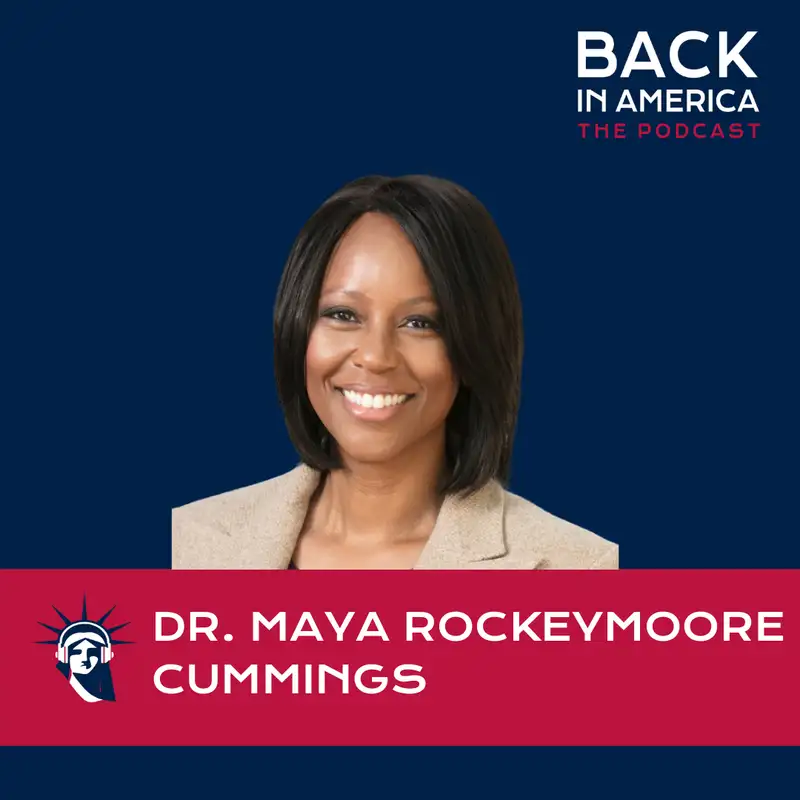
International Women's Day - Listen Again - Dr. Maya Rockeymoore Cummings: Black Feminism, Civil Rights…
People say, oh, you're just messing with the president because you don't like it. It's not about not liking the president. It's about loving democracy. And I'm begging, I'm begging the American people to pay attention to what is going on. Because if you want to have a democracy intact for your children and your children's children and generations yet unborn, we have got to guard this moment. This is our watch. That was Maryland Congressman Elijah Cummings, who brought such passion and spirit to the
House floor during his lifetime of fighting for justice. He was known as the conscience of Congress. And after we tragically lost him just three months ago, he became the first black lawmaker to lie in state. And right now, his widow shares his mission to continue his legacy in Congress. Please welcome Meyer Rocky Moore Cummings. That was Whoopi Goldberg on ABC News in January 2020. If you're tired of arguing with strangers on the Internet, try talking with one of them
in real life. Welcome to Back in America, the podcast. I am Stan Bertolow and this is Back in America, a podcast exploring America's culture, values and identity. My guest is former chair of the Maryland Democratic Party, a political consultant and activist. She recently ran for Maryland's congressional seat just after undergoing a double mastectomy. She is the widow of Congressman Elijah Cummings, a good friend of John Lewis. Together with her late husband, she has been a fierce advocate for civil rights.
Welcome to Back in America, Dr. Meyer Rocky Moore Cummings. I am so pleased to be with you today, Stan. So we're doing this call online, but if I were sitting in front of you now, what would I see? You would see me sitting in the living room of my West Baltimore home, looking outside onto the street, which is actually a beautiful street. It's reminiscent of the architecture that you might see in Holland, perhaps, in Amsterdam. It's full of old world homes that are connected together, but it's in the middle of a very
impoverished area in the United States of America, a neighborhood where there are too many people who live in poverty and most of them are black and brown. Well, that brings me to a question that I had, which is you've dedicated your life to civil rights and fighting for the others. What is it that's dear to your heart? What do you fight for? I fight for the right to exist. I fight for the right of everyone to be recognized on the level of our common humanity.
I fight for the history in this country that has been suppressed. I am the fourth generation from slavery in this country. My parents grew up in the Jim Crow South. My late husband, Elijah Cummings, grew up in the Jim Crow South. They were born into a world that denied African Americans the right to exist, that actually traumatized African Americans and oppressed them and forced them into separate and unequal accommodations from schools to public stores, et cetera. I fight for the right never to have to relive that history here in America ever again, that
anybody that is of color, that they have all of the opportunities that are afforded any human being to rise to become the best that they can be in life. I fight for a future that is multicultural, that is pluralistic, that recognizes all people, our human beings across all races and also genders, religions, et cetera. I fight for freedom. We are going to come back to that in just a minute. But in my introduction, I said that you had double mastectomy because black women are disproportionately carrier of a gene that put them at risk.
Your mother and your sister were both affected. What is the situation when it comes to clinical trial for black people and for black women in general? Unfortunately, America does not have an agenda for black women's health. America does not have any kind of record of actually pushing for government regulations or even government studies that actually take a really good hard look about why black women are dying disproportionately at younger ages from breast cancer. And so with that, while there is some burgeoning research that is happening out there and some
advocacy here and there, if I would have ran for Congress in one, which I didn't, one of my agenda items was to push for a more comprehensive women's health agenda that would take a deep dive into these issues facing women of color and black women specifically. And so, you know, along with the racism that African-Americans and Native Americans and Latino Americans and others face here in this country, we also see it translated into policy racism, which means a denial of government resources to actually address the issues that disproportionately affect us. Talking of racism, I would like to come back to the legacy of your husband.
He was one of the most influential members of the Congress, and he's been diagnosed with cancer 25 years before his death in October 2019. And he was about to finish a book at the time, a book that you've decided to publish. Take us through the process and the legacy of your late husband. So my husband was an incredible man. As I mentioned, he was born an African-American at a time when a country actually turned its back on African-Americans. And it was the early 60s where he actually, as a young man, 11 years old, participated
in an integration march. He and the other black kids were not allowed to swim in an all-white swimming pool in his neighborhood. And so they were led on a march to that white pool where they had rocks and stones and bricks thrown at them by white adults who did not want to see little African-American kids swimming in the same pool as their white children. And so with that, Elijah went on to become one of the first cohorts of black kids that integrated Baltimore City public schools.
He graduated from a very prominent high school in Baltimore City. It's called City College with honors. He went on to graduate from Howard University where he was Phi Beta Kappa with honors. And then he went to the University of Maryland Law School where he graduated and passed the bar on the first time. He went into private practice and then, of course, went into politics in the state legislature, becoming the Speaker Pro Tem, the first ever African-American Speaker Pro Tem in the Maryland's House of Delegates before he was elected to Congress in 1996.
And he rose to become one of the most powerful influential members of the United States Congress. And when he died, he left a legacy, a legacy of fighting to protect democracy, defending the United States against enemies, foreign and domestic, fighting the Trump administration and Donald Trump's corruption and lies, seeking to uplift the truth so that we could actually protect our democracy and make sure that it works for future generations of Americans. And so with that, this book was written in the last year of his life. He wrote it with a man named Jim Dale, and he recounted the stories of his youth and how these stories went on to influence his career.
He had two goals for the book. One was to encourage young people who were facing obstacles that, you know, he had a lot of obstacles that he faced as a kid, but he was able to work hard and overcome them. And he wanted to encourage young people to work hard and overcome their obstacles, to recognize that they could be anything they wanted to be. But he also wanted to warn the American people and certainly the world that Donald Trump was a danger, a danger to our humanity and also a danger to our democracy. And since he died, Elijah's predictions have come true.
We saw how Donald Trump tried to actually take American democracy apart brick by brick in his last months in office. And certainly throughout his entire tenure in office, he sought to dismantle the Constitution and disregard democratic norms. And so with that, Elijah's book will stand the test of time. It's called We Are Better Than This, My Fight for the Future of Our Democracy. And I encourage all of your readers and listeners to get it. And we'll definitely do that.
And I will post a link in the notes of this episode for sure. Your husband was definitely a prominent figure and a powerful man. You are also a very powerful woman. What is it like to be living alongside such a powerful history making personality? First of all, it was an honor and a privilege because he was just a beautiful, incredible man, very spirit-filled, God driven. He was, you know, he woke up every day trying to figure out what he could do to help other people. And he went to sleep every night, worried about the same issues and how he could
maximize his time here on Earth in order to make a difference. And so, you know, we connected on the level of the spiritual. We were in so many ways alike. You know, he cared and pushed for civil rights and human rights. I care and push for civil rights and human rights. And so to be connected to someone who I was so aligned with on so many levels was just a privilege and an honor. Of course, he was the love of my life. And I certainly am just so deeply honored that I had the time that I had with him.
That being said, you know, I have always been a professional focused on these issues. And so I spent a career focused on policy and politics. I'm a political scientist by training. My Ph.D. is in political science. And I look forward to certainly uplifting the legacy of Elijah, but also to continue pursuing the push for freedom, democracy and certainly inclusion here in the United States and everywhere around the world, because many of the issues that we're actually facing here in the United States are also apparent in France. They're in England. They're in countries across the nation, the
world. And so we have to make sure that we are uplifting all of humanity, because I think that's the only way we're going to actually uphold the promise of a new century that is able to leverage the best that we have to offer in terms of technological advances. But we also have to have human advances. You mentioned France and it's interesting. Last summer or last spring, after the death of George Floyd, we saw a lot of demonstration in France with the sign Black Lives Matter. Many commentators said that the fight against racism is quite different in France. We've got a colonial past, but we don't have a past with slavery the same way.
Although we were definitely part of the transatlantic slave trade, we don't have a survivor of slavery in France the same way as you do in the U.S. What can you say about that? I mean, this country has divided more than it has ever been. So we've got a political divide, obviously, but we also have a racial divide. And I think for people that have not grown up in the U.S., it's quite hard to understand the experience of Black people in the U.S.
So I think your divide is racial, is ethnic, is religious. And yes, while I understand that many French people are secular, certainly your history in North Africa and certainly your history with Muslims around the world is something that has come up in recent years as a fault point in your society. But anti-Black racism does not actually have to be connected to slavery. And it's actually apparent in Western Europe. The whole notion that whiteness is actually better than every other skin color on the planet is not something that's just confined to the United States of America. And so we have to beat back racism wherever we find it. We have to understand that that kind
of racism was apparent in colonialism as well. When the colonizers went into the homelands of sub-Saharan Africa and took over and dominated and perverted all the systems that were there to their own advantage in order to actually leverage and secure the wealth of the nations and to take them back to the France homeland, that is racism, a structural racism, but of a different kind. So we're fighting racism on every level in many societies across this country, I mean, in this country and across the world. And we need to actually come to grips with our past and understand how it influences the present. Do you have any hope for this country to actually come together? I do. I do. But it's going to actually take inclusion. It's going to have to
take basically confronting racism, confronting classism, uplifting a new vision for the world where the whole issue of oppression based on, you know, these, frankly, these characteristics that don't really matter much, except for the fact that some people seem to think that they should actually define our world order and certainly our social order. So we have work to do, but I actually have hope. I have hope that people can understand that they've been blinded by lies, lies that have been historical, lies that are contemporary, lies that have blinded them to the reality that we are all God's children and we all have and should have the opportunity to live our best lives here on this planet. And there is no characteristic that God has assigned that should
be demeaned or considered less than or undeserving. And so I am on a mission. I am on a mission to address this globally as well as here in the United States. And I am on a mission and I am determined to make sure that we can transform the way our societies operate, the way our world works so that we can take advantage of all of the brilliance that is apparent and evident and present among all the peoples of the earth. You are a black woman. Talk to me about black feminism and why a lot of white feminists did not understand that your fight had to be addressed maybe slightly differently than the way they were trying to process it. Well, you should understand that white feminists are affected by, infected and affected by the same racist paradigm that has
historically affected whites across certainly the Western world. And so they didn't understand that our history was different because they didn't actually care to understand because they didn't consider us to be equal. And so with that, black women, as one writer described us, have been the mules of the world. We have been considered the bottom of the bottom at the base of the totem pole because women around the world are not considered on an equal footing with men. And certainly black people around the world are considered not considered have not historically been considered on an equal footing with whites. And so as black women, what we have been able to do is see how oppression works, how these disparities work, how the isms work in an intersectional way because
they intersect in our lives in multiple ways and unfortunately too many ways. And so we have been able to utilize our intellectual power to dissect the structural isms in a way that can illuminate how they operate and then transform. And certainly, first of all, not before transforming, we actually need to deconstruct and then of course rebuild. And so black women in America are at the forefront of this effort to dismantle structural racism and sexism in this country. Certainly white women have gotten on board in many respects and in some cases are following. But we have a mission and we are determined to transform this world to make sure that we all have opportunities, including black women. So you're on a mission and you want to change the world and I believe that
yesterday the festival that you held online was part of this effort to change things around. You held the first Eli Jai Cummings Democracy and Freedom Festival and I believe that you had speaker Nancy Pelosi as a keynote. That is correct. How did it go? Tell us about it. It was wonderful. We had an hour and a half with some incredible activists, policymakers, intellectuals, leading people who have given a lot of thought to these issues around discrimination here, certainly in the United States. And it was certainly poignant coming only a week and a half after the January 6th insurrection where a certain faction of Americans tried to overthrow the United States government in the name of Donald Trump. And so with that, it was especially poignant
that it was named after my late husband who started his life certainly being discriminated against and ending his life fighting for the same system of government that once actually kept him out. And he fought for it because he believed that a democratic form of government was the best hope that we have towards working towards our collective freedom. And I agree with him and I'm working on this as an annual event. The first event went incredibly well but we look forward to growing it and building it in future years. Wow. Do you know how many people attended? So we had 770 registrants and we had 345 participants. Good. And will you be posting the speech and everything online?
Yes, I'll be posting the event online. Okay, so we will share it. Finally, my last question is always, what is America to you? America is both an idea and a possibility.
It is a country that upholds the notion that you can be anyone from anywhere in the world of any background and certainly have the ability to rise to become your best self, your best self, have influence and to have opportunities. But that's an ideal. It's an ideal that we actually have to continuously work for. And so America has historically been challenged in this area. It continues to be challenged in terms of its opportunities for diversity and inclusion. And so I am here to say that the possibility of America can become a reality. The notion of a multiracial, multicultural, irreligious, meaning that all religions on the world, or even if you don't practice a religion, that you can be welcome
and that you can become everything that you are meant to be here in this country. That is America. And that is certainly what I'm working for.
Let me ask you, what is it like to be a woman, to be Black, and to do politics?
It is to be constantly disregarded, disrespected, to know that the reason why you're being disregarded and disrespected is because people are myopic. They haven't lifted the scales from their eyes to recognize talent and opportunity when it's in front of them. And so it's also the continuous effort to actually have your voice heard and to basically fight through the negative perceptions to make a difference. And so when you're continually fighting, when you're continually rubbing up against the friction of the world, what happens when that happens to a diamond? It's something that's in the ground that has to be continuously polished in order to become brilliant. And to be a Black woman is to be continuously polished by friction, by
challenges in order to become brilliant. And so with that, I claim my brilliance and I claim the brilliance of other Black women around the country and the world who are working towards liberation. Maya, thank you so much. I thank you for inviting me. I thank you for having me on today. Thank you, Maya. Have a good day. Take care. Bye-bye.