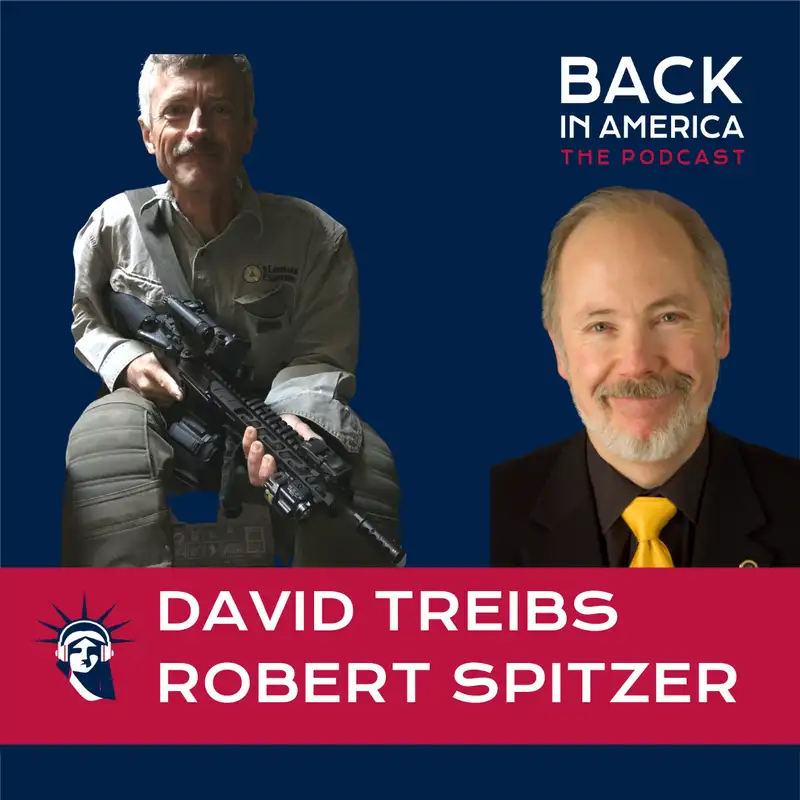
Guns, God & the 2nd Amendment in America - David Treibs Christian & Guns Activist - Prof. Robert Spitzer Constitution and Gun Control Expert, SUNY Cortland
If you're tired of arguing with strangers on the internet, try talking with one of them in real life.
Welcome to Back in America, the podcast. I'm your host, Stan Bertolow. In each episode, I trace America's identity, culture, and values back to its source, its people. A few weeks ago, John, a good friend from college, visited us for the weekend. At night, we were joined by a couple living next door, and we started to talk about politics as we drank beers by the pitfire in the backyard. You had two French persons, my wife and I, and three Americans. I can't remember exactly how and why John started to speak of guns' right, but the conversation became intense when he said that not only did he support the right to bear arms, but that it was essential to the protection
of civilians against the tyranny of the government. This made me dig further into the gun debate. I have learned that many support the idea of owning guns, any types of gun, and that in the U.S., some people believe that they have a God-given right to carry a gun. What has God to do with gun? And how can a democracy work when its citizens trust their guns more than their votes? To try to make sense of all this, we are going to hear from three persons. First, John Phoebus, my friend, will clarify his views. Then, David Tribe, a Christian and gun activist, will talk about his beliefs in a God-given right to bear arms. Finally, Professor Robert Spitzer, from Sunnicartland, an expert on constitutional law and gun control, will give us his interpretation
of the constitution and bring some historical context to the debate. Hi John. Hey Stan. So I was counting, I think we've been friends for over 30 years. Yeah, somebody asked me, I told them 25, but we'll go with your number, it's more impressive. Well, whatever. It's been a while you visited me in France, you went to my wedding, I went to see you in Maryland quite a few times. I remember amazing evenings and parties with you and with your parents. I mean, we come back a long time, right? Oh yeah, and you brought your freshly christened bride to my wedding. Exactly. So anyhow, as you know, the evening by the pitfire and the conversation we had about gun really prompted a conversation I now had with two quite interesting persons about guns in America.
Fantastic. And because I talked about that evening in the introduction of the podcast, I thought it was only fair for you to actually state in your own words what it is you stand for when it comes to gun. Stan, thank you for the opportunity. I'm really tickled that you've approached this topic for all of us. So I think it's important I describe myself as someone who's friends always think I'm either a Republican or I'm either a Democrat, whatever's the opposite of them. But I consider myself to be fairly left leaning and I personally believe as an American that our right to own guns is our guarantee against tyranny. All right. And this is what prompted that discussion. Would you mind telling me a little
bit more about how you think that having guns would protect you against the tyranny of the government? Sure. In its essence, any fight should be a fair fight. I mean, in its essence. So
if someone's going to come armed, potentially, I should be allowed to defend myself somehow, somehow equally. And you hear me stuttering, you know which corner I'm trying to avoid painting myself into. Do you own a gun? I do not own a gun. But gun ownership in the US is the only political thing that I get worked up about.
Again, thank you so much. And thank you for really bringing this issue up. Really as a European, it really triggered my brain and made me think and I think we are now going to have an interesting podcast. Thanks to you. Thank you very much, Stan. Thanks for including me. And I really like how you dive into all your topics. So really, again, I just want to thank you for tackling this topic. The following two interviews are edited version of live interviews that were recorded on October 20th and 21st. You can watch the entire broadcast on Back in America's YouTube channel. David, you are from Fredericksburg in Texas. And I believe that you've been an officer. Today, working as a land surveyor. Politically, can I say that you are a constitutionalist?
Yes. You are a Christian. And judging from our previous exchange, I would say that your dearest value is the defense of liberty. That seems about right. That sounds good. I would say politically, that is my highest virtue. Personally, my highest thing that I aspire to is to please God.
I think you're correct. Good. Anything else you would like to add to this brief introduction? No, I'm glad to be here. I feel honored that you sought me out to have this discussion and I hope we can have a good talk. We are here to talk about God. We are here to talk about gun. And I would like to understand when did you start to be interested in guns? How young were you? Well, that's an interesting question. When I was probably in middle school and my OPA, that's my grandpa, he had a copy of the American Rifleman magazine. And I read that. And I read several issues of it as it came in. And I became very interested in gun rights and second amendment issues. So I was probably, man, I don't know, in middle school, that might have been in 79 or
something like that. But even before that, I mean, I grew up in a rural setting. My OMA lived on a 300 acre ranch and you just needed firearms to take care of business. You go hunting during hunting season and you go shooting for fun. And if the skunk came to eat the chicken, take care of the skunk, things like that. So I just grew up around firearms. And then to find out that there are people who want to infringe on your right to own firearms, it just kind of doesn't make any sense. You are very representative of the American population. I read in pure research that nearly half of US adults grew up in a household with guns, 48%. So yeah, I mean, that makes sense. You grew up around guns. You shoot guns. How old were you when you
shoot the first time? Five or six years old and I was shooting the 22, you know, a little single shot, 22. Okay. And where does God come into play then? I don't really remember a sermon specifically about guns until I was in college, firearms specifically, but just the whole conservative mindset of, you know, private property, taking care of problems. It just all goes together with gun ownership. And obviously I never heard anything in church that was against gun ownership because one of the people who was my pastor when I was young, he sold me my first deer rifle. So he worked, he was a manager at a Gibson store and, you know, he sold guns to people. And he was, he was quite fine with that. So firearms are a means, in fact, in the bottom,
the bottom line, they are the last means to defend two things that are important to me, life and liberty. And without firearms, you are hamstrung in your ability to defend either or both of those. And so the more I see efforts of people to restrict gun rights, the more it becomes imperative to me, not just for the sake of a right, but for the sake of preserving life and preserving liberty to, I fear that if the second amendment is infringed enough, we'll lose our liberty for sure. And then we'll be vulnerable to whoever it is that comes down the street and wants to take our life as well. And so, so yes, I mean, I wanted to focus on religion, but I get the feeling that to you, religion and firearms are totally intricate. And, and that's fine. I
mean, we can continue to talk about the link between the two. Let me come back to what you just said about the defense of the constitution. Do you, I mean, what makes you believe that people in this country wants to take firearms away from you? I got the feeling that actually, you know, it is quite the opposite. You've always had rules and the rules have become a bit more loose in recent years, maybe since the last 10 years. Has gun ownership become more loose in recent years? I would have to say overall, no, because like every so many years, there are more laws that are being implemented. You know, you start with the National Firearms Act of 1934, the Gun Control Act of 1968, the, I think it was 1989,
the machine gun ban. You have the, the imposition recently, maybe the most recent one of red flag laws, which is kind of macro gun confiscation, one household at a time. You have the imposition of background checks and waiting periods broadening out to more and more people. At the same time, there has been, I guess, some of what maybe you would perceive if you watch the news and say, well, things are becoming looser now because there's more open carry, particularly of assault weapons, which I like, it's good. So maybe from your perspective, things are becoming looser, but I think in the grand scheme of things, they're not. Just to clarify your position, you said you were a constitutionalist and
for what I understand of constitutionalist, it's really sticking to the constitution. The rules that you want to obey are the rules of the constitution period. Am I right? That sounds good. Yes. Okay. Now, if we look at that, when it comes to gun, that means that the constitution allows you to own a firearm period. You know, it doesn't say anything about added control, all kind of waiting period, all kind of background checks. You know, you are entitled by the constitution to hold a firearm. Is that what you believe in? Do you believe that by the constitution, American people are allowed to have a gun and that no other federal or state
law should come on top of it? Well, the constitution says very clearly, shall not be in print. And so I think that's pretty clear. And so that's my, if I'm going to hold to the constitution, I don't know what other position I could hold. So yes, that's correct. So you're really infringement. Okay. And a background check is an infringement. Yes. Yeah. Okay. What about people that are mentally ill? Should they be allowed to have access to a firearm? There are many aspects of that argument to consider. First of all,
who defines what's mentally ill? If somebody went to a psychiatrist 10 years ago, are they mentally ill? If someone is taking some kind of medication, are they mentally ill? There's a lot of slippery slope involved in that argument. The left would be happy to use that criteria, oh, you're mentally ill, to deny as many people as possible the right to bear arms. And that's how it works out in the real world. My thought is if somebody is so dangerous that they are going to hurt someone, the law already allows us to lock them up and at least evaluate them. So what more do you need than that? Because if you take somebody's gun away, it's not like they can't commit an act of violence. I mean, that's ridiculous. They'll just go around the laws or use something else or use their car
or firebomb or whatever. Okay. All right. That's clear. Now let's go back to where we started this discussion. You believe that Americans, and let me ask you that first question. I said American, do you believe that God gives a right to human in general to own a gun or do you believe that God gives a right to American in particular to own firearms? No, you are asking what I would consider to be a good question. I think you seem to have a basic understanding of what my position is. And so I'm going to maybe explain it in a little bit more detail, but I believe you're in the right direction. So the Declaration of Independence says all men are created equal. They are endowed by their creator with certain unalienable rights. It says all men, not just
American citizens, not just people who are whatever. It's all men, everybody. So we all have the right to keep and bear arms, including people in foreign countries where they're denied that or where it's heavily restricted. So now where was I going with that? I think you answered the first part of my question. The second part is the Constitution was written and the Declaration was written by human beings. Where does God come into play? Well, the founding fathers, even those who didn't, as you might say, accept Christ, they had a biblical worldview and understanding of things and understanding, and I guess now we're kind of jumping into the kind of the biblical reasons, an understanding of human nature, that human nature is corruptible, that people can do evil things,
whether people, individuals or people in government, and there needs to be a way to deal with those people, either individually or if they're in government, you need a way to deal with them. And so the founding fathers understood that, okay, we have to have this means to deal with them. And having just fought a revolution where they used weapons to deal with tyrants and those who were enforcing tyranny, I believe that was very distinct and heavy in their minds. And of course, with their understanding of Scripture, you know that the whole idea of self-defense is just inherently a biblical one, that it was like falling off a log or, you know, that's just a simple conclusion you come to. If I hear you well, your reasoning is that in the Bible
there is Scripture mentioning the right to self-defense. And then you extrapolate that to saying, well, self-defense today means defending myself with whatever weapon I've got today, right? It's not going to be a sword, it's not going to be a slingshot, it's a gun. So self-defense means protecting my family with a gun, right? Is that it? Yes, that would be correct. And I wouldn't use, you know, if I wanted to exercise my first amendment right, I wouldn't say, well, I have to stick with a quill pen and, you know, a dipping bottle of ink. I can use a typewriter and a computer and a cell phone and whatever. And the same thing with, you know, with self-defense. You look, you try to understand,
okay, what was it that was happening back then in the Bible or, you know, in our county? You can see, well, they were using the personal weapons that were used by the infantry soldiers. And that's what the people had. And that's what they used. And so they said the right to keep and bear arms. They didn't say the right to keep and bear flintlocks, they said arms. And so obviously that is going to entail everything related to arms up there too. How do you feel about the upcoming election? Well, I think there's a lot at stake. Joe Biden or Kamala Harris, whoever is actually going to be in charge of that ticket, represent the radical left, not just liberalism, but the radical left.
I really, I think no matter who wins, things are not going to be good for our country. But if the radical left wins fairly and squarely, and it's evident, then we're in for a rough ride.
If I understand what you're asking me, I would say no. Obviously both sides are capable of violence and that's self-evident. Obviously our side is quite capable of violence. We have the firepower to do so. But I believe for the most part, the right is restrained and is happy to go to work and take care of their families and live life. Whereas the left is trying to seize power and they are going to do pretty much whatever it takes to do so. If that includes voter fraud, if they think riding can somehow give them a victory, then they'll do that. Potentially. Obviously both sides can do it. But I don't think the right is going to initiate anything. The right is going to just kind of watch and respond if the left becomes violent. So you personally would be ready to take
arms if the left becomes violent? I want to kind of phrase it generically because I want to be careful what I say. But I'm going to do whatever I have to do to defend the constitution of the United States. All right. And you said that whatever happened with the election, even if Trump is reelected, the things are not going to be well for the country. What do you mean by that? The left has been trying to overthrow a legitimately elected president for four years and I don't think they're going to stop just because he was reelected a second time. I think they're going to have an apoplectic fit and I believe that with all this mail-in ballot stuff, they're going to try to find some extra votes to overturn the election. Now that's assuming that Trump wins in the first
place. Okay, I think we understand what you mean. Where do you see this country in five years from now? In five years from now? Oh boy. I don't really think it looks good because after Trump, who's going to be on the Republican side? In the last, I don't know how many years, the Republicans have only managed to put up a bunch of spineless, not constitutionally oriented people. If we put up another one like that, I don't think they're going to win. And then the left is going to win. And once the left has power, I don't know. In your circle of friends, are most people believing what you believe in? I mean, do they stand for the constitution? Do they stand for gun? Are most people you mingle with have a gun? Now, I don't know if they have a gun. I think most
of the people that I rub shoulders with believe in guns. They believe in the constitution.
Some people that I associate with are not in any way Christian or they might be some other variety of religion. And some of my friends really don't like Trump.
Really? You do have people that don't like Trump in your circle? Oh yes. They strongly dislike him. They're strong Christians. They're strong believers in the constitution. And it is because of that that they don't like him. Because you have to be honest. Trump is not a concern. He's not a Christian. And he's done a lot of things that are offensive to Christians. And so there's kind of a debate in our circles. Can we support someone who's not really conservative? Can we support the lesser of two evils? That's really the core of the debate. And some of my friends say no. And some of my friends say yes. That's interesting. That's really interesting to me. You do realize that the man is not an angel. You do realize that the man is not honest.
Or always honest. Yeah, I can really understand where you are coming from here. We've got a question from Priest Boo. I think I know who it is. Who is asking. So it's not really, it has nothing to do with gun. But we'll see what you take it if you want. What is your position about COVID-19, the risk and the measure and the future risk? Well, I guess we want to try to stick with our themes that we're talking about. God and guns in the constitution. So how can I relate that topic? I actually feel that there's a pretty close connection between say gun control in the constitution and the response that government has had to the Wuhan virus or the SARS-CoV-2 or whatever you want to call it. I believe, and it might have been William Barr, he might have been
the one who said that this has been the greatest violation of civil liberties ever in this country. And I'm inclined to agree with that. I'm not saying that there's not a virus, but the response has been just totally over the top. The constitution has been thrown out the window by these tyrants, is what I'd call them. And I would not just say that's Democrats. There are plenty of Republicans who I wouldn't give you two cents for right now. And that includes our own governor, Greg Abbott. Gross violations of the fifth amendment with these mask orders, which by the way, I don't follow. And I've been kicked out of a couple of places. Of course, there have been a couple of places where I did wear a mask because I really had to use the restroom and I didn't want to argue about it.
When I go to the store, I don't wear a mask because of constitutional issues. And I think all Americans should defy this stuff, peacefully of course. This should rip down those signs. And individuals should ignore the stupid signs. And we need to defend the constitution, whether it's with firearms. Wait a minute. I need to make that clear what I'm saying. We need to defend the constitution, whether it's with the issue of firearms or whether it is with the issue of government officials trying to force us to do things that they have no authority to do. Okay. Okay. Again, we hear you. It's not the topic of the debate tonight. So I won't ask any follow-up question on that topic. But what I liked about what you say, that you really brought it
back to the constitution, which is central to what you stand for. And talking of the constitution, we've got a question from Jan Bendy, who said that he believed that it's wrong to ask why people believe in a certain constitutional right. And rather, he said we should demand to know the motivation of those who would take and or restrict right. So if I refraind that, I could ask you, what do you think would be the motivation for the people trying to refrain access to gun? Okay. What is the motive of those pushing gun control? At the top, I would say it is very definitely a seizure of power. They don't want anybody standing in the way of their agenda. And when you have millions of people armed to the teeth and with a mentality that you're not going
to violate our rights, whether it's second amendment or whatever, you're not going to violate our rights, period. Those people who are trying to seize power, they don't like that. Because in the end, guns equal power. I believe the people at the top, it is universally to seize power and to begin the process of eliminating the constitution. I believe that is their goal, to eliminate the constitution. And they want total power. Now, of course, there are people who kind of believe what they hear, like all these people wearing masks. They believe what they've been told. They believe, oh, it's because I care about other people. Okay, well, I think you're sincere in that. I'm not going to challenge you or make you feel bad. But these people that
are sincere, but pressing against the constitution, they're sincerely wrong and they're sincerely deluded. And we need to try to reach them, tell them the truth, educate them by whatever means we can. And so that's kind of one of the reasons why I'm talking to you, even though we might be from a little different perspective. Maybe I can say something that will cause somebody to think and say, well, you know, maybe something of what he said might have some truth to it. Right. Thank you. And I appreciate that. Thank you for sharing. And yes, we are not totally aligned politically, I believe. But, you know, it's good to have this conversation and to keep the dialogue open, definitely. Yes, you referred to one of the questions I might have asked you, which was,
we live in a democracy. And if you disagree with your government, we've been told that the proper way to address that is to vote or to sue your government. Are you advocating against that? Oh, not at all. I agree with that 100%. I mean, I don't believe in shooting people every time, you know, something happens. That's not what we want. And that's definitely not what the Second Amendment crowd wants. If that were the case, there'd be nobody left. Because like, how many guns are there in the United States? Like 200, 300 million? So, you know, if we decide, okay, we're going to shoot somebody every time there was something happened that we don't like, I mean, this would be like the Second Civil War would be Sunday School Picnic. So, no, I'm not
in favor of violence, because I don't agree. And I very much agree with voting. And I've been been engaged in voting since I was 18. And persuasion, that's what I like. I enjoy persuasion. This is fun to me. Waving guns around in the presence of other people, that does not excite me. I don't want to do that. So, that's part motivation for why I'm involved in advocating. The shooting starts when there are certain lines that are going to be crossed from which you cannot come back. I mean, if, you know, the Joe Biden is elected president, okay, we'll hunker down. We'll wait till his term is up. He probably won't make it to the end of this term. But, you know, and then we'll vote in somebody else. Hopefully somebody a whole lot better than him.
That's not a line that you crossed you can't come back from. We came back from Obama.
You know, things like that. These morons had passed these laws about masks. Okay, we can suffer through that. We'll wait till it's done and then, you know, sue them and then it's going to be over with. But the lines, let's say one line in particular that has been kind of the focus of a lot of the things I've written and said is firearms. Once you take away or restrict on a large scale firearms, you can't come back from that. Because once you lose real power, all you have left the voice and people in power don't care what you have to say. They don't care what you have to say, Stan. They don't care what I have to say. They don't care what any of us say. They have power. They're going to do what they want.
You can write petitions all day long. You can, you know, go march around the Capitol. I don't care. David Tribe, let me ask you something. Do you believe that you as a citizen and you within a militia, even if you are armed to the teeth, do you stand a chance against the US military? I guess I would counter with the question, do you believe the entire US military is going to go if ordered to do so? Well, I mean, we saw what happened with Waco. Okay, that's a good example of where enough of them did go against the citizens to bring about their deaths. There are other instances and as you mentioned, I was an officer. And I can tell you that most gun control measures are going to be enforced by the police. The military is not going
to be involved. Most of that's going to be police. And I can tell you there are a lot of police who will not enforce unconstitutional gun laws. That one picture I sent you of me with the sheriff, one of them up in Virginia, and there were a number of them, others up there too. The sheriff in my county has said there are certain unconstitutional gun laws I'm not going to enforce. And I'd be willing to bet you that a lot of the officers have the same view. And so you start with the assumption, well, are you going to be able to go against the tank? Well, you're assuming that that guy in the tank is going to come shoot me in the first place. And I don't think that's the case, that all of them will. I think it's going to be divided
and it's not going to be a walk in the park. And you think that this confrontation will come about? I hope not. In the immediate future, what I see as an actual confrontation coming is caused of red flag laws. I don't think the left is going to try house to house gun confiscation. That would be pretty wild. Now they might do a buyback and then try to go after the holdouts, which would hopefully be most people. I think where the right now what I see as the point of conflict is going to be red flag laws, where somebody is surrounded by the police and they say, we have to take your guns. And the guy inside says, go pound sand. I'm calling my buddies, leave or it's going to be ugly. So that's what I see as pretty much the point in the immediate
future. Okay. Okay. Thank you, David Tribe. Thank you so much. Before I let you go, we are on Back in America and I always ask one or two question at the end of each of my interviews. And the first one will be what is America to you? And then would you have any recommendation book wise or movie wise that you think we should all watch or read? So first question, what is America to you? America is very definitely both a place and a concept. America is freedom. America is life. America is economic prosperity. America is love of people and love of everything that's good. America is our history. What it stains. Yes. But that's part of America. And it's unique. It is beautiful. We need to preserve it. Thank you. So a book or a movie that has inspired
you. Oh boy. A book. Well, let's start with the Bible of course. Read the Bible.
And then after that, what are some books that I really thought were good? Shoot, man, I wish you'd have given me a chance to think about that. Love Letter to America by Thomas Schuman. Also, his real Russian name is Yuri Besmenov. Since we're on the topic of the constitution and rights, he would be a good one to consider. He was a defector from the Soviet Union and he wrote a book about freedom. That was a good one. This one, I don't know if it would appeal to too many people in your audience, but I read it to my children. It's The Persecutor by Sergei Kordakov. He was also worked for the Russian government and defected. He persecuted Christians in their program and he became a Christian and decided to escape to the United States,
or maybe it was Canada, I don't know, to the West somewhere. And he wrote a book about it, about what he did. And it kind of, oh yes, boy, I'm so glad. I just thought of another, a really good book. It's a short one. And again, somebody from a communist country, Richard Wernbrandt. He's the author and the title of the book is Marks and Satan. If you want to understand the spiritual connection of communism, read that book. It's short, it's easy reading, and you're probably going to either love it or hate it. But I think it's good and it helps me understand the spiritual nature of communism, which is, you know, aggressive liberalism, whatever, you know, the radical left. Interesting. Super. Well, thank you. Thank you for sharing
what you believe in. And as you can tell, I like to talk. Yeah, yeah. Well, it was interesting. And honestly, we don't have enough conversation like that on Back in America. It's slightly more on the other side of the spectrum. So thank you for accepting this interview and be well and stay safe. You also. Bye bye. I am delighted to welcome Professor Robert Spitzer. So welcome on Back in America, Robert. You are a distinguished service professor and the chair of the Political Science Department at the State University of New York College of Courtland. You are the author of 15 books. You are an expert on the U.S. Constitution. You have testified before Congress on several occasions and you are often quoted and interviewed by American and international news outlets.
It's an honor to have you on Back in America. Good to be with you. So when was the last time you shot a gun? The last time. Well, let me preface this by saying that I would not consider handling and firing firearms as a prerequisite for studying gun policy in America. Having said that, the last time I fired a gun was in 2014. OK, that's a while back. I read somewhere that you're a member of the NRA. I am indeed. And I've been a member for 25 years. I'm also a member of the Brady Coalition, which is a pro-gun control group. And I've been a member of that group for 25 years as well. OK, now the NRA is not really pro-gun control, is it? It's not, although the history of the relationship between the NRA and gun laws is a little more complicated than people might think.
These days, you pretty much assume that the NRA and its message is synonymous with no gun laws. And that's close to being true. But in its history, it has supported stronger gun laws. And in fact, it has in prior decades helped to write gun laws going back as far as the 1930s. And even in recent years, it has lent its support to some limited gun measures, although it's not something that they'd like to draw a lot of attention to. But by and large, they oppose gun laws. They do, right. OK. And what about you? I mean, you're pro-gun, are you? Well, I'm not pro-gun or anti-gun. I mean, my first purpose as an academic is to study the gun issue from many different points of view, from law, history, politics, of course, policy,
criminology, the US Constitution. And so the study of the subject is what animates me and the things that I write and speak about pretty often. I will say this, that I think anybody who owns a gun,
who does not have a healthy respect for a gun, probably shouldn't own a gun. Because any responsible gun owner knows that a gun is dangerous. And as soon as you pick it up, you open up the door to accidents, to mishandling, to loss of a firearm. People lose guns, have been stolen. I mean, a lot of bad things can happen that are not intentional on the part of the gun owner. So anybody who owns a gun needs, and I have no doubt has, healthy respect for firearms. That doesn't mean fear, but it means care. So do you own a gun? I do not. Although I do have a concealed carry pistol permit that I obtained here in New York State a few years ago. And I actually wrote up about that process in in a book that was published a few years ago. Okay. Owning a gun in New York is pretty tough,
right? It is compared to most other states. It certainly is not that complicated. One of the reasons I went through the process of getting a license was to see how long the process took, how complicated it was, how onerous. And it took me all about three months in all from beginning to end to get my permit. They do a background check. They fingerprint you. You have to submit a photograph. They ask for references from four people that you know, character references, and they ask them a bunch of questions that they answer on a questionnaire. And to me, these are good steps to take precisely because they are pretty effective at filtering out people who shouldn't have a gun in the first place. That's interesting. And we're going to
come back to that. So before we go any further, could you read or recite the sentence of the Second Amendment? Sure. The Second Amendment says the following. It says a well-regulated militia being necessary to the security of a free state, the right of the people to keep and bear arms, shall not be infringed. And I'm not reading from any text, by the way. That's from memory. Yeah, I can see that. You know, the first question that comes to mind is what is the militia in this context? Is it a state army? Is it civilian organized into an armed group? What is it, do you think? That's a very important question. And it even now doesn't receive the attention that it should because the first half of the sentence is all about militias. And
sometimes in the contemporary era, people scratch their head and wonder, well, what's that all about and who does that refer to? But we know exactly what it means and what it refers to. It refers to an organized body of military age eligible men, historically defined as men roughly between the ages of 18 and 45, who are called into service by the government. It could be state government, it could be the national government, but the whole definition of a militia is that it is a government organized, regulated, funded activity. Now, there are lots of people, and they've gotten quite a bit of attention in recent months, who on their own organize what they call a militia, who organize themselves, who get firearms, who sometimes have uniforms or do other things to
imitate military rank and order, but they're doing it on their own. And that's not a militia. Now, they can call themselves a militia, but that doesn't make them a militia. I mean, I can call myself the king of Prussia, but that doesn't make me the king of Prussia. I mean, I can say that, right? I can say lots of things. And in fact, every state of the union has laws against paramilitary private so-called military activity. And in fact, there are court cases, a very important one, back in the 1800s, that established and made very clear that there is no such right to organize a private militia. And this is part, this goes directly to why the second amendment was added to the constitution. It was added to the constitution in 1789 as one of the bill of rights,
in order to make sure that the right of citizens to obtain firearms for military service was not impeded. Because of course, one of the things the British did back in 1700s during the revolutionary era was that it would strip firearms from men who they thought were suspicious or might use the guns against the British army before and during the revolution. And this came at a time when the government did not provide weaponry to the militias. As a matter of fact, by law in the 1600s and 1700s and early 1800s, military age men were required to obtain at their own expense, military grade weaponry in case they should be called up for militia service, because the militia was the main bulwark of our military forces. Now, there was an implementation problem
back then, which was that most men didn't abide by these laws, because they couldn't be bothered, they didn't have the money, they had other concerns, they didn't want to serve in the militias. And the old militia system basically died out because it was a terrible way to have a national military for military purposes. But that's what the second amendment was all about. It was only in the year 2008 when the Supreme Court of the United States decided that the second amendment now referred to what's called an individual right, the right of average civilians to obtain firearms for personal self-protection in the home, that it now applied to that realm. And while the court has a right to reinterpret the law and the constitution, they cannot reinterpret
or rewrite history. And their interpretation from 2008 has nothing to do with what the second amendment meant, but the people who wrote it and the courts that interpreted it in the intervening time. Interesting. And I wonder if a lot of people realize that. But again, before we go there, last week, Judge Amy Coney Barrett's confirmation brought back the discussion about the second amendment. And I've read that Barrett said the appeal court treats the second amendment as a second class right. What do you think in a few words, before we go any further, what do you think she's talking about here? And what is the debate when we talk about the gun debate? What debate are we talking about? Well, her reference to the second amendment being
treated as a second class right is, as far as I'm concerned, it's false. It's not true. What she's referring to, and she's using a sentence that Justice Clarence Thomas wrote in a dissenting opinion in a court decision a few years ago. And she's referring to the belief by some that court rulings in the last 10 years or so have not been strict enough in broadening the definition of individual gun rights, because there have been many hundreds of court challenges of gun laws since 2008, the District of Columbia versus Heller decision that defined the second amendment as an individual personal right. So hundreds of challenges of federal and state and local gun laws. But most of those gun laws have been upheld based on the criteria that the Supreme
Court itself laid out back in 2008. And some in the legal community, some conservatives are not happy with that outcome, even though I think it found a fair balance between gun laws and gun rights. But these people who are unhappy with this, Justice Thomas is one, and Judge Barrett, soon to join the Supreme Court, is another. What they're clamoring for is an expansion of gun rights that would allow and require courts to start striking down gun laws, even though there's lots of evidence that existing gun laws are beneficial and that most Americans support them and that they have withstood constitutional muster up until now. Yeah, indeed. I read that the majority of Americans nowadays support gun laws. Yes, 60% of Americans in 2020 support guns
laws against 52% in 2017. So that's, that's indeed interesting. Well, Professor, last night, I interviewed David Tribe, a Christian and guns rights activist, as I said in the introduction. And I would like to play one minute clips of the interviews I had with him and to see how you can react to what he says. Firearms are a means, in fact, in the bottom, in the bottom line, they are the last means to defend two things that are important to me, life and liberty. And without firearms, you are hamstrung in your ability to defend either or both of those. And so the more I see efforts of people to restrict gun rights, the more it becomes imperative to me, not just for the sake of a right, but for the sake of preserving life and preserving liberty to,
I fear that if the second amendment is infringed enough, we'll lose our liberty for sure. And then we'll be vulnerable to whoever it is that comes down the street and wants to take our life as well. So you would be, you personally would be ready to take arms if the left become violent. I want to kind of phrase it generically because, you know, I want to be careful what I say, but I'm going to do whatever I have to do to defend the constitution of the United States. What do you think? It's a sentiment that you certainly hear that a segment of Americans believe in quite strongly, but there are a number of problems with this position. I mean, one problem is is to defend liberty in the abstract is of course something that America proclaims as one of its
most important purposes. But the way we do that in America is through the rule of law. It is through our legal system, the political process that we air our grievances, that we express our points of view. The whole idea of having a constitution is that you do not resort to violence and do not have to resort to violence. Now the further idea that somehow our government may become tyrannical and, I don't know, impose martial law or impose some kind of genuine tyranny and the idea that arms, the random armed civilians could somehow have an effect on that, beggars the imagination. How exactly would that work and what actions would that involve? I mean, he was talking a little bit about defense, defending yourself and of course on a personal level if somebody attacks you,
you have a right to defend yourself and that could involve a gun. But when we're talking about the society and the government, the whole idea of government in a democratic system is that you don't resort to violence. And this is where people often misunderstand our revolutionary tradition because yes, men organized and fought the British, which was the ruling government, but they did so not on their own, but they did so on behalf of a new and different government, our own government. Well, we have that government now. It was established and created first in the Articles of Confederation, our first constitution in the 1770s and then the modern constitution that was adopted and put into place in 1789. And the idea that had American civilians having guns
somehow as a bulwark against tyranny, I think really is an upside down view. I worry frankly more about Americans with guns who decide that they're going to try and do something that they think is right, that in fact hurts people and that takes other people's liberties away rather than protecting liberty. Right. Well, so he, David Tribe and many conservators such as Texas state representative Matt Schaeffer wrote on Twitter last year in the aftermath of the West Texas shootings spree that he wouldn't use the evil acts of a handful of people to diminish the God-given right of my fellow Texan. So that really made me think this idea of God-given rights. Do you think that using the Declaration of Independence preamble that all men are under by their creator or certain
and liable rights and quoting the Bible is a little bit too convenient for gun defenders? The legitimate part of that reference to the Declaration of Independence has something to do with what's generally called natural rights, the idea that people have innate rights aside and apart from the rights that governments and constitutions define and protect. And you could have an argument and bring in Thomas Hobbes and John Locke if you like and talk about the doctrine of natural rights. But in a functioning political system, we define our rights and the government that governs all of us through the Constitution. And to invoke the Bible specifically as somehow connected to the right to have guns, it's a head scratcher to me. I mean, I do not know how the teachings of Jesus
pertain in any particular way to getting guns and threatening people with violence. I mean, seems to me that's pretty well the opposite of anything that you could identify in the teachings of Jesus. So I, you know, people call it God-given rights. I don't know if does that mean that atheists don't have a right to have guns or protect themselves? So I'm not sure I understand math calculus or people who subscribe to other religions. I mean, if America means everything, it means lots of different points of view. And I don't think it makes sense to hang gun rights and owning a gun on God or the Bible. To me, that just doesn't make any sense. Right. Thank you. Thank you. So we could talk about guns for forever. And, you know, I would
like to revert to my initial question. You know, how can this country, how can democracy function when people trust their gun more than their vote? Well, that is a fair description of a crisis of democracy, because as I did suggest earlier, the whole idea of a democratic system is that you rely on peaceful democratic means to achieve your political ends, whatever they may be. And the very idea of people, for example, bringing guns, you know, aside from the police, I mean, right, civilians, people bringing guns to a polling place on an election day, is not only a threat to a peaceful political process, but it is a practice that was strongly frowned upon by our forebears. And in fact, I wrote an article a month or so ago that described old gun laws. And
we had laws in America that barred people from bringing guns to polling places as early as the 1770s. So even in the 17, late 1700s and 1800s, Americans realized that carrying firearms or threatening violence at or around an election was against a peaceful electoral process. And we did have violence and gun violence at times around election time in places around America. In the 1840s, 1850s, there were some pitched gun battles between supporters of the two preventing political parties at the time in a couple of cities. But that was not the norm. And it was widely understood that that was not what you wanted to do. That was not how you wanted to run a political system. Right. So coming back to that pitfire drinking beer with my friends, when he said that it's very
important to have access to gun in order to protect ourselves to, again, the tyranny of the government. I'm still not 100% sure what you, Robert Spitzer, make of that. Well, what I make of it is that I, at the least, I don't understand it. And at the most, I do understand it, but find it a fantasy simply because the American government possesses and controls a huge military establishment. The United States has the largest military of any nation in the world by far. It's larger than the military of the next eight or 10 nations of the world completely. Eight or 10 nations of the world combined. The counts vary depending on how you make that comparison. So we have a huge military. The people of America want America to have a large military.
Now, maybe we shouldn't have such a large military in time of peace. The thing is, in American history, we have one outstanding feature, which is that the military has historically been kept under the control of civilian authority, something that has not been true in French history, that's not been true in the history of many other nations, and has been one of the most important achievements of the American system. That the American military has never staged the military coup to overthrow the government and that it has retained its identity as being under the control of civilian authorities. It's one of our most important accomplishments and one that I think the founders would be most pleased about if they could look at us today. Right, right. Okay, so we're getting
to the end of this interview. I've got a burning question before my last two questions, which is, do you, like David Tribe, fear that the election might become violent? There's been a lot of writing about this and I've written something about it. It worries me some, but I honestly don't think we're going to have a serious problem for several reasons. One is because the number of people who are actually willing to pick up a gun or go to a polling place and actually threaten people, I think is pretty small. Secondly, we have a well-established law enforcement community in the United States. If it was me and I went to vote on election day and there's some group of people who are threatening others, I'd call the police immediately and I would expect them to show up
and to help me out. I think that's true virtually everywhere in America. I think Americans don't have any stomach for it or any tolerance for any real intimidation or display of arms, which is illegal virtually everywhere in America during election time. I think we'll be okay. I'd hate to make a blanket assurance about that. I have some concern, but I think we'll be okay. Okay, good. Finally, Robert Spitzer, what is America to you? Well, it's a lot of things and I consider myself a patriot, but I'll use a quote that my dissertation guiding professor used to repeat, which is that things must change if they are to remain the same. To me, that's kind of America in many ways. The thing that makes America great
is that it's always changing, that there's something always different, that it's always moving. It keeps and should keep its roots in the past like the Constitution, what the Constitution really says, not what people pretend it says, by the way. But to me, that is what makes America great and that's what will keep America, what will save this nation in the future as long as it functions in that way. Thank you. Finally, for our listeners, do you have any books or movies that you think people should read or watch? Well, there's a wonderful new book called The Politics of Gun Control that's just come out in the week edition. There's my commercial announcement. That aside, I read a
lot and I love movies. There's so much to choose from. I'll just mention two movies that have been on my mind. Two of my favorites are Casablanca, the Humphrey Bogart movie from the 1940s, and Bridget Jones Diary, much more recent, very different kind of movie. There are two movies that I really love watching. Okay, good. Robert, thank you so much for your time today. Thank you for this fascinating discussion and the light you put on this complex topic. Thank you and goodbye. Good to be with you. Thank you for listening today. If you enjoyed this episode, please share it with your friends. It's easy to do from your podcast app. Leaving reviews on Apple Podcast is also greatly appreciated. And thank you to all the listeners who have already given this show five
stars. As always, the transcript, the references, and the links to the books and movie recommended by my guests are available on the episodes note.