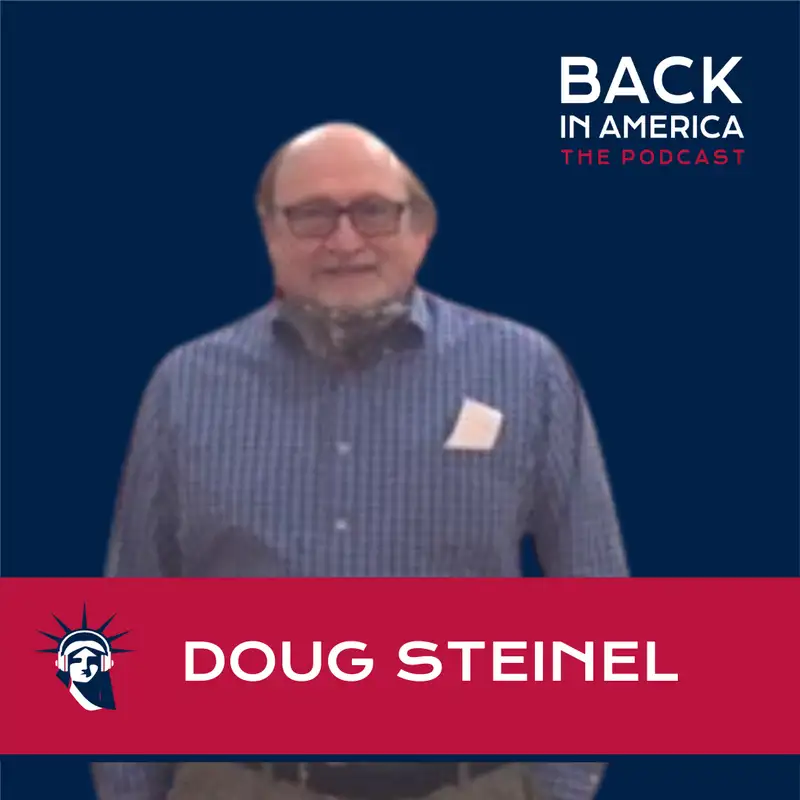
Doug Steinel: Cancel Culture in Classroom
If you're tired of arguing with strangers on the internet, try talking with one of them in real life.
Welcome to Back in America, the podcast.
I'm Stan Bertollo and this is Back in America, a podcast exploring America's culture, values, and identity. Before we dive into today's episode, a personal note. This summer, I will be going back to France for the first time in two years and I will be taking a break from podcasting until September. However, my interns, Josh and Emma, will be keeping the light on by releasing podcast episodes and newsletter articles. See this episode note to subscribe. Josh has been working on a series of episodes discussing American's music and poetry, which will be released weekly in July and August. So Back in America will be in summer mode and I know that you will love it. Now it's time for our interview. I wanted to make sense of the Trump
years and the sadness I felt for a country I loved but no longer understood. In more than 50 episodes and countless conversations, I have time and time again asked my guests what is America to them. Careful listeners of this podcast might have gained a better understanding of the fabric of these countries and I know I certainly have. Today, I want to turn to a man whose life has been dedicated to just that, understanding America. His students have praised him for forcing them to confront opposing views and his course syllabus require reading political critics from both sides of the aisles. Professor Douglas, or Doug, Stennel has been a professor of American political thoughts since 1982 at the George Washington University, just a few blocks away from the
White House. Welcome to Back in America, Professor Stennel. Okay, thanks. Nice being here. Tell me, when did you decide to become a professor and why a professor of American political thought? Now when I was five years old, I wanted to be a professor of American political thought. No, I went through a very circuitous route. When I was in high school, weightlifting and football were the most important things to me. I went away as a graduate to a Catholic school, the University of St. Thomas, and I was a biology major. My parents encouraged me to do science. I could do it, but you know what? My heart was in the humanities and social sciences. My favorite course was ancient Greek history. We read Thucydides. It's the first time I came in contact with a political scientist
like that. So I had that interest and then the counterculture came and I became a hippie. I was a hippie in the 60s and 70s. Now I tell my student I'm a hippie emeritus, right? Because I kind of moved beyond that stage in life. So graduated, got married, and then I worked at United States Steel as a steel worker. Not the guy with the white outfit on, but up in the crane moving steel around. I also worked as a gandy dancer. You might not know what that is, but I didn't have to take off my clothes. I'll give you a hint as a gandy dancer. Let me pause to say that I had to check what a gandy dancer is and I learned that it is a slang term used for early railroad walker in the United States. So while we were doing that, my wife was
studying Chinese in the evening. Now it wasn't cool to study Chinese then because Mao Zedong was the dictator. You couldn't even go there. But we became interested in China and began to study China. We went to graduate school in Chinese languages and cultures. We found that in the United States, not many people are speaking Chinese, so let's go to Asia. I lived in Taiwan for first for a year studying Chinese, living with a Chinese family. What a different experience for me. Then we went back to graduate school more and then I went back to, this was Taiwan. We lived in Taipei. I lived in the dorm with Chinese university students and that's when I began to see the contrast between how Chinese looked at life, politics, and I began to look more deeply into what it is to be
an American at that point. Then I did a PhD at George Washington University. I'm really interested in the United States more than China, so I concentrated on America and I taught American political thought for all those years, but I've taught many other courses. I taught Eastern civilizations and my students are now eligible for social security, so that tells you I've been around a little bit. I'm not a narrow specialist. Most professors are narrow specialists. I'm kind of a generalist. Tell me more about this hippie period of yours. Did you go to San Francisco and California? No, I was too poor for that. I was a working class hippie. When people were going to Woodstock, I couldn't quit my job and go off to Woodstock. No, I had to keep my nose to the
grindstone, but I absorbed much of the countercultural ideas. I fell in love with the writings of Bertrand Russell and he stripped my Catholic faith from me and that has never returned. I wish it would. It's so comforting, but yeah, that was my hippie stage and I learned to be suspicious of authority, of people that think you must think this or that, and I think that had to do a lot with Lord Russell. But freedom of thought and freedom of speech are so important and in America they've always been important, so I've been very happy with that aspect of American life. Did you predict Trump's election? You know when Trump, 2015, he went down that escalator and I watched and then I listened to him speak. Now I still have contacts in flyover country like Ohio, people that are working class
and they've been telling me for years the elites have sold us out. There used to be 18 blast furnaces in Cleveland, now there's two, same with Detroit, Pittsburgh. So I knew that they were economic nationalists, but no one talks about economic nationalism in the United States. Trump went down that escalator and he talked about economic nationalism. He talked about why should we let millions of foreigners come into the United States and take your jobs? That's just what people doing grunt work in America thought and I heard that and said, oh Jesus. Then I had a good friend call me up and said, I'm for Trump, I've had it with these two parties. And I've been watching for a long time Americans were unhappy with their government, going back decades, and now here was
someone who would, and then he would give the finger to political correctness. Oh and I knew, I had watched the polls, over two-thirds of Americans thought political correctness is a problem. I understand you're French, you're wrestling with this right now. And I heard Trump speak and then I read the Huffington Post that said this guy is a clown. We're not even going to cover him in the politics part, we're going to cover him in the entertainment part of our newspaper. I thought that was a mistake. I didn't think Trump would be the nominee, but I go this guy is not going to disappear. This guy has got balls and he says the kind of things that many people in the Midwest think that no one else says. And then he soon rose to the top and people began to drop out running
for the Republican nomination. And I thought they're going to keep dropping out and the Republican establishment is scared to death of this man. What they're going to do is they're going to have one candidate against Trump and they're going to all stand behind that candidate and they're going to defeat Trump. That's what I thought would happen. And it happened like that. People dropped out, the final person standing was Ted Cruz. And I thought, oh shit, there's no Republican. The other Republicans hate more than Ted Cruz, but they held their nose and they went behind him and Trump still knocked him right out of the ring. And then I thought he could never beat Hillary. He's going to do better than the press thinks, but he won't beat Hillary. But then he did.
And then when Hillary said, well, he's not a legitimate president, he's really a Russian agent and Vladimir Putin put him in office. I thought the intellectual elites have gone crazy in America. They don't understand common people. My brothers and sisters didn't vote for Trump because Putin told them to. It's because of what he was, that he would stand up to this newly emerging overclass in the United States. That's where I was at with that election. And I talk with my students about this. This is kind of heresy to most professors to think such a thing. Really. But then that's in my hippie days. I'm a bit of a heretic. Do you think Obama's progressive politics prepared the ground for Trump's election? Well, progressive, I like that word, you know, because I teach
American political thought, we had a progressive movement. People on the left call themselves liberals from Franklin Roosevelt's time on. And then I noted in 2000, it became the L word. And it was an albatross to hang around people's neck. And I remember in 2008, when Senator Clinton was running against Senator Obama for the Democratic nomination and a reporter asked her, are you a liberal? And she said, no, I'm a progressive. And I marked that the beginning of this new rebranding of the political left in the United States with the word progressivism. And it's not so far removed. The Democrats now stand for what the progressives did in the late 19th century. That is, we have to have more government involvement to make America a better place. So I could accept that. Yes.
And do you think this is Obama's politics that really prepared the ground for Trump's? Well, that and I think Michael Lind has really got his finger on this. What happened in America is our universities that I've been part of for every year, except when I was a steel worker since 1968, we began to pump out people and they formed a kind of powerful class that run many of America's institutions, what Michael Lind calls the university credential managers and professionals. They run the Washington Post, our big corporations. They are important and they have a kind of disdain for the people down below them. I think they're about 15% of the population. Charles Murray would say 5%. No. Putnam, Professor Putnam thinks any college graduate, that's 35%.
That's too big. But there's about a 15% that run things and they have a disdain for common Americans. Take if you're, well, most Americans, I'm an atheist, but most Americans aren't atheists. No, they're theists and they're Christians. What Christians have believed about marriage and the family and sex for 20 centuries, Jews for 30 centuries, Muslims since Mohammed, what they think about that you can't even utter now and you'll be thrown out of your job if you think maybe heterosexuality and homosexuality aren't at the same moral plane. These are things Christians have believed for all these centuries and now you can't believe that because this elite doesn't like it. And this elite has become very intolerant, I think. And I think they don't look to America's
founders like Madison and Jefferson for assurances as to what they think and inspiration. They really look to, I think, the Frankfurt School. So now we see the discussion of critical race theory, which is really derived, I think, from neo-Marxism. And Professor Marcuse, when I was a student, was the person that was pushing that and that was considered fringe. I don't think it's considered fringe anymore. And so you get with Marxist. Karl Marx was probably one of the most intelligent people that have ever lived. I put him up there almost with Bertrand Russell, but not quite there. And he had a great insight that dominant groups get the state and they control it for their own interest and that you have an oppressed group that's very angry and Marxism gives them a recipe
as to what you should do. Young Chinese intellectuals in the early 20th century rolled that all the way to power. Matter of fact, someone was counting for me. They counted 48 times Marxists have grabbed power and then they're supposed to end oppression. They haven't ended oppression at all. It's been a parade of horrors. So Marx was right about what the state does, I think, and that there's people who are aggrieved. But once his people grab power, I think Jefferson is right. When you concentrate power like that, people turn into wolves. I think he was talking to Madison when he said, judges and magistrates, you and I, Jimmy, if we have concentrated power, we become like wolves. It seems to be part of human nature.
So you have this group getting more and more powerful and you're thinking, God, are they being at the moon at night? Is this something we should worry about? And I do. I worry about it. I worry about the cancel culture. I worry about in the classroom, people who do not have the politically correct views are real reluctant to talk because they can get in big trouble. This is a problem in America because I always thought when I sat in China, I thought, look at this place. You can't talk honestly. If I want to find about China, I'd listen to the BBC and Voice of America. And America's becoming more like that. I read People's Daily and the Nationalist Press in Chinese for years and America's press has become kind of like that
propagandistic. These things have bothered me. And I want to come back to the cancel culture. But you were talking about Karl Marx and you were talking about classism. We've heard a lot about the alienated white working class in recent years. How do you reconcile this segment of the population with the fact that despite all their hardship, their white privileges keep them from even more suffering? I don't think people look at themselves as white privileged at all that are working class in America doing grunt work. Or people like my wife and I, no one handed us anything. We work really hard to get where we are, to go from working class to being in America, part of America's intelligentsia. And it is my belief America still does that.
I think Doug did not hear my question. I remain convinced that the word privilege should be understood as a condition that keeps us from having even more problems. Let's take a white factory worker. Life can be tough. But if that person were black or from any other minority, life would probably be even more difficult. I think our universities are really fair to people, no matter what color, no matter their sexual orientation. I know as a professor, I treated all my students the same. And the students changed over the years. There were very few people of color maybe 40 years ago in American universities. Now there's a wide variety. I think the universities do treat people fairly and I think many of our institutions do. So I'm more optimistic
about the future. And I think there's a certain resentment among the white working class. Because the most important decision made about their children is will the universities accept them or not. And the universities discriminate against Asian people and white people. Much like our universities used to in the early 20th century. They thought we can't have that many Jews in our schools. So they limited the number of Jews that could get in. That's being done to their children and they don't like it. Asians especially are feeling this. There's a big lawsuit going up to the Supreme Court now for Harvard. And Harvard's saying, oh no, we don't discriminate on the basis of race. The Asian Americans have a different story. They think that they're trying to limit
the numbers. I had people from a very elite school in the United States faculty members tell me, Doug, if we didn't look at the race of applicants, we would be 42% Asian, our student body. We don't want that. Well, I mean, that kind of violates Reverend King's idea that you have to treat people as individuals no matter what race. That's how I treat my students in class. I look at their paper and I don't care if they're blue or if they're yellow. What color they are. Let's see what's in here. That's what I think. Now, people say you think that, Doug, but in the back of your mind, there's a kind of prejudice there that you're not aware of. And I'm aware of that kind of argument, but I think we have to try our best. And I think there's a real effort in the United States to be
fair. I do. So I'm optimistic. I'm not part of, if you're now a fashionable intellectual in America, you have to think America's this horrible place spawned by these evil white supremacists. That's what the Chinese Communist Party thought about America when I studied China. Well, talk to me about the cancel culture. And first of all, for people that might not be familiar with it, how would you define the cancel culture? In America is no different than any country like France in different settings, there's a circle and you can say things within that circle and disagree. But if you go outside that circle, you haven't made a mistake. You're evil. And I think that circle is now what is called political correctness. The power of people in our cultural
institution is on the illiberal left now. And they have a very tight circle. And if you go outside of that circle, you're going to be fired from your job or you're going to be punished. And I don't think that's good for the country at all. So, you know, when I have honest talk with people about America's problems over my kitchen table, when I invite them to dinner, that's more open than the talk in our classrooms or the newspapers, the newspapers have become quite dreadful, I think. And part of it has to do with the digital world. I think Andrew Meir, Meir is a shortened form for long Russian name. He's an author that wrote post journalism. I don't know if you're familiar with his book. It's recent. It's very good. He's predicting the death
of newspapers. I knew they were dying when I had a student who worked at the Washington Times newspapers, an intern, and she said, Doug, we had a meeting. This was 10 years ago. We had a meeting and they said in three months, one third of us won't even be here. The newspapers had to cut back tremendously because Andrew Meir says, no one under the age of 70 looks for news in a newspaper anymore. Newspapers were dying. And then Trump came along. And then newspapers got the idea that we could rally the troops and tell them what they want to hear against this kind of monster that's out there. And that's the New York Times and the Washington Post kind of took off. But when I read my Washington Post, it reads like People's Daily. That bothers me. It has a certain spin to
it. I don't think there's anyone in the newsroom who supported Trump at all out of the hundreds of people. And he was the president of the United States. This is a problem, I think. And how does that affect you, that cancel culture? How you as a professor? Well, I have to say, sometimes in my classes, I followed what Galileo did. Galileo had views that were subversive. So what he did is he wrote a book on the dialogue of the two cheap world systems in which fictional characters argued it out. And he thought that would protect him from the authorities. It didn't. They said, oh, bullshit. We see who wins these arguments all the time. We know what you're up to, fellow. I'm reading another book about Galileo. He's one of my kind of, he's an intellectual hero for me.
So I would say I pull punches in class. There are certain topics that are just verboten. And that is a shame. But I had now because I was like most professors, I wasn't a tenured professor. Most professors are not tenured now in the United States. You'd be immediately fired if the student complained about what you said. And I've had students complain just on the edge. What kind of stuff are forbidden? About what? Well, I was telling them about this linguist, John McWhorter. He's an African-American linguist. And he argued that, well, we always have obscene words, but we've changed our obscene words. It used to be a fucking cock were obscene in the United States. Not anymore. Screw. Now it's nigger and the C word and the F word referring to homosexuals. These are obscene
words now. And I had said the N word and someone said, oh, he actually said the N word in class, like their ears suddenly went out of whack. Like they couldn't read Mark Twain or anything like that. Like they're not adults. Yeah, it's had that effect. And I think the students have been coddled to a great extent. Now I grew up with a lot of World War II veterans. My father was in the 101st Airborne. So I went to Normandy where they had landed. And my uncle landed on Omaha Beach. And now knowing and raising those people, if they heard what my University of Kansas did, after Trump won, they said they're going to make therapy dogs available to the students and they're going to ped away. And I thought, what? This is madness. This is utter madness.
This is come over my country. And I'm kind of a dissenter. But now, see, I don't teach at George Washington anymore. I'm 71 years old. A life sentence is not a big sentence for a guy like me. So it's harder to shut people up as you get older, I think. Let's talk about American values. And when I think of American values, words such as meritocracy, individualism, self-reliance, equality come to mind. Professor Doug Stennell, in your views, what is the unconscious collective of America? What is it made of? Well, the list you gave me is a pretty good ideal, but there's an ideal and then there's how you actually live. I think a real summary of American ideals is that business paragraph of the
Declaration of Independence, that all men are created equal and endowed with their creator with certain inalienable rights, among them life, liberty and the pursuit of happiness. The man who wrote that had 200 slaves. So he writes some real good paragraphs that's talking the talk, but you got to walk the walk. You can't have 200 slaves and believe such a thing. America's had these ideals and not always lived up to them. What I like about America is it changes over time. For those who say America hasn't changed in a racist society, I think you've got to be crazy. I was born into an America before the civil rights movement. I never had any black friends or teachers. Now that's completely different. My children learn to read from an African-American
teacher. When I look on my street, I have mixed race couples and it's changed very much. So I think there's just that attempt to hammer away at the United States that people like to do. But I think those ideals are here, but we don't always live up to them. And what over time we try to do is get closer to them. One of my moral heroes really of my youth was Reverend King. And he would get up and say, he would quote Jefferson, all men are created equal and down with certain inalienable rights. He said, I'm not here to piss on that. I want Americans to live up to it. And he was exactly right. Americans came around to that point of view. And the generation that did land in Normandy and storm Omaha Beach when they were young were the decision
makers that accepted, accepted Reverend King. In the White House, the Kennedy brothers, when he was getting in trouble, said, you know, he's right. We should stand up to him, which took guts because the South where a lot of this agitation was going on was the base of the Democratic party. So I think we do over time, we do make progress and America's always becoming something different. It changes so much. We've been flexible. I remember when Brezhnev was the head of the Soviet Union and he would walk so stiff, he barely move. He was a perfect symbol for the Soviet Union. The Soviet Union couldn't change. It was toppled as a result. America's pretty flexible. The Chinese saw that and they change. Now the members of the Chinese Communist Party are big business
people with yachts and things like that. I mean, wow, this is the party of Mao Zedong, how they change, but they weren't going to do well. They saw the Soviet Union didn't do well. I think America has flexibility in it and it can change. That's funny because you mentioned the, the preamble of the constitution and I was speaking to a Native American candidate for the election, Mark Charles, and Mark Charles told me that we, the people is, does not mean all the people. It means white landowner, Christian man. It did decades of centuries ago, but not now. No, I don't believe that. And most of the people I know don't believe that anymore. Some do. And you'll always have that. You'll always have that
antagonism, but that is not the dominant view in the United States now. And I think people have an anger about that history. I mean, I'd be angry if people treated my family members from the past bad, but you've got to get over that and realize that the people here are different people. Now I really do believe that. And they'll always be in some level of antagonism, but it's not like it was before. I think we, the people means all the people that come here and boy, we know people have come from all over to the United States. That's where it's a kind of experimental country that you're an American, not so much because of blood and soil, but because of what's put in your heart by the culture. I think. Yeah. And what do you think of what has happened with the civil
rights movement in this country since the death of George Floyd, George Floyd last spring? Well, even before that, the civil rights movement was such an important. I know, but I really want to come back to what has happened after the killing of George Floyd and sort of the reckoning, the reckoning of this nation to what, what it means to be black in this country. Yeah, there's a, it has an educational purpose to it. I agree with that. Yes. That someone could be mistreated like that, but I don't think that's a common way that people that are black are murdered or killed. Most black people die at the hands of other black people in the tremendous crime in our cities. It's such a big problem. Now you got to keep on the police. You
can't let the police abuse people. There's no doubt about it, but I wouldn't indict all of the police officers because of that one. No, I don't do that. And I think defunding the police would be madness. It wouldn't help black people at all in the United States. How about more education?
I think it, well, we always think more education if only people thought like me, right? People didn't really have that point of view, but I think you have to have more contact with different people. Now, where I grew up in Cleveland, it was a white working class suburb. It's changed and now it's about half black. There's a lot of antagonism, but there's a lot of what I hear people saying, well, my name is black. I thought he's really a nice guy and we get along and we're friends. This kind of this hope of integration was part of the civil rights movement and that people get to know that we're all members of the human race. We all have the same kind of problems. Getting to that point is important, I think. See, I'm not so pessimistic. You mentioned religion early on.
Why are religion and especially the white evangelism such a strong political force in the U.S. while there are fewer Americans who identify as Christian? I believe that the number has decreased to 12% over the past decade.
Religion is important to people. It was to me when I was a Catholic. It gives you your basic grounding and your basic ideas. Lots of Americans have not gone down the road like me and abandoned Christianity, so religion is important to them. I think this overclass of university credentialed people have a kind of disdain for religion and religious people feel that kind of disdain. And so there's a problem there with that. Let's just think. I mean, an institution among America's intellectuals could not really pass muster if it doesn't treat women as well as men. The Catholic Church won't let women become priests. My God, it's almost as conservative as U.S. universities are. Oh, yeah. So you think that women as priests is not going to happen?
It would be great for the church. Women would make excellent priests. Plus, there's very few priests. But the Catholic Church sticks to its ways. That's why it's around after 20 centuries. I remember was it in a meeting Stalin, someone said, how about the Catholic Church? And he said, how many divisions does the pope have? Now Stalin's party is in the dustbin, but the pope every Wednesday comes out on his veranda with his arms up and there are there's thousands of people cheering him. They're doing something right there is the idea behind it, I think. And when I go to the Vatican, I could almost become a Catholic again. Then I get outside and I regain my senses. But there's a certain majesty involved in religion. And that you're not just this little
piece of carbon on the earth, you're part of this larger sphere. So it's really powerful. I know it's powerful in France. I went a few years ago to France and I flew in on a Thursday and they said, it's Holy Thursday, everything's closed. And I thought, wow, they wouldn't do that in the United States, would they? What do you think is the most common misconception about American politics? The biggest misconception? Oh, I don't know. That there isn't an elite that has a lot of power. That in fact, the mass of people, powers diffuse among the mass of people.
No, I think elites have a lot of power in the United States. So this idea of class, I haven't given up on that. And the biggest misconception, I think for Americans is that class really doesn't matter in the United States. I think that's an idea. Oh, yes, it does matter. It makes a big difference. You had mentioned a meritocracy. And I think American institutions will let people capable rise. But there's a big advantage if you're born to say my wife and I, we both have PhDs, we have disposable income, we want our children to move up in life. This kind of educated classes, children have a big advantage in the United States. And I don't know how we get around that. What we do is we make education free. Plus, my wife and I didn't have
the money to attend universities. There was a lot of financial aid and the government helped in that endeavor. So I think that's a misconception too, that it isn't a big advantage to be born kind of near the top. Now Maoist realized that and said what we had to do is tear the family apart, put us all in big nurseries and we live all together. My God, we're not about to do that. That would really abandon America. So meritocracy is a problem. How do you talk about climate change to your students? I do a thought experiment with my students. I say, what if you take little old Doug Steinal, and you give me the right to decide to each person, family and business, what energy they use,
how much they use and how much they pay for it. How would my position in American society change if I had that power? Oh, I'd be the tyrant. I'd be more powerful than Julius Caesar. The climate change people want the government to have that kind of power. And government, that really hasn't at the seeds of despotism if you give that power. But on the other hand, you have this threat of changing the environment such that it's going to hurt the world. I think this is the big issue that America's idea of limited government's coming up against right now. And what can they do about it? I know when I was in France last time, what did I pay? Seven bucks a gallon for gasoline. You've got to have that sort of thing in the United States. If you're
going to get a control of the use of fossil fuels. So I think that's the big issue facing the generation below me now. Hmm. Doug Steinal, what is it that you believe that most people do not believe in? Well, I believe when you die, that's it. You're gone. Most people don't believe that. Most people pray to God and they think they're going to meet their mother who's dead and things. I'm eccentric, but I haven't gone as far as George Patton that thought his soul will go into somebody else and has been doing that for thousands of years. Now that, no, I don't believe that. So I think the ideas of Lucretius from the poem De Rerum Natura, that in fact, you're just here on this earth for the short while and you never were here before and you're never going to
be here afterwards. I think I have that belief that's different than most people. Most people I know just can't embrace atheism at all. About 8% of Americans are atheists and agnostics. And I've always thought agnostics are just atheists without any balls. Most people believe there's a big guy in the sky, I think. So religion is a big comfort to them. I'm different in that respect. But I don't argue with people about religion, no. I mean, my mother was a staunch woman, Catholic, not educated. I didn't try to strip her faith from her. It was a great comfort to her. Matter of fact, I'm kind of jealous of my friends that are religious. It's great comfort to them.
Okay. Okay. One last question before I ask you the typical Back in America's question. A question about Texas. And we know that Texas was his own country. Yes, it was. The Republic of Texas from 1836 until it joined the United States in 1845. Could Texas split from the U.S.? The Texans are too patriotic for that. Now, Oregon, they might try it, but Texas, no. Texas will always be part of the union, I think. And if not, the U.S. Army will have something to say about that. Like Lincoln's army had something to say about Southern states to try to do that. So, no, I don't think that's going to happen. Matter of fact, the thing I hear about Texas is Texas is becoming less conservative as more and more Hispanics are moving into Texas.
Plus, people are immigrating from many places like California to Texas. There's a big in-migration to Texas. Interesting place. Austin is one of the most liberal cities in the United States. My friends that live there tell me the worst thing about Austin is it's surrounded by Texas. That's what they tell me. So, Texas will be here. No, it's not going anywhere. What about Hawaii? Not going anywhere. Not since December 7, 1941. No, it's not going anywhere. I don't think the Americas are going to break apart. No, I don't.
Maybe Canada will join the United States. Canada? Canada is the 51st state. Then Britain could be the 52nd, right? Are you kidding me about Canada? I mean, big important people like John Lennon are from Britain. They live in New York. His apartment was in New York where he was murdered. Yeah, that's not at all uncommon. You kind of go to New York if you're kind of the international elites. I think there's a good book by David Goodhart from Britain. He's a journalist. He describes, they have something similar to us, where there are people that they're anywhere. They live in London. They could live in Paris.
They could live in New York. And then there are people in smaller towns. No, they're somewheres. They're attached to British culture and they have that antagonism just like we have here.
What would be a book that you think everybody should read?
Well, besides the Bible, I mean, that's been the most influential book. Plato's Republic. What a tremendous book. Some of Bertrand Russell's essays on free thought, freedom of thought, and free will, and freedom of speech. Oh, I think they're really, I read them now and you can look at him lecture on YouTube and I think, wow, look at that. This was done 70 or 80 years ago and it looks new. For the newest books now, I really do think the professor from the University of Texas, Michael Lin's book on the New Class Wars is very insightful into America and the class structure and what's going on. He's an economic historian. And I have a book going now on my Kindle. Kindle is so nice. I have 200 books right here in my hand when I go to Europe or wherever. And I'm reading
a book on Galileo I have there, a book on Andrew Jackson. Andrew Jackson of interest because President Trump would give his speeches at his desk and there was that portrait of Andrew Jackson behind him. He sees himself as an Andrew Jackson kind of figure. And Jackson was that way. He gave the fingers to the kind of white-wigged people along the East Coast in Philadelphia, New York, and Boston. I mean, we think Tennessee is the backwoods now. Just think what people thought when Jackson lived. So yeah, I like reading books on American history, present day politics. I keep busy. Okay, good. Well, Doug Stennel, thank you so much for your time. One last question before we say goodbye. What is America to you? Oh, wow. You know, there was an immigrant to the United States,
a Jewish immigrant from Russia, Irving Berlin, who of all people in history, Jews have had that target on their back. And he could come to America and say, what a place. I can practice my religion I have skills as an artist. I can write music. And he wrote a music for America. God bless America, land that I love, stand beside her and guide her. I have very much those kinds of feelings of gratitude for being in the United States and being an American like Irving Berlin. And I'm not embarrassed of that in spite of all her problems. Thank you so much. Thank you so much. Bye bye. It's been fun talking with you. Talking is fun, isn't it?