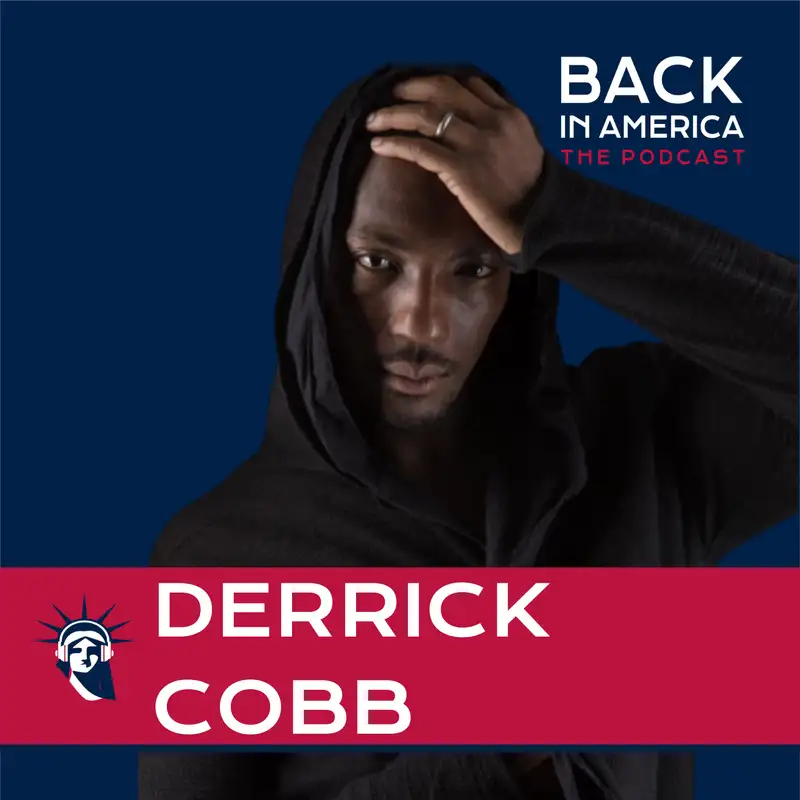
Derrick Cobb - From New York Homeless Teen to Hollywood Music Star
Two very quick announcements. First of all, I'm conducting a survey on you guys, my listeners. Please help me understand who you are and what you want by completing a quick survey, which you can find online on backinamericathepodcast.com. On the same website, backinamericathepodcast.com, you will find a link to an internship that I've posted. I'm looking for an intern to help me with the digital marketing and communication of this podcast. So if you know native American speakers that might be interested, send them to my website. Thank you. Do you know that Back in America is now recording some of its interviews live? The conversation that you're about to hear was recorded and streamed live on YouTube,
Twitter and Facebook. If you missed it and would like to see us talk, head to one of our social media profiles. If you're tired of arguing with strangers on the internet,
try talking with one of them in real life. Welcome to Back in America, the podcast.
I'm Stan Bertolot and this is Back in America. I'm delighted to welcome all of you today to this first live interview of the podcast Back in America. My guest will join us in just a few minutes. He is a model, a dancer, a singer and an incredible performer. Look him up on Spotify or wherever you get your music and you will understand why he's such a rising star in this industry. Getting where he is today has been a long and challenging journey. A journey that started in New York with a drug addict father and an abusive stepfather. A journey that took him through homeless shelters and sack wards. Despite the pain and the humiliation, he somehow managed to make it to school, to rehearsal and to castings.
His determination and hard work paid off. The Alvin Allay theater hired him to do a series of recitals. He won a modeling contract for 7 for Mankind and for Marc Jacob, which led him to his now eight years as a professional model. While working as a dancer and as a model in New York City, he teamed up with Ned Beats and Dee Gates, who produced and released his early singles. Now living in Los Angeles, he is working with Grammy award-winning producer Ebony Smith. He is recording his latest music at Atlantic Record and Warner Music Studio.
He was even invited to become a member of the recording academy and he is now recognized as a Grammy board, as a recording professional. I am delighted to welcome Derek Cobb. Hello Derek. Hi, good morning and well good afternoon to everyone. Well thank you, thank you so much for making the time to be with us today, to be in this first live interview. So it's a big first for me. Well let me start, as I said in the intro, you wear many hats. You're a model, a dancer, a singer. How do you define yourself? I'm not going to define myself. If I had to define it, I definitely would say that I'm an entertainer and an artist. Just because whenever I do something, I take all sides of that, all of my gifts and talents. I try to combine them as much as I can. You know,
when I'm modeling, I use the aspect of my dance to get certain shots, certain angles, certain body movements, and poses and things like that. You know, when I'm on stage performing, I pick up things from modeling, how to look at your audience directly, how to captivate people with your presence and those kind of things. So overall, I would be an artist, entertainer for sure. All right, okay. Well Derek, I was listening to your latest single, In Love, and I found it quite mellow, more intimate, really more intimate than the previous R&B, Savage, JF, or Don't Stop. Are you in love? I am. Wow, tell us more. I think everyone knows. I'm married. So yeah, four years now. Yes. Okay, well you didn't tell me that when you first spoke
to me. Okay, good. Yeah, it's probably one of the more mellow songs that I've done. I mean, to be honest with you, I really love doing R&B records. I think just over the years, over the course of me working as a musician, I always liked these big pop members and these big dance records. It was like a huge dance number, right? And that's great because I'm a dance artist and people expect that. I think for that particular song, I really wanted to just be a bit more vulnerable and more open. I wanted to make it more personal. And I think that song is really kind of defining what the next releases are going to sound like and what they're going to be and what the subject matters are. And I just kind of felt like musically it was time to, you
know, open up a bit more personally. Well, I know it's been quite a process for you to open up. Would you say that the mask is now down? I've gotten better at really recognizing my emotions and really understanding what's triggering that. I'm a person that I truly believe that everyone should be themselves. So I don't expect people to tiptoe around me, you know, to avoid my trauma. I think that's like a very, very bad way to kind of live in a sense. But I will say I definitely have been like more open and more honest about like what I'm experiencing and what I'm feeling. I think it helps you connect better with people. It helps you connect better with yourself. And to be honest with you, especially as a musician, if I'm not, you know, if I have my mask on and
I'm being so walled up and shelled, we can't create good music if they don't get to the root of how I'm feeling, you know. And that's kind of been helping because usually when I'm in a studio with producers, before we even start writing or recording, we spend about a couple of hours just calm conversing about what's really on my mind at that moment in time. So what's the latest in your music life? Any release on the horizon soon? Yes, I just got the copyright clearance for my new single. It's called Won't Let You Down and it's an acoustic mid-tempo type track for you. The schedule date for that is going to be October 21st. Wow, congrats. You know, we're going to go on to the earlier life of Derek Cobb, but I want to understand today where you are living in
Los Angeles recording. You've got this new single coming out. What makes you the happiest? What makes me the happiest? Honestly, I'm the happiest when I'm on stage, if I'm being honest. I think for every performer, every artist, being able to kind of show your work is amazing. Performing is a different connection between an artist and an audience member or an artist and a fan. And when people hear your music, of course, they kind of put themselves into it and they insert their own ideas and how they feel like the story should go. And that's a point you want to start those conversations. And when you're live, you really get the chance to express how you see it and what you hope it means. And I think that's what makes
me the happiest. Because that's the chance you really get to show your talent. You can't hide your voice, you can't hide your dancing, you can't hide your skill. So that's your chance to really show people what you can do. And that's what I love, being on stage. That makes me the happiest of everything. Has your mom ever seen you perform? Once. Once? Yeah. How did that make you feel? And where was that? This was back in 2018. It was at a club in New York called C.L.O. It made me feel really good at the time. I don't remember really seeing her there, and not in a bad way, but it was so like the lights were like the audience was so black and it's just lights on you and like on the dance. So you really don't get to see,
like you can't really tell who's who. So I can see her like when I watch footage from it, I see her reacting and responding. So that's really cool. I would like you to take us back to when you were a child growing up in New York. Your biological father had left your mom at the time and a new man had moved in in your home. So if you close your eyes, what do you see? Wow. I don't know. Honestly, to me, it was all a blur because as far as me and my siblings knew, it was one day my dad was here and then like all of a sudden he wasn't around anymore. And when you're a kid, that's such a fast transaction. Of course, as you get older, you hear the actual full details of like what happened, you know, the things that were kind of going on. And I think
most kids don't really know that their parents are having marital issues, you know, until it's actually over. I will say with my birth mother and my birth father, they made a very good point to never argue in front of us. Like we've never seen them argue. So when, you know, I hear versions of my parents' stories and why they decided to split up, it kind of makes sense. You know, my parents were really young and inexperienced and they had kids at, you know, very early age. And I just remember being a little taken back because my stepfather was very demanding. You know, we were young and he was very just like on top of things, like on top of us in ways that we weren't really kind of used to. You know, our dad was more like on the kind of laid back and like
super chill. And my stepfather was very strict. He was a Jehovah's Witness and his religious beliefs had him like, it was almost like he was like a drill sergeant, like crazy at the time. In the beginning, no, it was more so verbal aggression in the beginning. I remember just kind of thinking like, first it was kind of weird, like, why is he yelling all the time? Because once again, because I've never heard my father yell at us or at my mother. And over time, it's like, it's what abusers do, right? It's classic what they do. They work their way in and it's one thing one day, then it's two days and then it's kind of this buildup. And they're saying, you know, you're fully immersed in this very, very, you know, confusing, violent situation. I remember us, my parents, my
mom and my stepfather got remarried. And then they said, we know we were leaving our family. We were moving upstate New York and we just left. No explanation. I never got to say goodbye. I didn't say goodbye to our parents and say goodbye to our brothers. We just left. And now we live in this town. We don't know anyone. And, you know, and that was like his mission was to isolate us. Like that was the ultimate goal was to isolate and control us. And I think for my mom, she was in love. I think that my stepfather gave her a sense of security because he, you know, at the time was financially like in a very, very good place, you know, with four children. And my mom was still in nursing school at the time. I think she really was thinking more so along
of how to make sure that we were going to be able to live the lives that she always wanted us to live. When did it start to get violent on you? It got heavy when I remember being in the seventh grade and I remember waking up and my stepfather and my mom were like in a huge argument. So, you know, naturally, like any kid would do, you try to run to your mom's fence. And I was like, I just remember a fence just like really just flying at my face. Father, my birth father never hit me. So that was kind of, it really shocked me. I didn't really know what to do. And I'm standing there just like with this blank stare on my face. And then he looked at me and just like wailed at me again. And it was kind
of like the devil was staring at me and my eye. And I started to cry and I could, I just walked away. And my mom looked at me and she didn't say anything. You know, I don't think she even knew how to respond or what to say at that time. And I think at that point, because nothing was really done to protect us or there wasn't any repercussions for that action, you know, like I said, we were at this point, we're away from our family and our known environment. It's nothing we can do. You know, you just deal with it. And so I remember going to bed, waking up and being told when we got to school to make sure that, you know, that wasn't discussed. And he never even telling me one, what was happening. And we were instructed not to do so by him and her.
Wow. And at the time, did you know that you were gay? I kind of did, if I'm being honest with you, but I wasn't, I was like, I was in middle school, you know, you're 12, 11, 12, 13. I don't really think that you are thinking about your sexuality in terms of like being intimate or, you know, being sexually active. And I kind of think what kind of makes it a little funny is because my stepfather would make comments and he would say, they said, oh, I get this and that. And he would be very verbally allowed with it in front of me. And that's really when I started to kind of figure out what that was. But initially, I kind of think, I noticed that a lot. I think a lot of adults, when they see behavior that they don't necessarily
classify as, you know, a boy acts like this or a girl acts like that, they start spewing out all these judgments. And I think for most kids who are gay in the beginning, you really don't know that until someone actually starts to really put that in your brain. You know, you start to kind of say, maybe I am, maybe I'm not, because you're not really thinking of it. You just like this song. You don't care if it's a Britney Spears song. You just like the song. It's a great song. Everyone's singing the song, you know, or you're doing a dance because you see it on TV. Oh, this is cool. It's great. So I think, yeah, I started to realize, but I think he definitely knew and like that was like the shift, like in energy. It went from that to him controlling who
I hung out with. I couldn't hang out with friends. Like, it was almost kind of positioning me in a way to hang out with kids who were not really the most influential in good ways. You know, he much rather me hang out with the street kids. Right. Wow. To tough you up, right? Yeah. Yeah. So you told me that at one point, your mom kicked you out of the house. How did that happen? Take us back to that day. Just long story short, really, we, me and my stepfather had, like I said, we've always gotten into it. He's always gotten into it with us. So it was by this point, you know, I'm 17, you become a young adult, you're in high school. I'm looking at colleges that I want to go to, you know, like I'm like on the run of what I call planning my escape. You know, I remember
at the time I learned these kinds of every extracurricular activity that you could possibly imagine. I'm talking from football to basketball to dance practice to choir rehearsals to band. I haven't learned how to play the tuba for a week. Just so that way I can like stay active and not really be home so much. And, you know, it was one of those times he was kind of fitting in a rage and he literally, I remember him kind of giving her the ultimatum of, you know, like he has to go, I have to go. And it was very clear to me that I was the person who was going to be leaving. And then the next day was, yeah, you can't destroy my marriage. You can't destroy my family. So you, you know, you need to start being on your own. And then I just remember, I just left. At that
point I felt completely on one, like it was just nothing. It was nothing for me to really say. I just left. I just like, I didn't know where I was going. I didn't know what I was going to do. But I just knew at that point I didn't belong there anymore. So what did you do? Where did you go? What happened that night? I went to my cousin's house, you know, and it was kind of regular. Like it was just another day of me hanging out with my cousin and my friends. You know, it wasn't really like, it wasn't really like a big deal to me. At the time you're like, okay, cool. You're young. You think you're ambitious. You think you know, you're not afraid of the world, you know, when you're 17 years old.
You know, I get to just like do what I want and like go to my cousin's house to hang out. And then, you know, as the time progressed and you start to gather your things and you kind of move in and out, it became a little scary. And what happened eventually was I met someone who ended up becoming like my first serious like relationship. And that person was way older than me. He was 33 at the time. And you were? 17. Yeah. I was a kid. And I just remember him saying, hey, you know, you want to stay here with me. You can. And looking back on it, I have no idea. It would be probably one of the worst decisions I would ever make. Ever. Yeah. Do you mind talking about that? I heard of a particularly terrible event, a night when we got you drunk. What happened? It was a very, too much
Um, it was a very tumultuous relationship was very rocky. And then since the where he would be get very upset with me because he says to me, I was too ambitious. Like he was always like, do you want to do so much? And like, you should just graduate high school and get a job. Like, okay. You know, um, and so yeah, you know, he was interested in engaging a lot of sexual activities that I really had no interest in. Like I said, I was a kid at the time. I had no clue what any of that stuff was. You know, I didn't even know I was barely having sex with him. If I'm being very honest, I just wasn't into it at the time. And to be honest with you, my self-esteem was very low. So I never really felt like attractive or sexually desired in any way. You know, I just wasn't that type of kid.
It just really wasn't something that I focused energy on. So, you know, his older friends would always make these comments toward me and like these, you know, sexual innuendos. And I just always ignored it. And I, you know, looking back on it, I definitely felt like it was conspired to gang rape me because that's what happened. And he was the person facilitating the entire, the entire thing. The entire thing. You know, I never drank before. I wasn't doing drugs. And we were out at the restaurant and he was like literally like making me do like eat all this food and drink all this stuff. And I had no clue. And I was getting sick at the restaurant. I was. And I'm like, oh my gosh, I don't feel well. I don't feel well. He's like, oh, you're fine. You're fine. Just drink
some more of this. Drink some more of that. You know, like the first time you ever get trashed, like you don't know what that feels like until it happens. So that night you got raped. Yes. And, and what's next?
The next day, I remember just kind of like waking up and just being really, really pissed. I called the police. I went to the ambulance. I went to the hospital and they,
honestly, they kind of told me that, you know, this is what people your age do. Like, you know, they were like, you know, what black gay men are known for engaging in like these group activities. So we can't really say it's right. And no one wanted to help me. And I like immediately felt like this little, like this small. Like I felt that small, that bad. And so I just kind of retreated away. I didn't really talk to anyone for a while. And a couple of days after the incident, that's when I got the call that the shelter that I was applying to, I already applied to the Homeless Youth Shelter prior to the incident. That's when I got a phone call from them saying like, hey, you know, we have space if you want to come do your intake and you can like pack your stuff and
come. So I kind of did that. And I didn't talk to anyone for like a couple of weeks.
I got really, really sick. And I decided to go on a ski trip with my friends.
I'm like, listen, like I've never been skiing before. It's gonna be fine. So we go on the ski trip. And on the way to the ski trip, I get a phone call from the nurse telling me the shelter you had to do a physical, right? To be enrolled into the program and to make sure that all your health and stuff was up. And then, yeah, you know, when I got back, you know, the nurse, my counselor, the program director, they all like came into the room. And honestly, like when they all walked in the room, that's when I kind of just knew like what the next statement was going to be. But I knew she was about to tell me that I was HIV positive. Like I knew that. Like I saw that. Like I just knew it. I knew it. I knew it then. I knew it. I knew it. I knew it. How did you react?
I didn't. I didn't. I didn't react. I didn't cry. I didn't. I went back upstairs to the room and closed the door and fell asleep. I didn't react. I didn't react for a while. I didn't react. I didn't react. I didn't talk to anyone. I didn't react. Well, how long did it take you to just accept it and do something about it? I was going to the doctor, going to hospitals, like doing all that stuff, you know, regular smuggler stuff. And I think he was my doctor for a very long time. Actually, his name was also Derek. His name was Dr. Derek Walker. I remember meeting him. And, you know, when I signed off the paperwork, you know, and he goes, you know, I'm a HIV specialist. That's when I completely just like broke down. Because
I knew from this point on that I would be seeing this person like every, you know, for the rest of my life. You know, and it was, it just, it crashed on me. So every time I would go, I would just cry. Like it would always be an hour of me just like crying my eyes out, crying my eyes out, crying my eyes out, crying my eyes out. I, a couple of months, so this incident was in April of 2009. The following year, my uncle, my mom's youngest brother, he was getting married. And, you know, it was to see, you know, my uncle always had like these very like heartbreaking like relationships. So to see him finally like meet the woman of his dreams and, you know, to like get married, it just kind of was like, oh, oh, wow. That's something that I'll never experience. Like at the time,
I thought that I'll never experience that or I'll never be loved in that type of way, you know. And like that it really, that's when it broke me. And then I started to tell my friends and family, like following that. So it took me a while to even say it out loud. And when in the process did you try to commit suicide?
Shortly after that incident, that happened a week later, someone in my family had made a statement that I was never allowed to come to their house. And that's when I was like, okay, like, no one wants me. I'm not loved. I don't have anybody. And like, that's when you, you know, like you get reprimanded for being yourself. Like people don't want you because you're gay, because you're Black, because you're this and you're that. And I just was kind of like, yeah, this is kind of the end. And I went back to the shelter room and I literally just started Odeon on prescription painkillers. And my roommate, Ray Sean, hi Ray Sean,
thank God for him. He was the one who called the guidance counselor and then they took me to a mental hospital. They took me to Mount Sinai, the site for there. It's in New York on like 100th Street in Madison Avenue.
How was it there? How was it there?
I don't know. I was kind of, I remember feeling really disappointed that I woke up. I remember feeling that like, I was like, oh, it didn't work. And when I said that, they were like, yeah, we got like, you have to do inpatient care. So they are staying there for like a month and a half, two months. And who were your role model at the time? Whom did you look up to? How did you manage to grab life again?
I don't know. After I got out, things were kind of a blur. I was 19, 20.
Things are really, really, it's been a couple of years. So now it's 2000, let me see, 11, 2012, 19 and 20, you're doing all this stuff. So I'm partying every day. Now I'm able to go out to clubs. So hold on. That's after this episode, right? That's after you commit suicide. Yes. I'm like, okay, great. So I'm still here. What's the next thing? So when most young people do, or people with any type of issue, they try to do things to mask it. So I was drinking a lot. All the time. I mean, every weekend, like me and my friends, we would like do all of these like side jobs, get enough money to get an outfit, go to the club and like drink and party and party
and party and party. And I just kind of remember being at my friend's house one day and we were literally like, you know, and I'm still living in a homeless shelter at this time. Like I'm still there, you know, my time is coming down. It's like, it's almost time for me to start phasing out. You're only allowed to stay for 18 months. The maximum is two years. That's the maximum. And I was super drunk. We had literally no food in the refrigerator. We had nothing to eat. We were like hungover, laying on the floor. I was like pissy, laying on the floor. Being very honest. And I just remember thinking like, I just kind of said it out loud. I was like, dear God, like this can't be life. You tried to commit suicide. You were about to move out of
your shelter. You passed out on your friend's floor. And you realized that, hey, there must be something else. Life is not just about that. And that's sort of where you grab the energy to move on. Right? What happened in your in your mind at that time? Well, at the time, the day, the day that we partied, that day that I had that revelation, right? I was all celebrated because I had got a job at a gym. I got a job at Equinox. Equinox, you know, at the time is like a high-end gym. You know, it's like the creme de la creme. And I was going to start a couple days afterwards. And I just kind of remember thinking like, you know what, if I really like, you know, if I really want to like do well at this job, and I really want to like make good money, and like,
you know, I hear so many great things, I need to kind of be on it, I think. And I think that also, too, I just always, like I say, I always knew I had bigger plans for myself. Even as a kid, I always dreamed big. I always thought big. I always had creative ideas. You know, I once had a former art high school, you know, most of my life. So I always wanted to kind of do those things. And, you know, I think once the doctors told me that if I just stay on top of my regimen, I would have a normal life expectancy, like any other person in my age group, I was like, okay, you know, so maybe I need to give myself a fair chance at like really trying to do other things besides worry about, you know, things that are still having negative effects on me. And so,
yeah, it just, it's kind of like I said before, when you call it out to the universe, it starts to manifest itself as something powerful and saying what you want to allow. There's so much truth behind that statement. I think the tongue is a very powerful tool. For sure. You were also in the Cindy Lopez program, right, which is a shooter that helps you get back on your feet. So tell us more about its true color united, I believe. Yes. So the program pretty much was allowing you to live at a residency in any neighborhood that you chose where they had like apartments available. And it allowed you to kind of stay there without really worrying about paying your rent. Right. So I was kind of like, okay, cool, so I can stay here.
That was my plan. My plan was to stay there, work a job, get promoted, save some money, and then, you know, be ready to be on my own. Like that was the plan. Like that was my plan. And then other things happened. What happened? What happened? Other things happened. While I worked at the gym, one of the clients came to me and, you know, I had, you know, prior to all this, I had a semester at NYU and I couldn't afford the dance program anymore because I didn't have the money. And one of the clients of mine had at the gym I was working at had told me about this place in New York called Broadway Dance Center. And I didn't know what that was at the time or how it would have a huge impact on me and like my
life really. And like, you know, like all the teachers that teach at these schools, they do drop in classes at the studios. So you should go in and like try to get a work study job there. And I'm like, work, like I said, yeah, you know, rather than pay you in money, they pay you in classes. So the more shifts you work, the more classes you get to take. And I was like, you're kidding. So I applied for the work study job and got the job. And honestly, because I wasn't paying rent at the time, I started working less at the gym and being more at the studio. And I went to this audition and that's when I booked my first recital at Alvin Ailey. And it was kind of like, and you know what, though, looking back on it, I don't, I think they were more, they were more into
my determination because I had just started really training. You know, I haven't, I've never done ballet and jazz. I was always just naturally a good dancer, but I think they appreciated that I was like taking the classes outside of, you know, my just being a naturally gifted dancer or just a person who can dance. And I worked my ass off. I'm talking 16 hour days, four classes a day, eight hours of rehearsal. Like I want, oh my gosh, I want to be so bad. No, like, but that you can't, like your body won't allow you to, like you can't, you can't party and drink and do that level of work. It won't work. Like you would embarrass yourself and you would, you do your body a disservice to be honest with you. Like you need, like as a dancer, your muscles are everything. So
things like eating improperly, not working out, drinking, it breaks you down. So there's no way. And I'm trying to understand what was happening in your mind that was really pushing you to do that. I mean, how come all of a sudden you go from being a party animal and wanting to kill yourself to being there working so hard to achieve something? What is it that you were trying to achieve at the time? A lot of things, I think a party you want to, you still want to be accepted in some way, shape or form, you know, you still want a chance at being loved in some way, shape or form. And I honestly would kind of say to myself, you know, before I die, at least let me try to make my dreams come true. That was always kind of what I would say to myself.
You know, and my doctor would say, why are you saying that? Like your health is A1, like you're in great shape. Like why would you say that? And like, I'm like, well, I just feel that way. You know, I always felt that way, you know, whether it's going to be death by this or death by suicide, I always thought, you know, if I can make my dreams come true before that, you know, it'll be, it'll say something, it'll be worth something, you know, and if I do this and I do that and I accomplish it, then my parents will come back and they'll love me more and they'll be wanting to be around me more. Like, you know, that was always kind of the motivation, especially in the beginning, that I would always kind of, kind of hope that, you know,
let me do something great and then go back around them and see if this is enough for them. You know, so we get the dance thing, we get the performance, where does the music come into play there? So what happened was, I was dancing at Alvin Ailey and I met this woman named Genesis B. She was a rapper at the time and one of her friends, Nia, was dancing at the Alvin Ailey program I was in at the time. So we went to this gig and Nia was like, hey, I'm back up dancing for this artist, you should come and like, just hang out with us. And I'm like, sure, I would love to go. I love live shows, like, kind of go to the show and Genesis is rapping or whatever. And she says, hey, I would love to know if there's any songwriters in the room. So I'm like,
oh, I know how to write a song. And that's, so we talked and then I wrote this song and then like, the next day we were sitting in Washington Square Park and I like, literally like sang the song and danced the dance in like front of her.
And she was like, hey, great, cool. You know, we were, she was trying to get the song written for another artist at the time. And when I wrote the song called Mannequin Boy and that person, he didn't really like the song. So her and the producer, his name was Nate Beat, he, they were just like, why don't you keep the song and put it out? And when that happened, I was like, oh, this is so cool. So that my mind went to, okay, I need to get a vocal coach. I need to be trained and actually study music. I need to get music theory books. I need to watch all this. Like, I just wanted to be great at it. I thought it was like such a great opportunity, you know, and then it just kind of snowballed from there.
So it snowballed to you leaving New York and moving to LA. How did that happen? Well, as we fast forward to late 2018. So after pretty much all that stuff, you know, I was modeling, contract, dancing, recording music. I met my very first personal music manager. Her name was Crystal Alford. She runs an entertainment company called TE Music. And when I met Crystal, and she was very interested in managing me as an artist and developing me. And I was like, okay, like this is what I've been praying for since I was a kid. And so we got together in 2014, just kind of talked. In 2015, we decided to really like get together and start working on my, what would be my debut EP. And it was intense, but I loved it. She used to be a
science and Motown record. So, you know, she comes from that old school way of like training. So we were in like singing camps every day, writing camps every day. I'm talking like just hanging, like we'll be like hanging out at the park and then she would make all the artists that we would just have to sing in front of everybody and perform like at the spot, like no matter what. And like, it just really developed me, my confidence as a performer. She had a vocal training, you know, four days a week in the studio, five days a week. And her rule was we were not allowed to record unless we hit every note and knew every song word for word without looking at the lyrics sheet. Wow. This is amazing.
And at the time you're like, oh my God, this is so cruel, but it really developed you. And we put the EP out and then I started booking all these shows all over New York. You know, it was really insane. And, you know, now I was, I was the person hiring my friends to work with me and to, I hate the word backup dancer because I think, you know, I'm a dancer and I think what we do, what dancers do is phenomenal. Like that work that they put in, I can't do all that by myself, you know? So I always say my team, when I hire people to be on my team, that's the greatest feeling in the world, to be able to put people in positions who you love and worked with before in a position to get a bigger opportunity. So it was, and that made it more fun because they knew my style. They knew
what I liked. They knew who inspired me and all those things. And that was happening for a while. So, you know, Crystal had decided that she wanted to kind of, you know, close her company. She started a book and work as an actress. And I told her, you know, I said, hey, love, like that's what you really want to do with them. By all means, you should do that. Like I wouldn't, you know, don't, you know, you even sacrificed so much for us, you know, me and the other artists that she had under her label for a long time. You know, you've been given your resources, your financial resource, or you've been like, really like just giving us all that you have. And it's okay to want something for yourself. And so when we decided to part ways, I teamed up with my friend Ebony Smith,
who by this time was, she won her first Grammy doing the Hamilton soundtrack and like working on that project. And I was on social media, like, hey guys, I'm like back in the studio, producers hit me up and Ebony called me and was like, so you have everybody working your album, but me, right? But your friend. And I'm like, where are you? And she's like, I'm at the studio come by and I went by and then we started working on whether now like my current stuff, but I was always planning to move to LA. It was just about waiting for like the right thing that kind of happened for me to want to move out here, but I always wanted to. So do you think today in your mind, you've got like the previous Derek in New York that you left behind when you moved to
to LA? Is it a new life? Not really. Cause to be honest with you, I kind of, I think my struggle with moving to LA is kind of like everyone comes to LA because they want to, you know, dance or model or sing or act or perform. And I was already doing that before I moved here. But for me, it's really about just kind of taking that path as a professional and just trying something new and doing what I love just in a different space. You know, I kind of, it's always funny because I everyone that I work with, I literally know from back home, everyone from the director that I'm going to be working with on my new music videos. So like I said, to Eboni Smith, she's flown out here a few times to record me, you know, and to write with me and to give me records, you know,
the engineers, the dancers, like everyone from back home. So I think for me, California was really just a chance to just kind of come at peace and really just start that journey of my soul search, I guess. And like figuring out what that's going to look like, figuring out what my futures want to look like. New York is such a fast paced city. And on the, in LA is my chance to really kind of, you know, it's been, it's hella slow compared to, really, wow. Everyone moves at a glacial pace. And, but the cool thing is in LA, it's like the culture here is it's okay to focus on doing your one thing and like focusing and giving all your energy on that thing today. Where New York is kind of like, all right, you need to be doing 10 things in one day or you're
not successful. And here it's like, hey, you have a studio session, focus on going to your session and killing it all. And I kind of like that. So, but I like both. I go back home as often as I can. So Derek, I read that you sometime mentor young LGBTQ people. Do you still do that? Yes. Not in a more virtual way, not really in person. So back in 2015, I teamed up with the Resiprosby Foundation and we raised money for underprivileged kids who were in shelters, LGBTQ or HIV positive to help them get medications, to help them get job skills, you know, help them get back in school. Whether it was GED programs or getting like college courses to get into bigger schools. And I got invited to the White House to meet President Barack Obama, the real president.
And that was the same month that he legalized gay marriage across the country. So it was such an honor to be there that day. How did it felt? I mean, you traveled, as I said in the intro, such a journey from who you were when you were a teenager to whom you've become an ambassador. Are you proud? I am proud. I am proud. I haven't really thought about everything that happens because since quarantine, really, because I never really stopped, you know what I mean? I kind of think that the thing about the entertainment business is you are very, you're highly instructed to do as much as you can, as quick as you can. You know, that's always kind of the thing. So I think quarantine kind of forced all of us to really sit down and reflect.
And as things are kind of coming back and I'm like putting together resumes and, you know, portfolios, that's when it hits me like, oh my gosh, like I've done way more stuff than I ever thought I would do, you know, and it is still cool to be invited to do more things or better opportunities. I will say, I think in hindsight, the biggest reward is being able to get an opportunity from something you've done in the past. It's for me, that's always kind of like a thing. So I never realized, like I said, how much I've done because I feel like I have so much more to do and there's so much more that I really want to do. You know, unfortunately we're in the middle of a pandemic and we can't really. Well, there's something that you want to do, you told me,
which is to have kids. Yes. Do you want to share something about it? Yes, I want to be a daddy so bad. That's kind of like something that I want. You know, I think that I have a niece and a nephew, little cousins, one of my business partners out here, he has a three-year-old daughter, super cute, and kids kind of, kids honestly teach you what unconditional love is because they don't have conditions. They just want you to exist, you know, and I think at first when it's like, you know, kids are always like, oh, can I show you this? Can I show you that? But to be honest with you, they just kind of want you present and I think that that type of connection is beautiful. You know, you don't have to worry about how many records you sell, how many magazines you're
pushing, you know, how many likes or followers you have, you know, kids really like you for who you are, you know, and how you make them feel and that's what they respond to. And I would love to be able to have my own children one day and be a great father and a great role model. And hopefully my kids want to be in show business like their daddy, fingers crossed. Did you start on the process of having kids or where do you stand there? We've done research. We've done research. My uncle's a lawyer and he actually is writing a book on same-sex adoption and IVF process because, you know, from state to state the law is still bearing and there's so many loopholes in the law and his suggestion is that, you know, legally that
he feels like same-sex couples should go into any process of obtaining children with representation, like, you know, like being represented by a lawyer and also too that people should, you know, that most couples should give themselves five to seven years to really plan because it's super expensive. But you also need to do a lot of research, a lot of research. But yeah, we've loved, we've talked about that. That's your next project on top of everything else. You know, hopefully, I mean, I would definitely like to be making more money before I have kids. Kids are not cheap. So Derek, we are getting at the end of this interview, fascinating interview. Thank you so much for sharing your story. I think it's really inspiring. I have a question. What is
America to you? Oh, whoa. That's a very tough question given the current climate. You know, I think America to me, America to me needs a lot of work. We need to work on our compassion for human life. We need to work on our compassion for others. We need to work out of these old school ass ways of thinking. And we need to work on really creating better programming and better training for police officers. You know, we need better laws in place. We need to be protected and feel safe. Like we need a lot of developing. To me, America needs a lot of developing for sure. Mm hmm. For sure. So you, I mean, we spoke about that. And I just quickly want to come back on that because it's not really something we touched on. We touched on your childhood, you coming up
and realizing that you are gay and dealing with that. You having HIV and also coming to term with that and trying to embrace life, whatever it costs. What's your experience today being
in the black LGBT community? It's definitely tough. I will say that I've experienced more racism here in Los Angeles than I have in New York for some weird reason. I think that that's a part of the conversation that we aren't having when it comes to the Black Lives Matter movement and people who are black and that identify as lesbian, gay, queer, and transgender. You know, it's almost as if we're kind of erased from the conversation at most points in time. And I will also say too, if I could just shed some light on this really quickly, you know, there's also a lot of racism within the LGBT community as a whole. You know, it is no secret that white gay men are very privileged still and that they still get better paying jobs and
bigger opportunities than us. You know, I've been facing that as a model, as a performer. You know, you look at the budget sheets and I'm getting paid less and trust me, I'm kind of like, well, why when I can clearly sing this song better than this person? But, you know, there's a lot of that conversation that hasn't been happening as well. And I think ultimately we need to understand that there are systematic laws, there are laws in place that systematically keep us out of disadvantage. So until people are willing to admit that and let that privilege go, we will always be in this rut. Because I kind of find these things happen every couple of years. They never disappear. It's almost like something happened and then the country tries to put a
band-aid over a wound and then stabs at the same wound again. You know what I mean? It's kind of crazy. And I think that, you know, specifically to the LGBTQ community, there needs to be more community togetherness and more uprising in that. Where if you guys are understanding, the only reason why gay pride really exists is because there was a Black and a Latino transgender women who decided that they had enough of being bullied by police and by the cops and by the law. That's why you guys celebrate that. And when you see all this stuff, and I don't see people who look like me in these ads, in these campaigns, at these bars, at these events, that does us a great disservice at all. And, you know, not being included in the Black Lives Matter conversation,
it's painful because we experience the same thing. The same thing. I get funny looks. Yes, the cops have stopped me plenty of times in places where I didn't understand why. I got stopped in Devon Lee Hills a couple of nights ago. Going to the store for a friend because she wasn't feeling well. You know, that still happens to us. You know, despite how people feel we live or how great they think our lifestyles are, I still face that every day. You know, I have my father and my uncles are Black men who have been arrested by police. These people have been killed because they've been a family member of mine. It's very, very painful, but we need to get it together, like now. Is it something that you address in your songs? In the newer stuff, yes.
All right. So that's coming out in October, right? Yes. Okay. Well, I think this is the right conclusion. We will be looking forward to your album in October. Thank you so much. Thank you for making time. Thank you guys for watching everyone. I love you so much, Jessica. I adore you so much. As soon as I get to New York, I should be in New York for like a week or two. I found out Friday. You definitely have to hang out. I love you so much. Nat from France, thank you so much for checking in. Nicholas, thank you for being patient with us with our whole technical glitch. I appreciate it so much. Stan, thank you for having me. Everyone who's watching this live or who will watch it or listen to this podcast, thank you so much. Remember always, as you fight
to find your inner strength, make sure you connect with your inner peace. Thank you. Thank you, Derek.