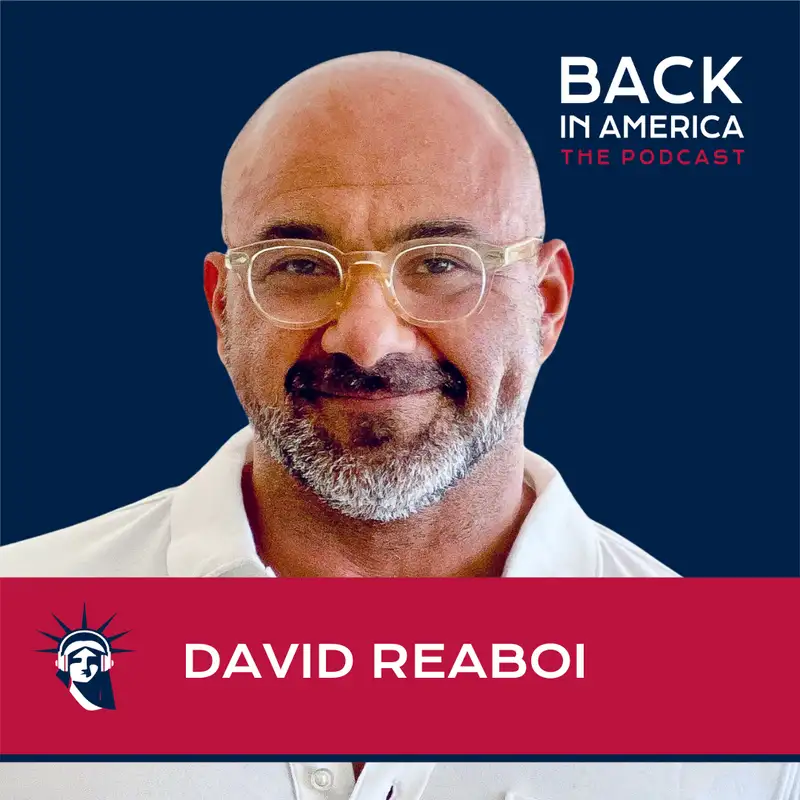
David Reaboi: Trump, DeSantis, January 6 and America’s Divided Future
Since Donald Trump was elected, I have always wanted to speak with a right-wing conservative and understand how they see politics and the US. And this is what I'm doing in this episode. I ask a lot of questions. I wish we would have had more time to debate every single topic. And you will see that we touched on many, many things. We talked about Donald Trump and Ron DeSantis. We talked about January 6.
We spoke about slavery and Native American history and whether America needs reconciliation. We talked about federalism and the growing tension between the states and federal power. We talked about David Walk as he lobbied for the Hungarian Prime Minister Viktor Orban and the influence of figures like Elon Musk in politics and leadership. This conversation is absolutely not an endorsement of David's view. And my goal in doing this interview was to engage in a meaningful dialogue to better understand the forces shaping the division of America today. So I hope you enjoyed this episode and I am looking forward to your comments.
Thank you. If you're tired of arguing with strangers on the internet, try talking with one of them in real life. Welcome to Back in America, the podcast. Today we are speaking with David Reboy, national security expert, media analyst and political commentator. David's work spans political warfare, influence, operation and national security. He's never backed down from controversy.
And today we will explore the ideas that drive his work and spark debate. Welcome to Back in America, David. It's my pleasure to be with you. I want to start from the beginning so that we really understand who you are. I've read that you've got Hungarian Jewish ancestry. You grew up in the northeast of the U.S. Tell us about your childhood and the sort of the household you grew up in. I'm a first generation American and both of my parents came from Transylvania and where
they were Jews who spoke Hungarian at home. So they were kind of ethnically Hungarian in a place that was kind of mixed for a while. It was mixed German, Hungarian and Romanian. They came from communist Romania. They settled here in the 1960s in New Jersey into a community of Hungarian Jews from Transylvania. That was the environment in which I grew up politically. My family was comprised of Reagan Democrats and folks who were very committed to fighting the Cold War.
Folks who understood that evil is a very real thing and there are horrible regimes out there. And we grew up in a very patriotic environment. And so supporting John Kennedy, supporting Nixon, supporting Reagan, but still as Democrats and then finally once Reagan was elected, they all kind of formally flipped over. So that was the environment that I grew up in. I grew up always hearing about the Holocaust from my grandfather who was an Auschwitz survivor. Most of his family died in the Holocaust. And so that was really kind of an ever present thing.
While my peers around me who were more American, many of them just didn't have that experience. I grew up fascinated by all of this and it led me to study Marxism, Leninism and totalitarian movements have been my interest since I was a kid. Obviously from an adversarial point of view, but I always thought that knowing more about the enemy is better than knowing less. So that's kind of been the guiding principle of my career. When did you speak at home? Again and as time went on as my grandparents got older and passed away, a combination of
Hungarian and English. And you still speak Hungarian? I do. Yeah. And what did your parents do? My father is in the kosher meat business and my mother is a retired therapist. I read that you've got an interest in design, in music, in Islam, even in bodybuilding. And it seems that politics is really your calling.
When did you realize that politics was your thing? You said that coming from this background, you were fighting the enemy and it's interesting because you use that war terminology. You recall how young you were when you said, gosh, politics is my thing. I had a neighbor, a next door neighbor back in the day. We used to watch the Iran-Contra hearings together. This was probably 1988. I was quite young and fascinated with it at that point.
I campaigned for Reagan in 84 in my Jewish school. So it's just kind of been a lifetime's concern. And as you get older, things change. It's funny that my opinions in general haven't changed all that much. The basic lodestar is still pointed in the same direction. When I went off to college, I went to George Washington University. I wanted to be in D.C. and I got a degree in international affairs, Russian and Eastern European.
History was my minor. That was a great interest. But at the time, it was the 90s. And it seemed like the world was very different. It was pre-911. It was a world where completely ridiculous conversations were taking place and the conventional wisdom was just nonsense. I remember this very clearly.
Thomas Friedman's The Lexus and the Olive Tree were very much in vogue. And I was rebelling against my international law professor because I thought international law as a concept was completely ridiculous. They would look at me. My colleagues and the professors would say, what are you, a Neanderthal? But I was very confident that reality would reassert itself. It ended up reasserting itself. At the same time, I was studying abroad in Budapest.
At the time, it was after the fall of the Soviet Union, the Cold War had ended. All of Eastern Europe was going through a trend of privatization, trying to figure out how to incorporate some of these freedoms into their society that had once been behind the Iron Curtain and closed. Seeing that was a wake-up call for me because it was very obvious that the idea of history had not been settled. Everyone was not, in fact, in agreement that Western liberal democracy was the final end result and the kind of perfect form of government for everyone.
I was very lucky, too. I was in ninth grade with a very hip history teacher. She taught us a book that had just come out at that time that she was very enamored with called Clash of Civilizations by Sam Huntington. This would have been in 1993, maybe 1994 at the latest. This was an extremely hip thing to give to these kids. She would have probably been fired today for doing so, but that book was something that we spent the entire year discussing and looking at world history through the lens of that.
That kind of prepared me for not really buying into the absurd consensus of the 90s at the time. All right. We start to get a picture of where you come from, how you got your interest into politics. I want to jump to today and the current political situation. Did you realize that Trump was going to be reelected? What sort of sign made you understand that? To be honest, I was not confident that was going to be the case until it happened. Even when it happened, I didn't believe it.
I have a reputation as a bit of a doomer who sees the black cloud in everything. I just assumed, as a friend of mine says, I'm not a pessimist, I'm a realist. I assumed that they wouldn't let him win. I assumed they would find as many ballots as they need and do it that way. But to my great surprise and immense pleasure, I was wrong. Trump did win. And so that's been a really great surprise for me. And to be honest with you, I think that I, as well as a lot of the other doomers, need
to take stock and say we admit we were wrong and that things are not so bleak in terms of the all-powerful Democrats and their all-powerful vote-generating machine and things like that. And yet you haven't supported Trump in the past. I supported Trump very strongly from 2016 up until the primary. When I supported Ron DeSantis, I thought he was a better man for the job. The primary voters disagreed, but there was never a moment when I wouldn't support Trump in the general. For sure.
And what made you go with DeSantis at the time? Well, I live in Florida and I saw firsthand what DeSantis is capable of. What I think is most important is what DeSantis had that Trump didn't have was discipline and follow through and a kind of strong executive leadership. And I feel that's part of what plagued the first Trump administration. I thought DeSantis could do a better job in that respect. I've always been kind of ideologically right wing. And in DeSantis, I saw a kindred spirit.
I saw someone who wouldn't be fooled by people telling him this appointment is good or this policy is good. He's someone that doesn't need to be told. He kind of has very strong opinions about these things himself. I like that he comes from a strong right wing intellectual tradition. That was my rationale. And of course, being a Floridian and seeing firsthand what he did with COVID, but not just COVID, his whole approach to the use of executive power is exactly what I think
America needs. So that's why I supported him. Tell us more about that. So there's, I think the easiest way to say it is that DeSantis rejects this idea of a value neutral application of the law. For example, he understands that at the end of the day, politics is there to reward your friend and to punish your enemies so that people will want to be your friend and not your enemy.
In case after case, DeSantis was doing this. He was doing this with Disney. He was doing this with many, many other things. He was just scoring win after win after win. And he just kind of didn't take no for an answer. His actions were legally well thought out and he would always end up winning in court as well. So it was a matter of preparation also.
But at the end of the day, DeSantis was a rebuke to a kind of libertarian approach to politics that had, to my mind, done kind of terrible things to the right, which is to say that on a whole host of issues, we say, you know what, the state has no compelling interest in this issue. It's up to the people. I think DeSantis is not that kind of guy. He understands that at the end of the day, the state absolutely has a compelling interest in things like the sexualization of educational materials and putting a stop to that.
For example, when DeSantis took aim at Disney, Nikki Haley and even Donald Trump, they couldn't understand what he was doing. And they said, wait a minute, Disney gives us so many jobs, let them do what they want. And DeSantis said, no, we're going to make them pay a cost for doing what they're doing with the woke stuff and pushing the woke stuff on kids. Whereas every other Republican would have just said, well, you know what, we'll take big businesses money and that's it. DeSantis saw the bigger picture.
All right. So you just spoke about the woke stuff and I want to come back to that. But that brings me to a question I had about the national divorce. It comes to me as your vision is that America is so polarized that unity between the left and the right or the Democrat and the Republican is not possible. How do you see this conflict being resolved? I see it being resolved one way or the other in a kind of terrible way in which the United States collapses.
I don't think it's going to happen tomorrow, next week or the next year, but nothing lasts forever. And all empires fall for the same reason, which is the fact that they're overstretched too many competing ideas about the nature of the good and justice and the most basic philosophical things. That's the situation that America finds itself in today. The left likes to talk about the American Empire and some folks on the right now, too. They talk about the American Empire all around the world.
At the end of the day, we are an empire. Even if we stay on our shores, we are a continent sized country that encompasses people as diverse as Maine, Texas, Washington state, Florida and Arkansas. At some point, the things that divide us will far outnumber the things that unite us. I think frankly, we're there. And I'm sorry, go ahead. America is a big country. You've got a lot of people living in this country.
And the fact that we don't all agree is okay. It's part of politics. The disagreement is so big that we cannot live together any longer. I'm not sure that's true. Coming from France, looking at America, looking at the flag, looking at what unite this country, the pledge of allegiance, the fact that you've got so many people coming together from different reasons to make this America. I mean, being American is something which is possible even if you were not born in America.
Try to be German. Try to be French. Try to be Spanish if you weren't born Spanish. It's a totally different story. I still believe that, especially seeing America from my eyes of a European, I don't know if you're that divided in the end. Well, I think the comparison is to compare the US with Europe. Imagine the EU as a governing body, a unified Europe.
See how that goes. That would be far more contentious. Yes, you absolutely have things you would agree on for sure, just like we do in the United States. But there are other things that are unresolvable. The founders of the United States knew this. Even with 13 original states, they understood this. And the way they, you know, the thing they figured out was federalism, which says, okay,
the federal government can do these X number of things. Everything else is left up to the states because they understood that really where they were coming from was that most laws, that the part of government that would interface most closely with the citizens of the United States would be their state governments, not their federal governments. Now, over the years, the idea of the federal government, specifically in the last 120, 140 years or so, has ballooned with the rise of progressivism on purpose, with the express purpose of overriding the will of the people in these states.
What you have is a federalism that doesn't really work the way our founders intended in a way that would allow for the release of tension. It would allow for one state to have one particular policy based on its politics and convictions and another state to do the opposite. But really what you've had, and it's not just the progressive movement, it's also mass media and a whole bunch of other things. But in 2024, and there's very little agreement, let's say with the left, there's very little agreement about federalism as such.
For example, on abortion. The last Supreme Court decision, the Dobs left abortion policy up to the states, which is where most folks on the right thought it should be. Immediately, the Democrats want to federalize that issue. There's no issue they don't want to federalize because they look at every issue, frankly, is through the lens of civil rights because it's advantageous to them politically. You can't have an issue of civil rights being decided by the states. We get back to the same conflict, which is that the right wants more local representation
and the left wants more federal representation so long as they're the ones in charge. That can go on and has gone on for the last 50 so years in the United States, maybe more. But we're getting to the point where it's going to exhaust itself as more and more issues fall underneath of the left's banner of civil rights. So this is the conflict. I wish we could have a situation where we have true federalism, where one state could decide to do X and the other state could decide to do Y and then we say live and let live. But unfortunately, that's not the political environment that we live in.
And I don't think that's coming back. Talking of this political violence, I read in one of your piece that you've written in 2021 that you said violence might arise from political rhetoric. And then in a recent Substack article, you suggested a similar trajectory. So you said that you're actually fueling the very unrest that you predict. What do you say to that? Well, that would be really rich coming from the same people who believe that the greatest terrorist threat is domestic extremism.
Therefore, we must control the speech of American citizens. I don't think it's legitimate to say that warning against political violence is the same as advocating for it. If that was the case, then everybody at CNN, MSNBC, the New York Times, the Washington Post, the New Republic would be jailed, guilty of the same thing for predicting that fascism would descend and Trump is Hitler that's going to put everybody in camps. It's completely ridiculous. The point I made in my last piece at Substack is that we always operated with the assumption
that explicit Hitler and explicit Nazi comparisons were kind of the third rail. They were beyond the pale because beyond which there's really nothing. It exhausts the political rhetorical universe. I'm not sure where you would go after that. If you're accusing your political opponent of being Hitler, of being a Nazi, of wanting to exterminate their opponents, the most rational thing would be, okay, join a terrorist group. Do targeted assassinations. Do whatever you can.
Set the country on fire. That would be the rational thing to do. But I don't think that's the case. I think it's a highly irrational, completely insane comparison to make. That's where the fault lies. The fault lies isn't in me warning that these guys are saying crazy stuff. It's the guys who are saying crazy stuff. And so you still believe that Antifa may take to the street and may engage in political
violence? Oh, for sure. I mean, it's not theoretical and it's not new. Many of us have seen it. You've seen it on the streets of Paris. is something that is in the doctrinal toolkit of the folks who self-identify as Antifa and who trace their lineage ideologically and organizationally through that movement. That's just a thing that they do.
But I believe that there is a logic governing how they act. My assessment was that they did not pop off after the election this time because Trump's win was just too big. And from their point of view, they like to be in the position of the majority and they like to clothe their particular violent actions in a slipstream of what could be called mostly peaceful civil rights protests. They are the tip of the spear when it comes to those types of movements as opposed to just random anarchists that just pop off.
I hear you. And yet, what do you make of January 6? In what way? I don't think the left has ever attacked democracy like the right has. I'm not sure what you mean by attack democracy. Can you unpack that? I mean, stepping on the Capitol to disrupt peaceful election. That's not really what you call democracy, right?
The left has broken into the Capitol many times. Folks on the left have tried to blow up the Capitol, as a matter of fact, several times in the last several decades. I think unpacking that important because it's a rhetorical trick that a lot of the left likes to use, and frankly, the Democrats, by synonymizing their particular agenda with the word democracy, like you did in your question. Did I think that January 6 was a stupid, ill-advised expression of impotent rage? Yes.
Do I think it was the worst thing in the world? No, of course not. I don't think it changed anything. I don't think it was in danger of changing anything. I don't think anyone serious believes they would have taken over the United States or done anything that had any lasting or even medium-term impact at all. It's basically a bunch of hooligans who are angry and did some mischief. Now, the people who were violent should be punished the way any violent protesters are
punished. In the case of January 6, the law has come down hard on many people who, frankly, did nothing wrong other than follow folks into a building. Those people have been hounded. They've lost their livelihoods. Many of them the weight of the Department of Justice thrown down on them. Many of them have lost their homes and their families. Some have lost their lives.
Not really doing a tenth of what some of the Antifa folks did in the summer of 2020. If you have an equal application of the law, I'm all for it. It was only a few months before January 6 that an attorney was arrested for throwing a Molotov cocktail into a police car in New York City. Now, do I think that's a more serious offense than someone who was there on January 6 and didn't break through or didn't break anything and just followed a crowd through the Capitol building? Of course I do.
I think you'd be crazy not to. That person, that attorney, got off. That attorney was well connected with the Obama administration and with the Department of Justice and that attorney got off. You have many cases just like this. A lot of those people thought, I mean, stupidly as it turned out, but they thought, hey, the left went crazy all through the summer. They burned down cities, smashed stores, did all kinds of violent stuff.
They weren't punished, so why should we be? They did not account for the unequal application of the law. So I think that was their mistake. I also think every poll, I know how hard the media and the left has tried to push January 6, that's the most horrible thing in the world, a terrible assault on our democracy and it's worse than 9-11 and blah, blah, blah, blah. Nobody believes it. Everyone thinks that this argument is totally full of shit.
Not only does the election bear it out, but every public poll bears it out. Look for any poll on what people think about January 6 and you'll get the reaction back. We don't care. You guys have completely oversold this. I listened to your interview in The Blaze and I would be interested to hear how you understand when Jill Savage, the journalist, said America is capitalism plus scripture. What do you make of that? I don't want to put words in her mouth.
That's a quote. I don't want to second guess what she has to say. I would interpret it one way and she may interpret it a different way, but I'm not going to touch that one. Well, maybe you can tell me. I mean, capitalism, yeah, it's a given. How important is religion in America? I think it's very important.
I mean, as a unifying concept. Look, I mean, this country was founded by very religious people. The founders were not necessarily very orthodox practicing religious, but the bulk of the American people was certainly towards the more religious side. It goes back to the earliest days of America, even before 1776. The Tocqueville made a point to talk about the religiosity of Americans. You can take religious or scripture and synonymize it with the concept of virtue and righteousness. And like John Adams said, this constitution, this form of government is for a righteous,
virtuous people and it's not fit for another. So I think the place of religion in American society, American politics has always been very strong, but it's not necessarily sectarian. From the beginning, we had no state churches and that was a deliberate thing that was in opposition to England, France and many other places. We are generally religious, but it's not necessarily a sectarian thing. I believe that. I don't think there's a scenario where you can have a completely a religious people and
still have a functioning liberal democratic society for the long haul. I just don't think it's possible. So when we touch on that topic of ethics and religions and the history of the US, I can't not mention what happened to the Native American and to slavery. How do you think America can reconcile that? Or does it need to be reconciled? I don't think it needs to be reconciled. These things happen.
This is the history of the world. Slavery is not unique to the United States by any means. It is thankfully an extinct artifact of human civilization. It's something that was present with us from our earliest days. You could say that it's an artifact of a certain type of agrarian system that becomes obsolete once you have the Industrial Revolution. You can kind of make that argument. But the truth of the matter is that slavery existed through most of history in every country.
We ended it in 1865. There's a constant harping on it as if we still have slavery or as if slavery is a sin that this country can't wash away. It's a sin that every other country, every other civilization can seem to wash away, but the United States can't because of reasons. I think the constant harping on it serves to delegitimize the United States, which is the intended agenda, and to put races at one another's throats. And it does that very well.
When I grew up, race relations were far better than they have been. And the Obama years were when we first started to see racial riots for the first time since 1968. We started to see more and more animosity building in black communities against white communities. After that, you saw the proliferation of anti-racism and other nonsense that has the intended effect of putting us at each other's throats. I don't think these things need to be reconciled.
I think the United States has done a far better job than most in dealing with its legacy of slavery, the legacy of racism, etc. I'm very glad that things like Jim Crow are far in the past. Right now, the constant dwelling on it does more harm to some of these communities. It does more harm to the black community than it does to me or to folks of a different race. I would like to see us go back to the 80s and 90s in terms of this attitude. In regards to the Native Americans, look, it's a complicated issue. We should start talking about the indigenous peoples of every country.
It's very interesting that it's just the United States where this is concerned. Through history, these are the things that happen. You have conquests and migrations, a natural thing, and then to rewind 500 years to establish the original sin of the United States as either slavery or the treatment of Native Americans. I think that's a very clear political agenda. Going back to the political warfare point, it's absolutely political warfare and it's not on the level. Okay. Talking of political warfare, I read that you worked for Viktor Orban. Did you work for Viktor Orban?
I represented the Hungarian government. You could say that it was for Orban, the prime minister, but I worked for the Hungarian government. Yes. What did you do?
I tried to give them some good press. That's basically it. My job was to let American conservatives know about some of the things that Hungary was doing that they would like and build bridges between Americans and Hungarians who see eye to eye on some political issues. As I was preparing this interview, I realized that Hungary, since at least 2022, has been really extremely active in drawing American, but not just American, worldwide conservators to Hungary, developing close ties with, in France, Marine Le Pen, in the US, Trump and more. What do you think is interesting in Hungary? What makes Hungary a focus point?
If you go to Budapest today and Amsterdam tomorrow or Paris or London, you see very different things
in little ways and big ways. Hungary committed the unforgivable sin of saying, no, we're a small country and we are controlling our borders. We're not bringing in as many refugees from Syria or who knows where to overwhelm our societies. We're a small country with a small population. We don't have that much money and we don't want it for the simple reason that we know we can't assimilate these people and we know that we can't pay for this. I think that's why many American conservatives look to Hungary and they like what they see. When you visit Budapest, it's a safe city. A woman can go walking in the middle of the night and not worry about horrible things happening to her, frankly, by migrant Middle Easterners, such as what happens
in most of Western Europe. Hungary is pushing back against this tide of homogenization throughout much of the West, specifically the EU. Many American conservatives appreciate that. It's important for a distinct people to have their own space, to have their own country, to make their own laws. You saw this expressed in Brexit and in other places too. Sovereignty is very, very important. Hungary is the lead and has been very strong in asserting and trying to maintain its own sovereignty as a country that's not very powerful economically, militarily, or population wise. They're pushing back against a tremendous tide and a lot of American conservatives appreciate that. Thank you. So I'm conscious of time and I've got a few more questions I would
like to ask you before and I'm trying to debate which one. I would really love to have your take on Elon Musk as being an advisor to Trump. Elon Musk in general or as an advisor to Trump?
Well, Elon Musk and the role of big business in the government. The role of big business, I don't think that's a coherent applicable question because the role of big business, what does that mean? Within big business, you have people who are very ideologically globalist left, George Soros types on one hand. On the other hand, you have people like Elon Musk, who have completely different opinions about all of this. I think it comes down to what people believe. But about Musk, I think he is an indispensable influence on Donald Trump, specifically when it comes to choosing some of the folks for cabinet and other appointees for his government. If there's one thing that Elon Musk knows how to do well, it's to find
smart, competent people who will execute in his absence. He runs a number of companies and the success of any one of those companies depends on having someone at the top who knows what they're doing and has his trust. I think that Donald Trump has always had difficulty with that particular aspect of evaluating people. He's more apt to find someone who is good on TV. A friend of mine said that Trump isn't staffing his administration, he is casting it. Which is to say that someone looks and acts the part and he likes them, so he's going to pick them. And that person's ability to actually do the job well is a secondary consideration. I think for Elon, as we've seen reported, the press has heard about Elon pushing back on some of the cabinet possibilities. He'll sit down
with someone and in a few minutes, they'll take their temperature and understand if this person possesses some competence or intelligence. He's a tremendous asset at this point. This is something that goes beyond ideology. There was the old red Chinese saying is, you know, you want someone is either red or expert. So like, are they politically aligned or are they an expert? Do they have expertise? What you want is a red expert. Ideally, you want the combination of both. And hopefully that kind of person makes it through more often than the others. Finally, the question I always ask in this podcast is what is America to you?
That's a big question. That's a very big question because of course there's an emotional component to it. There's a familial component to it, an intellectual one. It's hard to answer because the possible answers are just so great. Everything from America being the last hope of mankind to it being the great flowering of the kind of great experiment in freedom that had never been tried before, been more successful here than anywhere else. You have that on one. And of course, I've always been an American patriot and someone who has a great deal of reverence for the American founding. As someone who does have a great deal of reverence for the American founding, the ways in which America falls short today of that founding is definitely a concern.
I think we're a great country. I think we're great people. The American people are wonderful, not perfect by any means, but some of the best people that I would hope to find. I always think about the Churchill quote, America is going to do the right thing after it exhausts all other options. I think that describes us perfectly. Thank you, David. All right. Thank you very much. If you enjoyed this episode, make sure to subscribe wherever you get your podcast. Please leave us a comment so that more people can discover back in America. Next episode will be about Chinese American, the election and cryptocurrency. Goodbye.