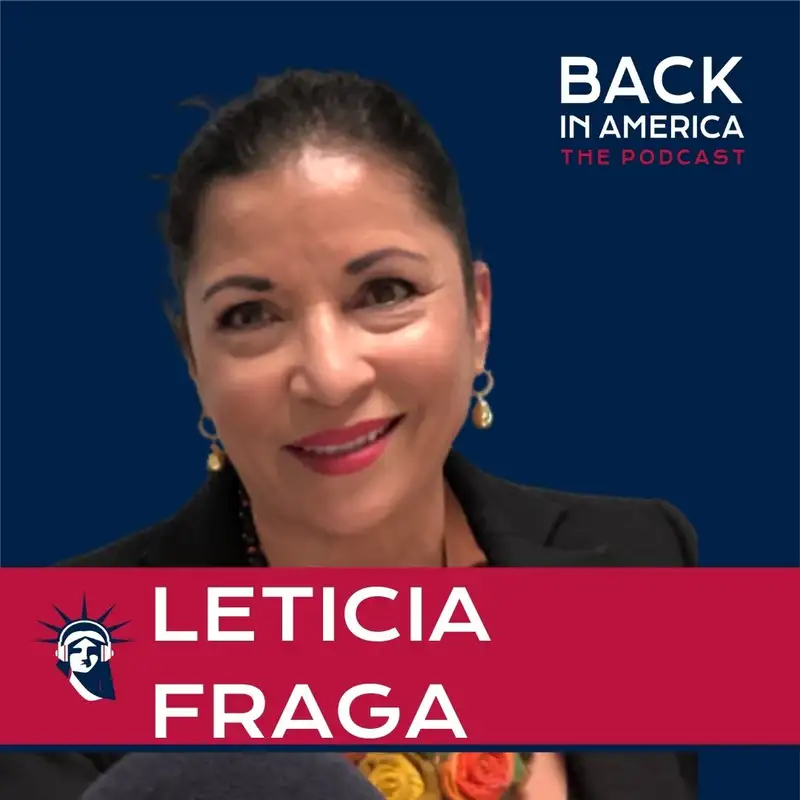
Councilwoman Leticia Fraga - From Mexico to Princeton, NJ - A story of immigration and integration in America
If you're tired of arguing with strangers on the internet, try talking with one of them in real life.
Welcome to Back in America, the podcast.
Quick update before we start this episode. As you know, I usually ask my guests to share books or movies they really enjoy. If you want to read those books, just go to the notes section of the episode. You will find a link to Amazon where you can purchase those books. Also, I've been pretty busy recently, recorded four episodes in a week, and I think they are just amazing. I look forward to your comments and suggestions. Tell me what you like, what you want to see more of.
And the easy way to do that is just to send me a direct message from Twitter. My handle is Bertolo.
Hello, I'm Stan Bertolo and this is Back in America. Today, I'm at the Princeton Library with Councilwoman Leticia Fraga, the first Latinx ever elected to Princeton Municipal Government. I am so grateful that you accepted this interview, Leticia. Thank you for taking the time to share your story with me today. You have many responsibilities in Princeton. Can you briefly introduce yourself as well as the various commission that you lead? Sure.
And thank you for inviting me to this interview. I am very thrilled to be speaking to you about the work that I'm doing because I think it's important for others. Others will be able to who have not even thought of themselves and being able to be in elected in an elected position can hopefully, through learning about my work, will hopefully will encourage them to follow suit. I've been on the Council. This is starting on my third year.
Very excited with the committees that I've been assigned to from year one, I would say. I've built up on those, starting with liaison to the Civil Rights Commission, the Human Services Commission, public safety. I happen to be the designated police commissioner here in Princeton. I lead the Youth Advisory Committee, Economic Development, the local emergency planning. Now I've, starting this year, taken over being liaison to the Board of Health, which I feel there's a really clear connection between Human Services, Board of Health, and I would even say Civil Rights,
as far as ensuring that there's equal access to health care. Yeah, wow, you are pretty busy. I'm busy, but it's work that I truly, truly enjoy. And you were elected in 2018, right? Yes. Okay, so we are going to come back to that. Let's back up to your early days. Obviously, you are from Mexico.
Yes. I read that you immigrated to the US at the age of 12. Yes.
Can you tell us about it? What was your experience? And I would love you to tell me what was your first impression when you stepped into the US? Sure.
I'm originally born in Mexico, Mexicali, Baja California, and I am one of eight. I have seven siblings. And back in 1970, my dad had his own business. His business was on the US side. We lived close to the border. Economically, things weren't going well. And also on top of that, my mom's, her health, she has some health issues. Her doctors had actually recommended that she move to try moving to a cooler climate.
My mom, the majority of her family, she also comes from a large family, was in Mexicali. And it was very, very difficult for her to make that decision. In fact, the only way she agreed to come was if it was just going to be temporary. Right. And my dad said, let's try for one year. So we left everything behind, our house, our household belongings. And we just came. Actually, there were 12 of us because my uncle and his wife traveled to Mexicali to pick us up.
And we traveled 12 of us in a station wagon, pulling a little trailer with some of our belongings because it was only going to be for one year. How did you feel at the time? Was it exciting? Oh, yes. So I can say for my mom, it was a sacrifice for her leaving family,
leaving everything that she knew, leaving her home, her home where most of us kids were born. We were born at home to a place that she was not familiar with, didn't know what to expect. So for her, there were a lot of tears leaving. For the children, for my siblings and I, it was exciting. It was an adventure. We didn't speak any English. I would say not even, there were numbers or ABCs, nothing. We didn't even have to say hello.
We didn't know anything. And so was it the first time you left the country? Yes. Yeah. Yes. So it was exciting. It was exciting for us. So my first impression, we hadn't gotten very far.
We actually had just crossed the border and had gotten in.
We went to our very first Kentucky Fried Chicken. I had not tasted American food before. So everything was an adventure. Did you like it? I did. Yeah. I don't anymore. I'm more self-conscious and a healthy eater, I would like to say.
So no, I did at the time. Yeah. You were 12-year-olds, right? Yes.
But on that note, too, arriving, my family settled in Kennewick, Washington. Most of the Mexican families that lived there were migrants. So they followed the crops. Our family was very unique in that we were only one of a few that actually settled there. In fact, at the schools at the time, there was no ESL classes. So when we were sent to school, we dove in. We had the school did provide for all the children a tutor for one hour a day to teach us English. So you crossed into the US.
Was it legally? Yes. Did you at the time manage to have a... So I consider myself very fortunate. My dad was actually born in Colorado, so he was being US born. And he was also very forward-thinking so that because he was a US citizen, as each of us were born, we were born in Mexico. But he submitted the paperwork for us to be...
We weren't citizens, but we had legal permanent residency. We could choose to live where we wanted to. So very forward-thinking. So for us, when the decision was made to come here, it was an option. That, like I said, it was very fortunate to have that option. What did you do once you got there? You went to school? Yes, we went to school.
I was 12. We were also expected, just as we would have if we had been in Mexico,
to help contribute to the family. And so we went to work in the fields, except for the youngest children. How did you feel about that? I thought it was great.
We started off working in the asparagus fields. It was that season when we were there. But then, depending on what the season was, we also picked apples, picked cherries. In the wintertime, that job I did not like. And to this day, I would not do that again. But it was a job. We worked in the vineyards, pruning the vines. So doing that in a lot of scratches and doing that in the cold, that was not my favorite.
Did you walk every day? Yes. From 3.30 to? No, actually it was earlier. We would go before school. Wow. So just as the sun was rising, we would go to work the fields. And then after school, we would go back again.
But always our parents ensured that we did our schoolwork as well. So we did it seven days a week. And what do you think that taught you? Not only taught me the value of earning a living, responsibility, and taught me to appreciate what we have. At the time, we were working. Early on, when we were in elementary and junior high,
what we earned went towards the family fund. But then once a year, even with eight kids, my parents managed to take us on vacation. We went to Disneyland for the first time. And we even traveled back to Mexico to visit family in the city. So you kept friends in Mexico, right? Yes. What would you tell them? Did you write to them?
If it had been social media, I would say yes. We did with cousins. Our cousins were like our friends. So we stayed in touch with our cousins. There was a lot of letter writing. Do you remember what you told them?
Everything we were doing, our experiences, shared our experiences with them. I would also say that as far as the values that we were taught,
it's just something that concerns me in the younger generations. That even for my own kids, sometimes I'm concerned that things come too easy for them. And that it's not benefiting them.
Now going back to the work that we did, even at the age of 12,
in addition to working in the fields, we were expected to help around the house. I have a twin sister and a sister that's just one year younger than us. And then an older sister. And all the girls were expected to take turns cooking. We would take one would cook, one would do the dishes,
and then another one would make the tortillas. Because we were expected to make homemade tortillas every single day. Well, yeah. So you learn how to cook, right? Which a lot of young people don't know. Exactly. And then on the weekends, we had to take turns cleaning sections of the house or doing the laundry. Now, what didn't happen was because of whether cultural or that's how they,
my parents had been raised, only the girls had those responsibilities. The boys, their responsibility was to take out the garbage once a day. That's it? Once a week. And yes, and they were, there's three brothers, five girls, three brothers. So when I got older, when I had my own family, I actually made the statement, ours is going to be an equal opportunity household. Because I don't see it as right.
I see it as an opportunity because my children, I wanted both the girls and the boys to learn how to do things for themselves.
We are going to come back to that because as you say, you are a woman, you are a woman from Latino origin.
And I'm sure you have a lot to share about your experience in the political world. Before we do that, let's stick to the early days and you work in the field. I printed from your website this picture. Can you describe it to us? That day, I think that was the end of the season. And we had cleared the fields and gathered all the dry brush. This is in Eastern Washington where it's very desert like. We get tumbleweeds.
How are you? There's actually recently there was a tumbleweed avalanche where cars were buried under tumbleweeds. We actually would just for fun make pretend snowmen out of tumbleweeds by stacking them up and dressing them. But this after we had cleared the fields and picked up all the brush, I remember there was a fire pit where we burn all the brush. And I got too close to it. And for a while there I was without eyebrows.
But there's instances where I can laugh at now. Obviously it was dangerous at the time and some of the things that
some of the situations that we would sometimes find ourselves in. But now I honestly believe that everything that I've experienced when I talked about working in the fields, even in grade school and getting up before sunset, I don't refer to it as well as me, poor me. I thought I still just like coming here. It was an adventure.
It was character building. Yeah. So you came here at the age of 12. You went to school without speaking a word of English. You learn everything at school. You had a tutor one hour a day. You worked before school in the field.
In your house you were expected to cook, to clean. The boys, their only job was to take the trash out. Right. And you just told me that this is something that you want to see changed in your own household where you want everybody. How many kids have you got? I have five. Five boys and girls, right?
I have two boys and three girls. Three of them are adults with their own families. And then my youngest one, my youngest two are twins. 15 year olds that are still at home. So you definitely have a view on what it means to be a woman in this country. Yes. And what it means to be a woman from Latinx origin. Yes.
So let me say first as far as Latinx woman serving in elected office, it's not something I ever even imagined. It's not something I even dared to aspire to. So it's not something that I would say growing up. I said to myself, this is what I want to do when I grow up. I would even say for even as an adult, I would often joke, I still don't know what I want to be when I grow up.
And as far as politics, I can honestly say that I did not choose politics. Politics chose me because of the opportunities that I had throughout my life that took me different paths. So everything that I've done, it wasn't until someone that was some of our who were in office at the time encouraged me to run for office. And well, I was flattered, but at the same time, What did you think? Me?
That's what you thought. Me? Why me? Can I do it? Can I do it? But then when I started thinking about why I should, why I needed to,
then I realized that it was something that I needed to do. Why? Did you need it for yourself? No. So if I can back up, when I was in Seattle, I worked for civil rights enforcement. It was my dream job. I really loved the work that I was doing. I was at the time, my now husband, we weren't married at the time, was already working in pharmaceutical.
Bristol Myers used to have a site in Seattle, and he had been transferred there, and that's how we met. I was working in Seattle. BMS closed that site, and he was given the opportunity to transfer to New Jersey. He's originally from New Jersey, so for him, it was a no-brainer. For me, however, we weren't married yet, but still we were together. But for me, was able to empathize with what my mom went through. A job that I loved, my family, my siblings, my adult children.
I have grandkids. I have nine grandkids, by the way. They were all there. To leave that behind was a really difficult decision for me. In fact, when he did convince me to give New Jersey a try, I actually only took a leave of absence from my work.
Like my mom, I took a one-year leave of absence, and I thought, I'm going to give it a try. But to be quite honest, when I came to Princeton, in the beginning, I didn't have a warm and fuzzy feeling about being here. My impression was that the people were very clickish.
You didn't feel welcome? I did not feel welcome.
Was it because you weren't from there? Was it because you were of Latino origin? I don't know. It's just a sense. Just to be clear, something that I'm very sensitive about is being too sensitive. I'm often second-guessing myself.
Am I being treated this way? Am I being talked to this way because I'm Mexican? Because I'm a woman? Or am I being too sensitive? You could still make the difference between how you were treated in Seattle and how it was here. Seattle, I already knew, was very progressive. It was very easy to make friends. It's a big city, but I could still, even when I would go back to visit,
walk down the street and run into people I knew and who would greet me. Here, it was culture shock for me.
In the neighborhood where I first moved to, it's one of those private communities that are the Homeowners Association, the Hall Works. I remember walking to the mailbox. That's where you tend to meet the neighbors.
Very often growing up, I would get asked, so what are you? I know they're asking me what's my background, but doesn't it seem offensive to say, what are you? Yeah. What are you? I'm a human being. Exactly. I remember a neighbor at the post office asking me that, what are you?
I said, well, my background, I'm originally from Mexico. Then their comeback was, oh, my son has a son. My son has a housekeeper that's from Mexico.
Thank you, offensive. So they were trying to make small talk, I know, but how they related to me. I now live across from the high school, so I walk here. But I remember we moved there five years ago.
By that time, I had a dog. By the way, I found that before we had, my husband and I had our twins,
we had a dog. I remember getting to know, meet people in the neighborhood. Through the dogs? Through the dog. They knew, they didn't know my name. They didn't remember my name, but they knew my dog's name. So how did you make it through? How did you manage to make Princeton your city?
And that's where I would encourage others to do. Because I tell that story, including even after I moved to where I am now. I remember my first, I had already been here. I felt myself, like I'm established now. I wasn't on council yet, but I've made myself known through my work. But even there, I remember walking my dog in the new neighborhood and someone asking me, I haven't, hello, I haven't seen you here before.
And are you a dog walker? Right? Gosh. No, not, are you new to the neighborhood? They assume looking at me, I couldn't possibly live in this neighborhood. I must be a dog walker.
Anyway, I made Princeton my home when I decided this is my home. Was when I made the effort. So it came from you. It came from me. So I can actually pinpoint the day.
Reading the, I believe it was, it was either the packet or the town topics, one of our local papers. Reading a story about this office, the human services department, who because of budget cuts was not down to a one woman office.
Cynthia Mendez. And even though her last name is Mendez, she did not speak Spanish. And in the story, it pointed out that this office actually served a significant number of our Latino population, but now because of funding, they had lost the only individual that spoke Spanish. So I gave her a call and volunteer my services. And it started from there. How were you welcomed?
There I was. Most definitely because of my background. You were helpful. I was very helpful. I actually was able to suggest procedures that we could implement to improve our service to the community. So I had only been there for a few months when a position opened up on the human services commission and I was invited to join.
Wow. So this is very interesting. And being French, I can really relate to that. How disheartening this is to be in a community where you don't really feel welcome. You are one. I mean, nobody told me if I asked me if I was a dog walker, but nobody really pay attention to me. And coming from a different culture, you sort of expect your neighbor to invite you,
people to come to you saying, oh, would you like to come for a drink or something? And that doesn't happen. And you feel very secluded. So what you are saying is that your advice would be, if you want something to happen, it has to come from you. Well, sometimes it does happen. After I've been in my new neighborhood for a while, I did get to meet one of my neighbors who has a son that's the same age as mine.
So it was just natural for them to become friends. And so she organized something to introduce us to the community. Yes. So but I would say, yes, don't wait for somebody to welcome you. Don't wait for somebody to invite you to become involved. Right. To be to take the initiative to find out what's out there and introduce yourself. How long had you been in Princeton?
It's been a while already. Yeah. Just to tell you the truth, up until I would say maybe three years, because up until that point, my husband can attest to it that I continuously nagged him. I'll use the word nag, even though it's not a very flattering word. Nagged him about looking for opportunities in the West Coast.
Initially, that was the plan. That's why it was only a year. Because at the time, Paul Allen, former Microsoft, that he was trying to develop a part of Seattle to attract biotech to that area. But it just didn't happen. So there were no opportunities, at least in Seattle. So three years, then this article, you get involved with the city, with the town, and then you apply for a position, an official position there, right?
Yes, as a civil rights commissioner. From there, I actually was invited to join LALDEF, which is the Latin American Legal Defense and Education Fund, which was also my colleague.
I didn't know it existed until I was invited. But I also served on the board of the YW, on the board of Princeton Community Housing for Affordable Housing. And just a lot of my volunteer work that shaped me and prepared me for work to serve as an elected official. So now, as an elected official,
what are some of your achievements that you're the most proud of? Well, there's several. But for me, let me just say, and this is something that I need to work on. Everything that I do, everything that I accomplish, generally I don't take credit for it, because I feel that it's not just me. Whatever we've been able to accomplish. Do you think this is very feminine, where a man might maybe take the credit for it, a woman has a harder time taking credit for that?
I can tell you, as frustrating as it is, I'm not going to change who I am. But as frustrating as it is, there are both men and women who have frustrated me by taking credit for things that I initiated or that we did as a group. So, yes. Okay, so let me rephrase the question. You know, as a group, what are you proud of what you have been able to achieve? Proudest accomplishment, starting back with my work on the Human Services Commission.
When I found out after joining the commission, I learned that although at one time, at one point in time, there had been a civil rights commission, a local civil rights commission, it hadn't been active for years. And so I advocated for reinstatement of that. Took three years, but we did it.
And what does that do? The Civil Rights Commission is here to advocate for policies, to make recommendations to mayor and council on policies that advance equal protections and equal rights, and including most recently, was enacted gender neutral bathrooms for all our within Princeton. Last year, the Civil Rights Commission also advocated for and council and mayor passed a resolution to establish Indigenous Peoples Day. I read that in October.
Yes. So the commission, although they don't have the power to enforce civil rights, it is there to provide guidance and assistance. And when there are issues, when someone's an experienced in an issue, whether through work, through housing, or place of public accommodation, they can come to the commission and the commissioner, there's a subcommittee that's available to help facilitate with conflict resolution. Okay.
What are some of the key projects you're working on at the moment? Well, one that I would like to continue working on, one is domestic work. Domestic Workers Bill of Rights. We do have wage protection that mainly covers day laborers, but also our
workers here in Princeton. But there's nothing in writing to protect domestic workers. So we'll be working on that. One of the major ones that is really important and I'm very focused on is the upcoming census. Yes. Because in educating and doing outreach to ensure maximum participation, because not everybody realizes that what our numbers are locally will determine representation
in the legislature, but also the funding that is available to us, including for school lunches and for grants and projects. That seems, so not knowing how it works, it sort of seems a no-brainer, right? You fill up a form, you declare how many people live in your household. Yes. And you've got a clear picture of how many inhabitants you've got in the town. Correct. However, and this has been historically, this happened in the 2010 census, is that
historically there are populations that are undercounted. And that would be, I would say number one, our immigrant community, but also up there are families, individuals of color are also undercounted. And the other major group that's undercounted is children five and under. Why is that? I would say for as far as for immigrants and people of color, communities of color, I would say lack of trust, not trusting in the government. In the government.
They might be illegal and they are afraid to be kicked out. Well, definitely for the immigrant community, but for others, even those that have legal status, just lack of trust is how is this information going to be used? Especially under this administration, not to get political, but I would say especially under this administration who already tried to suppress, I would say participation by trying to introduce a citizenship question, which is not going to happen, but I feel the damage was already done that there's those that will be afraid to participate. So what do you do to change that?
So something that I would like to build on already, another one, you know, as we talk, I think of other accomplishments that I'm proud of. So starting with my work on human services, I initiated some community events.
I would refer to them as community building events to help build trust with our communities. We do a lot area event, which is Mexican bingo. It's a very popular event that we started out by holding it at the Y. The YW hosted it for us, but twice already the university's art museum hosted it for us to let folks know that this museum is for you too. It's open to everybody. It's a fantastic museum.
It's a fantastic museum. We encourage everybody to go see it, right? I will share with you the picture just how, oh my goodness, it was to me, it made my heart swell to see the picture of we had, at the very least, we had 50 participants, but we've had more, up to 100. But we've had more, up to 100.
At the museum in the main second floor hall surrounded by these magnificent pieces of art. So we have all these families and participants playing loteria. So as far as how I have made it into community building and also building trust, I started out by having celebrity callers, the ones that call the cards. So we started. What kind of celebrities? So celebrities, well, and I call them celebrities, but the very first one was our mayor. I've had council members also participate.
One of them was our police. So we have police in uniform and I would always make it a point to introduce them. These are members of our police department. They're here to serve you, get to know them. And what kind of feedback did you get from the community? Wonderful. So that's your big project. That's a big project.
Yeah, I would say that's the major one that I'm focused on, but there's others. One that I'm hoping for years I've been advocating for. One thing that I've learned is that, yes, we all share the same values, but we may not always have the same priorities. So as an individual, it's not easy to get things done unless you have others join in working and moving forward. So one that I identified years ago, and it should be obvious to everyone that lives in Princeton, that here in Princeton, we only have one laundromat.
It's on the other side of town at the shopping center. However, most of our community that is in need of that service lives on the other side of town in the Witherspoon Jackson. Right.
The majority of them don't drive.
So especially where I live now, that's a shortcut. So I see them year-round, even in the wintertime, summertime.
The men, young men on their bikes carrying big duffel bags with their laundry. I see women with their strollers loaded up with laundry bags and walking with the children behind them to go to the laundromat on the other side of town. Liliana is one of them that has shared with me how, in the for a while there, she would hear from teachers commenting to her, would you please talk to this family because their children are coming in, their clothes smell, or they're dirty. Can you talk to them about the importance of hygiene?
Well, they don't take into consideration and realize that when the families don't have access to a laundromat,
they most likely are not going to do their laundry as often. On top of that, it's expensive.
Again, not as often. So it's an issue that, to me, it's so evident that we need to address. And are you addressing it? Well, I'm working on it. Because the issue is why no one has stepped up yet is because it can be very costly, too. The hookup fees, the sewer hookup fees.
I heard as high as $10,000 per machine to hook up to the sewer. I'm looking for opportunities, could even be a public-private partnership, including, I won't get ahead of myself, but I see that there are opportunities coming up now that the municipality is set to build more affordable housing. If there's something that's within the area, can we look at those sites and see if there's something that's more accessible? I believe we are getting at the end of this interview. I would still like to ask you a few questions.
Sure, please. And the first one might be what keeps you awake at night? The current state of affairs. In this country? In this country. I felt that times where this is surreal, I'm going to wake up from a dream because this doesn't seem that this is happening in our country. I think many of us were not expecting it.
You mean Trump being addicted? Yes. Many of us, honestly, myself included, didn't see the writing on the wall, didn't think it was going to be possible. In fact, I was ready to celebrate first woman president. So that evening when the numbers started coming in, there was just this sense of dread. This is the first time where I literally felt sick. I felt sick.
I could not sleep all night. And if I felt sick, imagine our immigrant community. I had individuals because I'm very accessible. To anyone that wants to reach out and they have my cell number. So I had individuals reaching out to me that night, texting me, do you know any churches that are open because I feel I need to go pray? Well, when I hear something new, something that is really attacking our way of life, attacking the values that we all know, the things that we come to expect from our country.
That keeps me up. So that brings me to a question that I like to ask in this podcast, which is what does it mean to be an American? To be an American, for me, I can say as one that was not originally born, naturalized citizen, it was the proudest moment in my life. What it means is to have opportunities that I may not have had in my country of birth. My country of birth. I say opportunities because I don't take anything for granted, nor should others,
whether my family or others, we should not take anything for granted. We're not handed, even those that because of the situation they find themselves in is in need of public assistance.
We work for it.
I pay taxes and I do not, I feel that if others, if what I contribute is helping others, I feel good about that. And also, as far as what being an American is, for me, is just doing my part to really live up to the values that are this country was found, what it was founded on.
Maybe it's not necessarily being an American, but for me as a Mexican American, those opportunities that have been given to me to also pass it forward, to not be what I would call some of our, even some of my fellow immigrants, ladder pullers. That just because we reached the point where we want to be, even as immigrants, we don't pull the ladder so nobody else can reach it. Hmm. We need to be able to make it possible and do everything within our power
to ensure that others have the same opportunities. Okay.
Thank you so much. Would you recommend, are there any books or any movie that have forged who you are today that you would recommend listeners to read or watch? Well, I love to read. So there's been several books that have been, for me, have been very meaningful and have made an impact.
One, and I would recommend, mainly with current affairs as far as with the need for immigration reform. One is Enrique's Journey. That was by Sonia Ornasario. And then the other one I recently read, actually hasn't even been published yet. I believe it's going to be released later this month, but one of my friends at the library let me her advance copy and it is a must read. It's called American Dirt by Janine Cummins.
Okay. And they both deal with, I think for those that are willing to listen, would be enlightening for those who question why are people coming here? Why don't they just do it the legal way?
Why? I think it's very insightful. Okay. As far as that. But another one, if I can add another one, the title is Hitler's Willing Executioners.
It's a dry read, but what I got from it is that it's something that I keep reminding my own children and grandchildren is to not be a bystander. Just because we're not the ones that are, whether it's children bullying, you know, whatever the situation may be to not be bystanders. To take a stand. To take a stand. As an example, my children, they may not be the ones that are excluding someone, but if you're not including them, it's the same.
That's very deep. So three books, Enrique's Journey, American Dirt, and Hitler's Willing. Hitler's Willing Executioners. Okay. Okay. Well, Leticia, thank you so much. Thank you so very much for this opportunity to talk about my background.
Share my story. Thank you.
Good. We could go on and on, couldn't we?