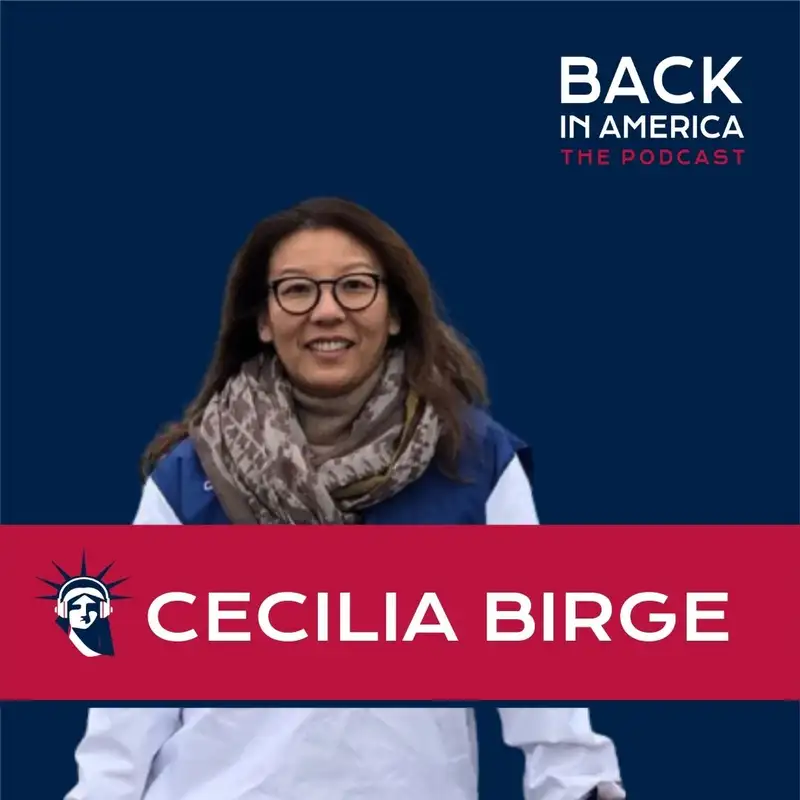
Cecilia Birge - Anti-Asian racism during the Pandemic - Growing-up in Chinese Labor Camp - Student on Tiananmen Square protests
If you're tired of arguing with strangers on the internet, try talking with one of them in real life.
Welcome to Back in America, the podcast. Welcome to Back in America, a podcast where I explore the American's identity, culture, and values. In this episode, I look at the experience of an American of Chinese origin and how the current pandemic has impacted her life. My guest is a former mayor from Montgomery, New Jersey. She grew up in a Chinese prison camp and was a former mayor of New Jersey. My guest is a former mayor from Montgomery, New Jersey. She grew up in a Chinese prison camp and was a student in Beijing during the Tiananmen Square protests. President Trump is trying very hard to blame his failure to contain the COVID-19 pandemic on the Chinese.
In turn, anti-Asian racist action had raised to about 100 reported cases per day in February, according to Congresswoman Judy Chu.
That name gets further and further away from China as opposed to calling it the Chinese virus. By the way, it's a disease without question. It has more names than any disease in history. I can name Kung Flu. I can name 19 different versions of names. Hi, Cecilia. Welcome to Back in America. Hello. Thank you for having me. So, Cecilia, back in March, you were instrumental in launching several fundraising to help first responders here in Princeton in their effort to fight against the COVID pandemic. I wonder if you could tell us what motivated you to run these campaigns. Well, first of all, it actually wasn't me. It was the entire Chinese community led by a group of, we call it the organizing committee, which is a group of 10 people or so.
This happened probably around February or so when coronavirus first hit China in late December and early January. Many of the Chinese residents in Princeton and frankly in all over the world experienced that remotely. And many, many of them participated in fundraising donations to back home to their relatives, to their colleges, and so on and so forth. Nobody expected coronavirus hit America so heavily and so abruptly, and nobody certainly expected that our government responded in such a slow fashion. So as it gradually moved inland towards us in Princeton, unfortunately, is one of the first places that had coronavirus in New Jersey, people got really worried. And as the government was formulating its ideas, gradually the next piece of news we heard was we didn't have enough PPEs. And so as you can imagine, as someone who just went through this experience remotely and now seeing it happening in our own community, people got really anxious and people wanted to do something. And so that's when these 10 people jumped in and got the community organized and quickly came up with a plan and executed it.
PPE? Personal protective equipment, which includes goggles, masks. There are different kinds of masks. And this is something I've learned along the way as well. I never imagined that there could be so much specifications, different classifications and certifications and approvals that could go into masks. Medical gowns, face shields, anything that you can imagine that protect our first responders. That includes policemen, EMS, and of course, our doctors and nurses and everybody in the hospitals. So would you say that because the virus originated first in China, Chinese community was particularly concerned about this pandemic? Absolutely. And also, don't forget, this is also at least, you know, I haven't I've been in this country for 30 years. I don't have a strong connection with China anymore, but many residents in Princeton still have that strong connection.
And many of them actually witnessed the SARS some years ago. So this is not only second time around by the time it hit America, it's third time around. So in a way, they are they know what kind of speed to expect for a government to handle this kind of thing, to keep it to keep it under control. And we were not doing that at the time. And how much did you raise altogether?
The total value exceeded about sixty two thousand dollars. We actually initially set the fundraising goal. There were two parts. We raised money. We also collected donations because we identified the needs in the community. It's not just personal protective gears for first responders, but also the most vulnerable segment of our community, which is especially the kids on free and reduced lunch programs in our schools. So we collected food, we collected daily essentials. We also collected money. The fundraising goal was initially set at ten thousand dollars and we reached that goal overnight. So we quickly added to that. Eventually, we raised over twenty six thousand dollars in cash in total.
And then the rest of it are all donations of PPEs and food and daily essentials. Wow. So you saw the entire Asian arm, should I say Chinese community come together in order to help the local community fight the coronavirus. And yet, President Trump calling it the Chinese virus. How do you think that made you and other Asian people feel?
So it's so infuriating and frustrating in so many ways. I think that just the fact that we have to explain to the leader of this country why it's so wrong to identify a virus based on its location and specifically link it to a certain ethnic group and almost with the sole intention to insult someone. I've reached the point where I'm so angry and mad. I don't even I don't have words for it. Really, I don't.
And what do you make of Secretary of State Mike Pompeo accusing China of putting the world at risk because of his lack of transparency? It's another lesson learned for all of us that these kind of bias and prejudice and racism comes from the same place, which is ignorance. And for someone who deliberately to use the power of words, to use their positions to practice this kind of racist views and filled with bias and hate. And even that is just wrong. They don't deserve the office that they hold. It's an insult to all the citizens, not just the Chinese. It's an insult to the office as well. So let's come back to you, Cecilia Burge. You are Princeton High School head coach. You're also a member of the speech and debate team. That's quite a stretch from your career on Wall Street, where you were a bond analyst.
I guess so. I grew up in an academics family, and I think that I have lots of physicists and mathematicians in my house. However, there were also mathematicians and physicists who are very devoted to community affairs. My grandfather was the president of Peking University. He led the effort against the Three Gorgeous Thieves. This was back in the 80s, and I was still in China at the time as a teenager.
I witnessed what he did back then against the communists. Can you tell us a bit more about this effort and what it was? Sure. So the Three Gorgeous Thieves is, I believe, still the largest dam in the world. As many people know, the Yanxi River carries a lot of heritage, and a lot of people identify that with China. It's the second longest river in the world, and it has lots and lots of cultural heritage along the way. It starts in Tibet, and ends in Shanghai. It cuts through China, literally halfway through. This was in the 80s under Deng Xiaoping's leadership. The government decided to build Three Gorgeous Thieves. This was partly to fulfill the need for hydroelectricity in China,
because the country was beginning to develop and needed that power. But more importantly, it was more for building a legacy for Deng Xiaoping, because it's located in the province where he came from. My grandfather, being a scientist throughout his entire life, believed that these decisions should be made based on science rather than political convenience. He led a team of scientists, journalists, local politicians, citizens, and initiated an opposition effort. It went all the way up to the political consulting firm. It's almost like in the US, we have the Senate and the Congress. This is the equivalent of the Congress.
The Three Gorgeous Thieves vote received more than 30% of no votes, which is the highest no votes in the entire country. It humiliated the Communist Party at the time. That's the history of it. Now it's been built, and it has created a lot of environmental, military, and other issues, as you can imagine.
You have a history of activism. I guess few people knowing you, either as a bond analyst or as a teacher, know that you grew up in a labor camp in China. Can you take us back to that time? If I were to ask you to close your eyes and tell us what you see and what you feel from your early memories, what would it be?
To begin with, I always said that I have a happy childhood. It's not as dark as most people assume.
But I was born in the dark ages of the modern Chinese history. I was born at the end of the Cultural Revolution when my mother, who grew up in America, spent her teenage years here with my grandparents in California. I was born right when she was about to finish—it's not a term in the labor camp—but basically all these intellectuals were sent down to the labor camps to be re-educated because Chairman Mao thought that they were too worthy. They only know how to use their words. They don't know how to use a tool in the countryside. So let's send millions of these intellectuals go down to get re-educated so that they can appreciate what we peasants went through before we took over the country, and then they would appreciate what we have been done for
the new country. That was an oversimplified version of the Cultural Revolution. I was born around then, and as soon as I was born, she was sent back down to the countryside. I was left at home. At the time, my grandfather was hiding from the Red Guards in Peking University, where he was working as a chancellor. So my grandpa raised me a little bit. My father was probably the equivalent thing in this country as a house arrest. He was considered a, quote, counter-revolutionary intellectual. My father was also educated here, went to University of Michigan Medical School, and he actually was the one who introduced Western antithesiology to China. But because of these affiliations, he wasn't allowed in the operating room in China for
almost 10 years. Every day, he was supposed to be home late at night. He would start the day very early, go to the hospital, have to do a loyalty dance in front of Mao's portrait, and then he would spend the whole day to reform himself by cleaning all the bathrooms. He was the janitor in the hospital for that many years. Then in the evening, he was supposed to still be in the hospital writing his confessions, reflections of what he has learned from Mao's works, the little red books that he read again and again. Then he was allowed to come home late at night, 9 o'clock, 10 o'clock, and the next day would begin. In the meantime, the place where I was born in, it was a traditional
Beijing style bungalow. But back then, the affluent families had those homes. The Chinese idea was to have four generations living under one roof. All the rooms were taken by the proletariat.
My family was left in a 12 square meters small room with no toilet, no nothing. So that was the environment I grew up in. Of course, I remember some of this. My memories are, there were very many happy memories of playing with stones and sands, whatever I could find on the street. There were also stories being told about me spitting. The courtyard eventually once was taken by this many proletarians. The courtyard became an open-air kitchen, so to speak. So people made food there and then they would brought it into the rooms and then ate with their families. There was this granny who was supposed to be very revolutionary. She always spied on my family. She always reported to the hospital where my dad worked about what we were doing. If we had
visitors at all, we really didn't have many visitors. So apparently, I was told when I was four, one day I disliked that granny so much that I got into her pot. She was cooking and I spit into her pot, which obviously created invited political problems for my dad. Then he ended up doing more loyalty dances. When things got worse in the city, at the age of four and the age of six, my mom took me. I went to the labor camp with my mom. Again, for kids, that was a happy time. I got to play in the mountains. I do have memories of us living in a shed in the middle of the field. The scary part was our job was to make sure that the crops that was planted was not taken away by birds or other animals. So that was my mother's job. But at night, we didn't have any electricity.
We didn't have any running water. And in the meantime, it was so dark and the mountain is right there. And you hear these wolves hollering. And then the next morning you would hear the reports from, we call them peasants, I guess today as farmers. The farmers lived in the commune. And that's where it's more concentrated. We lived in the field. So they would report how many chickens were taken by the wolves, how many rabbits were eaten by the fox and so on and so forth. So as a little kid, four years old or five years old, that was when I felt like, oh, are the wolves going to take me? What am I going to do when they come and attack me? So yeah, that's- Wow. Some kind of memories you've got.
A different world. And then you studied in Beijing. And in 1989, you went to the University of Beijing. Then you studied in Beijing. And in 1989, you participated to the Tiananmen Square protest.
How were those days?
In the 80s, the economy began to grow. And it was growing very unevenly. And actually, the leader at the time announced that it was okay for some people to be rich first, which was very different compared to the socialist ideology that the country had been holding onto. But unfortunately, certain people meant those with access to higher power. So there's the creation or the labeling of the clubs, which is to some extent, by then, my family got rehabilitated. And we're part of that club in many ways. Children whose parents are in power have access to everything. If the country is developing, it needs concrete. So we could probably, with somebody's letter, and then all of a sudden, everybody else got a no from certain manager.
But because we had the letter from someone from higher up, that manager is going to sign up on that. So all of these privileges that came along. So it was very unfair. And it was also a time when
American school of thoughts began to get into China. So the concept of equal opportunity became more and more prominent. And it was at that time Hu Yaobang, who was a strong advocate for China to shift westwards, get closer to America and Western European countries, which is a very different mentality and philosophy from the traditional approach of being allies with Soviet Union and other countries. So he died suddenly. And because the students in particular viewed him as a champion of free speech, of equal opportunity, and because Deng Xiaoping's suppression over Hu Yaobang, because he got shoved away later in his political career, the students made a request in Tiananmen Square, which is the
center of Beijing, right in front of the Forbidden City. And the government ignored the student again and again. And it just got escalated to the point, I think it was April 26, 1989, Peoples Daily, which is the official government newspaper, had an editorial and called the students' march and student protest a terrorist attack. And that's when things erupted. It paralyzed Beijing. There was no school anymore. All of us, college kids, were on Tiananmen Square. We occupied the square with tents. Hunger strike was going on. We demanded a conversation with the government. So eventually the government did come out. It took them a long while to come out and engage in a dialogue with the student. So here again, my grandfather, by then he retired,
but as a recognizable voice, probably one of the most recognizable academic voice, he got 10 college presidents together as a consortium and wrote a letter, a joint letter, and submitted to the central government, asking the government to come out and speak to the students and hear their voices. Like I said, they did eventually meet. It wasn't a productive meeting. The hunger strike ended soon after that. So arguably, if managed properly, it would have just died down. A lot of students were prepared to return to school, expecting school to reopen the following September. But all of a sudden in early June, uniformed militaries, trucks and whatnot descended upon Beijing, occupied the major arteries, and cornered the students in Tiananmen
Square. And we all got the news. And some people, I wasn't on the square that evening, but I was there the previous nights and whatnot. And before you know it, you hear bullets. That night I was at home. I did not know, never in my life did I imagine that guns would be pointed at students. But I heard nonstop bullets. I actually thought, who's getting married now? And who's getting married late at night? That the fireworks is nonstop. How much fireworks did they buy? It wasn't until the next morning when I got onto the street did I see students with blood on their shirts, on their faces, and with eyes crying, bawling, with eyes being red. It was a disaster. So my first instinct was to protect my family. I was living with my grandparents at the time.
They were, you know, these are people who had gone through wars. So I remember we used every single container we could find in the house, bathtubs, you know, different trays and whatnot. We filled it with water because we were afraid that water was going to cut off. The next thing was I rushed to the market. We just got everything we could get our hands on, especially canned food, to prepare for who knows what to come. It was three, four days of a city, one of the largest cities in the world, with no government. Every now and then there would be a truck of soldiers driving by. And some just drove by quickly with nothing. Others, you know, you would hear bullets. As soon as you hear bullets, everybody is on the ground. So it went
on like that for three, four days before finally the government came out and pronounced it a terrorist attack. So the government had to come out and put down. In the meantime, and the part with Timber Square was all sealed. No people are allowed to enter. But gradually people were going on their bicycles around town in Beijing, trying to have a peek into what's happening in there. And you see burnt trucks, burnt tires, you see, you know, bloody clothes left somewhere. So there are some pretty gruesome scenes around then. And up till today, and up till today, nobody knows how many people died on the square. Nobody knows who's responsible for it, although, or I should say everybody knows who should be responsible for
it. And if you go to China today, the topic is heavily censored. Nobody talks about it. And that concerns me more than anything else, honestly. And it's going to be one of these things not going down in Chinese history. Well, I don't know how, whether it's by force or by will, if a country of its people, especially if it's forced, as is the case, not to remember its history, I can't imagine the impact it will bring upon humanity. You mentioned it early on when you started talking about Chinaman Square, and throughout your memories, I could not avoid but think of the current protest with Black Lives Matter, especially when you said a country not remembering its past and its history. The protest might not
have much in common, but what do you make of the current protest in the US?
I support it. The current one is much, much more complex, and the Chinese immigrant community is divided. There is a group of people like myself who strongly support it. And I think that, I take myself for example, it's been a process. The racial discrimination in this country has so much history and is so complex. And especially it's not just black and white as it was the case in the Civil War. It wasn't even black and white as the case as the Civil Rights Movement anymore. It's much more embedded into our culture, and to some extent, it's so much accepted. I accepted the fact that a black person living right next to me is stopped more frequently by cops. Did I know about the fact? Yes. Did it shock me as it does today? No, it didn't.
So I think it's been a process for all of us. For someone like me who's been here for 30 years, I've got a lot more opportunities to hear how black folks go through life. Anything from being killed like George Floyd did because of a $20 counterfeit or because of nothing. So regardless what it is, it comes from the same place. Again, it's about ignorance. So I absolutely support it. I hope that as a country, this reminds us how important it is to talk about some very uncomfortable topics. I think part of the reason we got to where we are today in large part is, and to some extent, is the Anglo-Saxon culture of sweeping the discomfort under the carpet and let's not talk about it so that we can have a perfect image in front of everybody. But if we want to be perfect,
if we want to strive for that perfect union, we have to face the reality. And the reality in many, many ways is black and white. As a nation American, I think we straddle the two worlds. We get some of the benefits from especially the civil rights movement. We get some of the privileges from the white community. But every now and then, like the case we talked about earlier about the Trump calling a China virus, especially bamboo ceiling, and all of these examples are the same kind of, we suffer from the same kind of decisions made by people who are ignorant about our culture and about ourselves.
So tell me, in 2007, you became the first and only Asian American woman mayor in New Jersey. You were the mayor of Montgomery, right? What can you tell me about daily and lifelong experiences of racism and discrimination against Asian American? For you personally, where are you impacted by that in your life, in your experience?
Like many immigrants, when I first came to America, all I thought about was, I'm just going to work hard. Racism doesn't bother me. I will just hunker down, work hard, and work harder, and I will make it. I did that. I did work hard. I did work harder, and I did, quote unquote, make it. However, through that process, I've also been very lucky that I haven't experienced the extreme kind of racism. But through that process, I definitely became a lot more aware and certainly recognized the racist incidents that happened to me with or without me recognizing it then. When I was mayor in Montgomery, there were people who would come to the township committees and monopolize the public comment time frame just to complain. And they are just there.
They just want their own platform. And when I tried to impose certain rules just to keep the meeting in order, I was called a communist. And before I became mayor, I was deputy mayor. And it just happened so that the mayor at the time, who was my mentor and good friend, is also female. So the comment from the fellow male counterpart on the township committee is, now you girls can do whatever you want. That's the thing. If we allow those kinds of discrimination, whether it's based on race or sex or ethnicity, whatever it is, there's no end to this war. So some people complain, why do we have to be politically correct all the time? It's not that we're political. We try to be politically correct all the time. It's because words have power.
And as the coach of our debate team at Princeton High School, I see that every day. I hear that from my kids every day. They carry weight. They carry power. They can help us love. And they can help us hate. And we all hope that it helps us love. Thank you. Finally, Cecilia, I would like you to tell me what is America to you. Home. America is home. The reason actually I came to America, I think now that I know what America is like, obviously, I'm more American than Chinese in many ways. I'm very proud of my Chinese heritage. But because of my family's connection to the West, I came to recognize the way I was raised was half Western, half Chinese, which have to pick my family, thank God, left it to me rather than forced it upon me.
So to some extent, I never quite fit in in the Chinese culture, especially in the Chinese school culture. Part of my family was also separated for many years because the two countries didn't have any connections back then. So one of my uncles finally went back to China after marrying my aunt. It was the first time we met in the 80s. And then he met me and
for a Chinese American who left China for so long, they really didn't function very well. So I was the tour guide assigned by my family to help him out, to take him to different places, tour around the Great Wall, the Forbidden City. So we got to know each other. And at the end of the trip, he said, I think this girl will be happier in America, I'm going to bring you to America. So that changed my life. And I'm eternally grateful for that. And he's right. I think that for someone like me who enjoys challenges, who enjoys doing different things in life, who tried to be as thoughtful as I can be, there's really no better place on Earth than America for me. And not to mention now that I have four kids, and especially, you know, we were talking earlier
that you and I both have a high school graduate, witnessing how they have transformed from the little baby that I held on day one when I literally touched love to the young ladies and young men that they have become and the transformation that they have gone through, both physically, academically, and socially emotionally. And for them to be filled with so much passion and love and kindness, and have so much expectations for the world. I really can't imagine any other country can do it better than than what we have done. And our job for our generation as an educator in this country is to make sure that tradition continues. And I see talking of kids, I see your kids coming and waking up in the kitchen behind you. And that's quite all right. Thank you.
Interview Corona's virus, COVID-19 style. Yeah, absolutely. Well, Cecilia Virge, thank you so much for your time today. Thank you. Thank you for having me.